Wednesday, December 12, 2007
LaGuardia And Public Housing
Audio is a segment from the Laguardia/Wagner Archives concentrating on LaGuardia's housing record. The tenement conditions on Cherry Street are mentioned in a passage from Jacob Riis. The First Houses on East 3rd Street and Avenue A were the first housing projects built entirely with public funds. Knickerbocker holds that "first" distinction for a "partially" public funded housing project. The beginning of the slide show has images from a LaGuardia visit to PS 147 on Henry and Scammel Streets in the 1940's. Parents were evidently protesting a loss of services at the school. Eventually the school was torn down in the early 1960's and replaced by PS 134. Marty B went to PS 147 in the 6th grade because there was a gifted program available there that wasn't available at PS 177. As mentioned before 147 was the school that the famous Epstein twins went to. There are also images of the original Madison House. This settlement house was raised when the LaGuardia Projects were built in the late 1950's. It would then combine with Hamilton House.


KV Holiday Shopping 1956
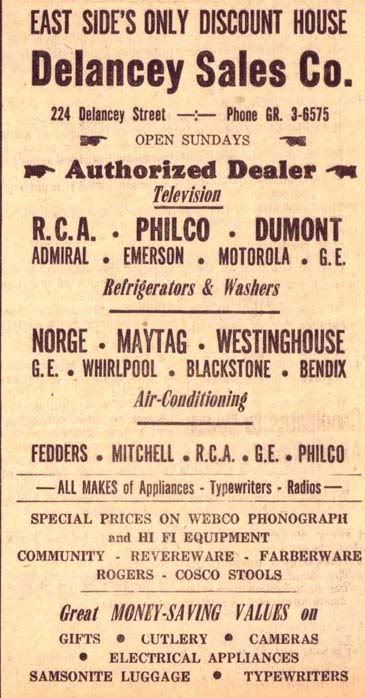 Don't forget to shop locally for your holiday gifts. Maybe a nice DuMont television or Webco phonograph at Delancey Sales at 224 Delancey Street. I seem to recall buying such appliances on Rivington Street, off of Clinton, at a store called National Radio. It was a real mess of a place, mostly devoted to repairs. The owner, Hy Frohmer ?, may have been an old Seward Park classmate of my father's. Image from East Side News, 10/13/56, courtesy of Seward Park Library.
NCLB According To The Wire
There's been recent talk of the Wire over at nyceducator. In my opinion, it is the best show that television has to offer. The final season, number 5, begins January 6, 2008. Last season focused a great deal on the Baltimore school system. The Wire fiction rings truer than any non-fiction account. Here are two (part 2 is on the succeeding post) especially powerful clips about "juking the stats." As Prez says, "You juke the stats so Majors become Colonels." And similarly, Mayors try to become Presidents
Triangle Shirtwaist Fire
A slide show I did in 2001 with fourth graders about the Triangle Shirtwaist Fire. They had just read "East Side Story" and then we researched where some of the victims lived.
Some lived within a few blocks of Knickerbocker Village. Nettie Rosenthal lived at 105 Monroe Street (between Market and Pike). She was 21 years old. Another victim lived at 55 Pike Street and another at 177 Cherry Street
The Triangle Shirtwaist Factory fire in New York City on March 25, 1911, was the largest industrial disaster in the history of the city of New York, causing the death of 146 garment workers who either died from the fire or jumped to their deaths. It was the worst workplace disaster in New York City until September 11th, 2001. The fire led to legislation requiring improved factory safety standards and helped spur the growth of the International Ladies' Garment Workers' Union, which fought for better working conditions for sweatshop workers in that industry. The Triangle Shirtwaist Factory Building, also known as the Asch Building and as the Brown Building, survives and was named a National Historic Landmark.
Who's Who In Knickerbocker Village History: Mark Toby
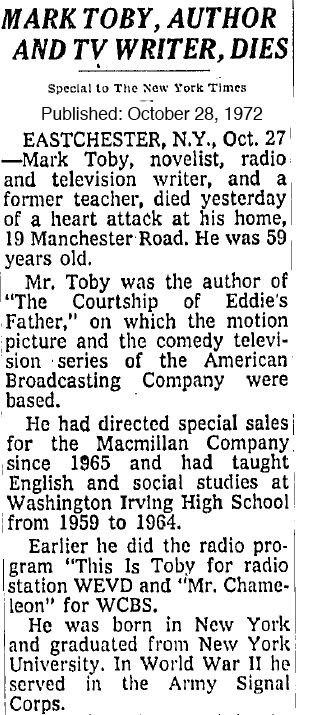 Mark wrote "The Courtship Of Eddie's Father" and I knew Eddie, but not well. He was two years my junior. Eddie spelled his name Tobey. I've googled him and he seems to be a writer judging by all the references to articles to a Eddie Tobey. Makes sense that he would follow in his dad's footsteps. The Tobey's probably moved to Eastchester after the success of the book and later the movie with Glenn Ford. Unfortunately Mark died at a young age in 1972. I couldn't find a picture of him.
Lower East Side: Then And Now
I did this many years ago with the thought that it could be a narrated piece for kids.
One of my first attempts using a piece of software, Live Slide Show, that allows you to combined images, text and sound to make a little movie. It's tough to decipher in the 320x240 confines. I was using sights on the LES that the great photographer Bereniece Abbott had used in the late 1930's and marching them with a current (in this case 2001) image.
What Were We Thinking?
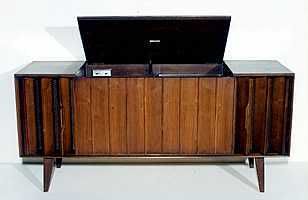
We had gotten a similar looking Zenith console just before we moved from Knickerbocker in 1964 and we bought a Ferrante and Teicher album. Eventually we had a whole bunch of them. Was this part of those 1950-60s LSD-experimentation like plot on the part of the government to gain mind control? Certainly those toupees of Ferrante and Teicher were from another world.
Birds Flying High
The NYTimes city section had an interesting article about competitive pigeon clubs in New York. I converted the images so it would fit into a slide show format and then added Nina Simone. When I read the story it reminded of this March, 1934 image. It was taken from a rooftop on Catherine and Cherry looking eastward at the Knickerbocker Village construction site
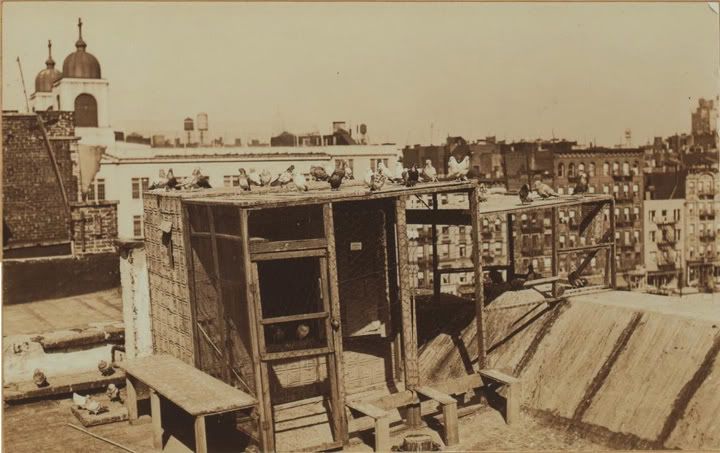 Here's the story
Look Homeward, Angels
By JOSHUA YAFFA
Published: December 9, 2007
JUST before midnight on Nov. 3, a white truck pulled up to the Frank Viola Homing Pigeon Club, on a dark and quiet stretch of Stillwell Avenue in Coney Island. The air was cold and smelled faintly of the sea. Two men hopped out of the truck. One opened its rear doors. The other approached a handful of older men who were standing in the street. “How many you got tonight?” the man asked.
Fourteen crates, came the reply. The crates, which were stacked near the curb, held hundreds of pigeons.
It was race night at the Viola club, and for a few hours, the club’s pigeon fliers had been tagging the birds’ feet with electronic bracelets and scanning the information on the bracelets into a master clock in preparation for their 300-mile overnight journey to the town of Somerset in southwestern Pennsylvania. There, half an hour after sunrise, at a truck stop just off Interstate 76, the birds would be released to race back to Brooklyn, with the earliest arriving back in early afternoon.
Homing pigeons may be icons of the city, with rooftop bird coops a familiar image like the skyline, but the sport has been in decline for the last half century. Although only a couple of hundred pigeon fliers remain in New York, however, that small band, organized into a half-dozen or so clubs like the Viola, forges on, participating in races that span hundreds of miles and conducting hundreds of races each year.
The races are divided into two formal seasons — one in the fall and one in the spring — with prizes awarded both for weekly races and season-long performance.
The Somerset race was the last of the fall season for the Viola club, and a crucial one for John Fasano, a 75-year-old retired roofer who began racing pigeons in New York when he was in his teens. Before the start of this race, Mr. Fasano led the club’s rankings for the season’s best overall average speed, an award that is the closest thing the sport has to an annual championship.
Mr. Fasano was feeling optimistic when he checked in his birds at the Viola club earlier that night.
“I wish I could fly this good every year,” he said. “I’d like to finish with a bang.”
As the drivers loaded their cargo into the back of the truck outside the clubhouse, the soft chatter of the birds could be heard through the wooden slats in the crates. The fliers said their goodbyes. “Guys, I’ll see you tomorrow,” David Kurtz, wearing a heavy flannel coat and a black baseball cap, said to his birds. Then the truck let out a low rumble and disappeared into the darkness.
New York’s pigeon clubs, loosely organized by geography and custom, are a cross between an urban sportsman’s lodge and a time capsule of immigrant, working-class New York. Even as recently as a generation back, fleets of racing pigeons swirled above New York like pulsing gray clouds, but the numbers of racers and birds have thinned, with not enough new fliers to replace the old.
Yet the dynamics of a pigeon race have remained mostly the same. The birds are trucked to a central “liberation point” anywhere from 100 to 500 miles from the city, where they are released so they can fly home. The birds’ owners sit waiting by the coops on their rooftops, or in their backyards. Most birds return within several hours, but some take days or even months. Others never come back.
Homing pigeons start their training a few weeks after birth, which, for birds that will compete in the fall season, means sometime in early spring. After the young chicks learn their way around the coop, racers start taking the birds on training flights, first carrying a crate of young pigeons down the block, then driving them to New Jersey or Pennsylvania and releasing them so they can fly home.
Longtime fliers say they can spot a winner by looking at a bird’s eyes, its plume, the white of its beak. Homing pigeons are members of the same family as common street pigeons, Columbia livia, but the two classes of birds have little else in common.
“It’s like comparing a Lamborghini to an old pickup truck,” said David Martinez, a New York police detective who is a member of the Viola club.
Pigeon fliers, whose flocks usually number 40 to 80 birds, do indeed treat the birds like fine automobiles, feeding them a careful tonic of antibiotics and vitamins, and birdseed blends with names like Tipple Mix and Vinny’s Candy. Steroids are forbidden, and there is random drug testing at many larger races. A champion pigeon can fetch several thousand dollars at auction, with the hope that it will breed future generations of winners.
“It’s like having your own sports team,” said one Viola club flier. “And you’re the owner, the trainer, the doctor.”
In the early 20th century, matters were a bit less elaborate. The city’s pigeon fliers raced by paying a railroad conductor a couple of dollars to let the birds out when a train bound for Pennsylvania reached Erie. In those days, training meant riding the Staten Island Ferry for a nickel and releasing the birds on the other side. The only supplement a racer might use was a rusty nail placed in the birds’ water dish, to give his pigeons an extra boost of iron.
If there were a commissioner for pigeon racing in the five boroughs of New York, in recent years that title would have gone to Frank Viola. Mr. Viola, a slight, white-haired man from Bath Beach, Brooklyn, founded his namesake club in the early 1990s and ran the Frank Viola Invitational for the last 16 years. With 1,500 birds, the race became one of the largest in the city, the Kentucky Derby of the pigeon season. This year, the Viola Invitational was scheduled for the first Saturday in October.
However, two nights before the race, when the city’s pigeon men would ordinarily have been readying their birds for the trip to the starting point in Cadiz, Ohio, they were gathered at Torregrossa and Sons funeral home in Bensonhurst. Mr. Viola had died the previous day at age 87, and the pigeon men had come to pay their respects.
A group of fliers stood in the hallway at the wake, telling their best Frank Viola stories. Remember how his birds flew missions for the Army Signal Corps in World War II? And how about the time he turned down $20,000 from a Taiwanese breeder for one of his champion pigeons?
Mr. Viola’s nephew Peter, who in recent years has taken on a larger role in running both the club and the race, decided to cancel the Viola Invitational in light of his uncle’s death. “He held everything together,” Bobby Presto, a retired New York police officer and pigeon flier, said of Mr. Viola. “He was like the godfather.”
It was a cold fall afternoon, a week after Mr. Viola’s funeral. The sun was starting to dip behind the Coney Island parachute jump, and a 44-year-old flier named John Mantagas was waiting for his birds to return. Mr. Mantagas had entered 10 pigeons in a contest called the Main Event that is sponsored by a club in the Westchester Square neighborhood in the Bronx. The birds, 600 in all, were flying back that day from Weston, a small town in West Virginia.
Mr. Mantagas was sitting on the roof of his two-story house in Coney Island, the ground floor of which he rents to the Viola club. Of the 10 pigeons he entered — most fliers enter 5 to 20 birds in a race — he was favoring a blue bar hen wearing the band number 511.
That bird, he said, had been “sitting on eggs,” a strategy that involves putting a handful of fake plastic eggs in the nest of a female pigeon in the days before a race. If a bird thinks it has been separated from its unborn chicks, the theory goes, it will fly back faster to the coop.
Nevertheless, no one is exactly sure what gift of biology allows pigeons to navigate their way home from a far-off, unfamiliar place. In studies in the 1960s and ’70s, scientists at Cornell University said that pigeons use the earth’s magnetic fields as a guide. Other research has pointed to the birds’ heightened sensitivity to low-frequency sounds. A group of Italian researchers suggested that the birds navigate by smell; in Italy, birds travel south toward olive groves, or north toward garlic fields.
In Brooklyn, meanwhile, the sky grew darker, the air cooler. “All I want is one,” Mr. Mantagas said. “Just give me one bird.” By around 4 p.m., his cellphone started ringing. Staten Island, the Bronx, Queens — they all had birds. Vieni Benedetto, a flier who lives in Bay Ridge, called to say he got one, too.
“Benny, you got a good one!” Mr. Mantagas said.
“You might be buying us all dinner,” he added with a deep, raspy laugh. “We want linguine with clam sauce and fried calamari!”
He shut the phone and went back to staring at the sky. As a seagull streaked past, Mr. Mantagas started talking about family. “My kids love the birds,” he said of his children, ages 2, 3 and 11. “But I don’t know if the sport will be around when they’re older.”
These days it can cost several thousand dollars a year to raise and train racing pigeons. Not to mention, Mr. Mantagas said, all the other distractions of modern life with which pigeon racing must compete.
A minute later, a dark gray bird started a sharp dive toward the roof.
“Thank God!” Mr. Mantagas said, popping out of his chair. “That’s her!”
His hen was home. Inside the coop, she drank greedily from a water dish. Although the bird had returned too late to place among the top winners, Mr. Mantagas was happy. “You made it,” he said, picking up the bird and giving it a soft peck on the top of its head. “And here I was, thinking you’d never come home.”
A little after noon on Nov. 4, just 12 or so hours after the white truck had left the Viola club and headed for Pennsylvania, Mr. Fasano — the flier who had a good chance to snare top honors for overall average speed — was pacing on the roof of his house on Avenue Z in Gravesend. Mr. Fasano was waiting for his birds to return. This season would be his last, he had decided, and he wanted to go out a winner.
Soon his favorite bird, a blue-checkered cock, appeared on the horizon, its wings pumping. Mr. Fasano reached into a crate at his feet to grab a chico, a bright white, non-racing bird that fliers use like a flare to attract the attention of incoming pigeons, and threw it into the air. Noticing the chico, the cock flew toward the roof and landed on the edge of the coop, a few feet from the electronic timer that would record its return.
Mr. Fasano took a few gingerly steps toward the bird, shaking a plastic tub of birdseed. “That’s a baby, go inside,” he said softly. The timer beeped, registering the bird’s arrival. 13:02:11. A little more than five hours from Somerset. It was a good time, maybe a winning one. After a few more birds returned, Mr. Fasano jumped into his car and set off for the Viola club, a few exits down the Belt Parkway.
The Viola club’s quarters are about the size of a studio apartment. One wall is lined with pigeon crates; on another is a faded-green chalkboard for posting race results. Mr. Fasano and the other fliers had gathered at the club to hand over their clocks to Peter Viola, who was entering the times in a computer. “Going out a winner,” Mr. Fasano muttered to himself. “That’d be something to talk about all my life.”
Although the club was full of loud talk and pigeon stories, the mood, in the absence of Frank Viola, was different. The place felt totally empty, his nephew said.
In recent years, as his uncle’s health declined, Peter Viola helped him train his birds, and the two men would drive 70 miles into New Jersey for practice flights. “We’d load the birds early in the morning,” Mr. Viola said, “stop at a bagel joint off Route 22, get some bagels and coffee, go sit up by the lake, release a few birds at a time, just sit and talk.”
After Peter had entered all the times, the results were posted. Mr. Fasano had come in second for the day’s race, beaten by a few yards by another Viola club flier. But his finish was strong enough that Mr. Fasano would earn the trophy for the year’s best overall average speed.
“Congratulations,” Mr. Viola said to him. “You did it!”
Mr. Fasano shook hands all around. Winning would get him a plaque, maybe a short article in The Racing Pigeon Digest. The Viola club used to hold an end-of-the-season awards party, but the event was canceled a few years ago. “These guys are interested in pigeons,” Peter Viola explained. “They ain’t interested in dancing.”
By 5 p.m., the men had filtered out onto the street. A few climbed into their cars to drive off; others came up to Mr. Fasano to offer their congratulations. The Viola club would miss him, they said.
“Oh, I’ll still be in the coop every day,” Mr. Fasano said as he lingered for a moment by the club’s open door. “I can’t stay away from the birds.”
On The Job
Why Jim Liebman, the nycdoe accountability czar, was allowed to run away from parents who had 6700 petition signatures.
Tuesday, December 11, 2007
Character Traits Of The Main Characters In The Great Escape
A technology integration project involving social studies and literacy. After watching
this quicktime template of a powerpoint students will complete their powerpoints by adding a character trait they observed from the movie. Coward may be the obvious choice for the senior accountability officer so use your thesaurus for other descriptions
Run, Run, Run: But You Just Can't Hide
from ny1.com
The school report card system is under fire again, inside and outside City Hall. As Education Reporter Michael Meenan explains, some council members and opponents of wide-scale testing graded the system itself and handed out an F.
"We are sick and tired of you lying and not telling the truth about these report cards!” yelled a school advocate confronting the architect of the Department of Education’s school report card system, who tried to leave through a side door after testifying before the City Council.
Indeed, Jim Liebman already had a rough time inside City Hall.
"Mr. Liebman, you familiar with the game of rotisserie baseball or fantasy football? Well, it strikes me that the person who designed this is a fellow fantasy football fan,” said City Councilmember Lewis Fidler.
The councilman said the number crunching that led to some schools getting As, and 150 getting Ds and Fs is too confusing. But Liebman insisted the crunching was fair and easy to understand.
"Every single measure in the progress reports is entirely transparent,” said Liebman.
The biggest measure is, of course, how kids do on high-stakes standardized reading and math tests in grade school and on Regents tests in high school. It's that emphasis on testing that sparked the confrontation outside City Hall.
"We want to put an end to using test scores to determine grades of city schools,” said Jane Hirschmann of the advocacy group Time Out from Testing.
Members of Hirschmann's group held up Fs to show their disapproval of the report cards. Councilman Simcha Felder joined in. The showdown was all part of the fallout after 13 schools were ordered closed and reorganized last week.
City lawmakers wanted to know did the closed schools get singled out to send a political message from City Hall or did they really deserve this big shake up?
"Kids are in those schools that are failing year in and year out and they can't wait, we can't wait to close those schools,” said Liebman.
Councilman Robert Jackson accused the DOE of being heavy-handed by not consulting with district parent councils before closing schools.
"That’s the direction the chancellor's going – he's in big trouble – and that's why these parents here are given him an F – for that lack of consultation with them," said City Councilmember Robert Jackson.
The DOE pointed to a recent poll showing parents overwhelmingly back the report card system, although Hirschmann says she has 7,000 petitions from parents who are opposed.
– Michael Meenan
The Great Escape: A Closer Look
I always thought Steve McQueen did his own stunts in the Great Escape
But upon closer look it's Jim Liebman, the accountability czar from the DOE. Jim used that ability to flee from angry parents last night. I'm sure the media will portray him as the innocent.
The Great Escape
 Defending School Report Cards, Over a Chorus of Boos
By JENNIFER MEDINA, from the nytimes
an excerpt:
After Mr. Liebman finished speaking, several parents gathered outside of the council chambers with boxes filled with protest petitions containing nearly 7,000 signatures, hoping to present them to Mr. Liebman in front of the television cameras. But Mr. Liebman, whose title is chief accountability officer of the Education Department, ducked out a side door, leaving parents to chase him out the back of City Hall to behind the Education Department’s headquarters at Tweed Courthouse.
There, several education officials ran in circles for several minutes to avoid Jane Hirschmann, the director of Time Out From Testing, an advocacy group, as well as parents and reporters.
Later, in a telephone interview, Mr. Liebman said he had not deliberately avoided the parents and had followed the direction of his staff in leaving the building. By the time Ms. Hirschmann and others were outside, he said, “it didn’t look to me like it was going to be a productive conversation.”
Ms. Hirschmann said she was “completely in shock” by Mr. Liebman’s behavior. “I think it shows total distain for all our concerns,” she said.
Monday, December 10, 2007
The Bowery Boys
I was searching for resources on the history of the Bowery (part of KV's "backyard) when I was amazed to discover a terrific history in Podcast form at the bowery boys. I was also amazed to see Knickerbocker Village on that sites blogroll! I hope the guys view it as returning the compliment by reposting most of it here with images I harvested to make it into a vlodcast. Here's info about Tom and Greg's site
Join us as we take a weekly romp down the back alleys of New York City history. Get our weekly podcast free on iTunes or listen to the podcasts here. The Bowery Boys Creed: We maintain this website both as a support to our weekly podcast, as well as a resource of entertainment and information for native New Yorkers, former New Yorkers, tourists and those who have never been here. We're looking broadly at New York's colorful history, from its beginnings to its recent past.
Many of the images I used come from another great site I discovered. It has toy models of bowery boys and other "gangsters" in history along with inexpensive sets for hobbyists to construct. It's called The Virtual Armchair General
“Mean Sets” provide inexpensive but highly practical interiors in which fans of role-playing games of the first half of the 20th Century may place and move their 25/28mm scale alter egos. These Sets complement TVAG's line of 25/28mm scale City Blocks,"Mean Streets" and may be used in conjunction with them (but not fit inside!).
Though very expensive resin models of entire buildings and even some interiors are available, the plain fact is that they do not lend themselves to the filmic nature of "Pulp Fiction" games. Even if there is room to physically reach down into the model to move figures, no one can see the action except from above: Fine miniatures, beautifully painted, but only whose heads/hats/shoulders are visible to players standing directly over them!
1900 New York In Black And White
It looks like the beginning and end of this film were taken at Chatham Square
from early cinema
The Lumière brothers, Auguste and Louis, were sons of well known Lyons based portrait painter Antoine Lumière. They were both technically minded and excelled in science subjects and were sent to Technical School.
Antoine, noting the financial rewards of new photographic processes, abandoned his art and set up a business manufacturing and supplying photographic equipment. Joining him in this venture was Louis who began experimenting with the photographic equipment his father was manufacturing.
During his experimentation, Louis discovered a process which assisted the development of photography. Louis developed a new 'dry plate' process in 1881 at the age of seventeen, it became known as the 'Etiquette Bleue' process and gave his father’s business a welcome boost, and a factory was built soon after to manufacture the plates in the Monplaisir quarter of the Lyons Suburbs.
By 1894 the Lumières were producing around 15,000,000 plates a year. Antoine, by now a successful and well known businessman, was invited to a demonstration of Edison’s Peephole Kinetoscope in Paris. He was excited by what he saw and returned to Lyons. He presented his son Louis with a piece of Kinetoscope film, given to him by one of Edison’s concessionaires and said, "This is what you have to make, because Edison sells this at crazy prices and the concessionaires are trying to make films here in France to have them cheaper".
The brothers worked through the Winter of 1894, Auguste making the first experiments. Their aim was to overcome the limitations and problems, as they saw them, of Edison’s peephole Kinetoscope. They identified two main problems with Edison’s device: firstly its bulk - the Kinetograph - the camera, was a colossal piece of machinery and its weight and size resigned it to the studio. Secondly - the nature of the kinetoscope - the viewer, meant that only one person could experience the films at a time.
By early 1895, the brothers had invented their own device combining camera with printer and projector and called it the Cinématographe. Patenting it on February 13th 1895, the Cinématographe was much smaller than Edison’s Kinetograph, was lightweight (around five kilograms), and was hand cranked. The Lumières used a film speed of 16 frames per second, much slower compared with Edison’s 48 fps - this meant that less film was used an also the clatter and grinding associated with Edison’s device was reduced.
Perhaps most important was Louis’s decision to incorporate the principle of intermittent movement using a device similar to that found in sewing machines. This was something Edison had rejected as he struggled to perfect projection using continuous movement. The brothers kept their new invention a closely guarded secret with Auguste organising private screenings to invited guest only.
The first of such screenings occurred on 22nd March 1895 at 44 Rue de Rennes in Paris at an industrial meeting where a film especially for the occasion, Workers leaving the Lumière factory, was shown. Unlike Edison, the Lumière Brothers were quick to patent the Cinématographe outside of their native France, applying for an English Patent on April 18th 1895. The brothers continued to show their invention privately, again on June 10th to photographers in Lyon.
Louis photographed the world around him and some of his first films were 'actuality' films, like the workers leaving the factory. The brothers began to open theatres to show their films (which became known as cinemas). In the first four months of 1896 they had opened Cinématographe theatres in London, Brussels, Belgium and New York.
1941-2 New York In Color
From the gothamist
Drop whatever you are doing and go check out the Charles W. Cushman archive. They've got a series of New York City photographs from the 1940s and 1950s that will literally blow your socks off. It's all there- from the Old Fulton Market pictures above, Wall Street, the Waterfront, LES, more LES, Pearl Street, the East Village, and 42nd Street. All beautifully notated. Gothamist hopes that in fifty years, people will look back on the archives of the New York City photoblogs and feel a similar sense of wonder.
The exact url fro the cushman archive with these photos
MOONLIGHT SERENADE
Glenn Miller
I stand at your gate and the song that I sing is of moonlight.
I stand and I wait for the touch of your hand in the June night.
The roses are sighing a Moonlight Serenade.
The stars are aglow and tonight how their light sets me dreaming.
My love, do you know that your eyes are like stars brightly beaming?
I bring you and sing you a Moonlight Serenade.
Let us stray till break of day
in love's valley of dreams.
Just you and I, a summer sky,
a heavenly breeze kissing the trees.
So don't let me wait, come to me tenderly in the June night.
I stand at your gate and I sing you a song in the moonlight,
a love song, my darling, a Moonlight Serenade.
Chinatown Panoramas With Students
I did these about 5 years ago with 5-6 Chinese bilingual students in Ms. Yang's class at PS 20. They were mostly recent immigrants who spoke little or no English. I had found the vr movies online on a panorama site and converted them to a quicktime version. I then had the kids narrate what they viewed.
Later they wrote out their narrations so there would be a listening and speaking and writing connection. Did I really know what I was doing? No, but it seemed logical and the kids enjoyed it and were very proud when they got to show these projects at a learning fair.
The first panorama was taken on Pell Street. The second was taken at the intersection of Canal and Mott. The third at the Kimlau Square at Chatham Green
The fourth, above, is taken on Doyers Street. The Vietnamese restaurant with the yellow sign used to be an old hangout of mine in my 20's. It was then called Wah Kee
The fifth is taken at the intersection of Pell and Mott and you can see Transfiguration Church. I could swear the woman in the purple and black ski jacket at the end of the clip is Lori Grasseli, who I used to work with. The sixth below is on Pell Street and shows much of the same scene as the first movie
Sunday, December 09, 2007
Hard At Work Or Hardly Working
 See Gary Babad's always humorous and insightful comments on the absurdities at work in policy making at the NYCDOE
I Want To Rock With You
Above: An old school technology project focused on the landmark churches on the LES. Each of these churches had a commonality, the stone that was used in their construction was quarried from a Mount Pitt that existed by, of all places, Pitt Street. The 5th grade kids and their wonderful teacher, Rafael Guzman, who has since sadly died a few months ago, visited the churches, sketched them as part of an architecture project and learned about their history. Later they wrote about their discoveries on their class computers.
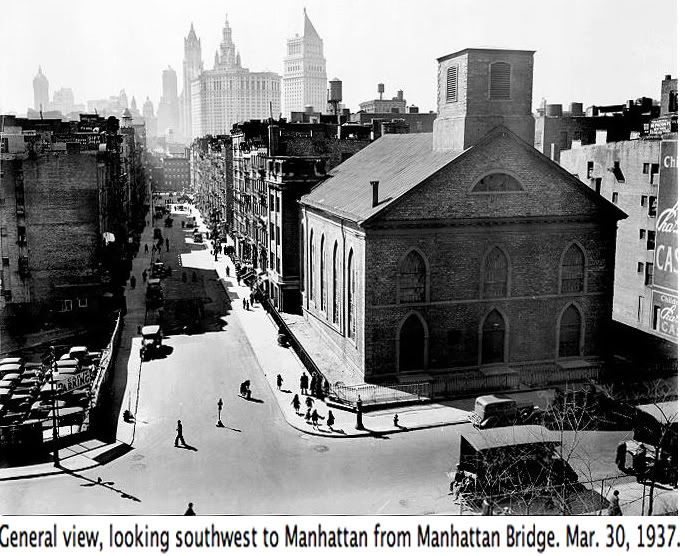 One of the churches they visited was the Church of Sea and Land on Market Street, near Henry. The church was the focal point of one of Berneice Abbott's photos in the late 1930's.
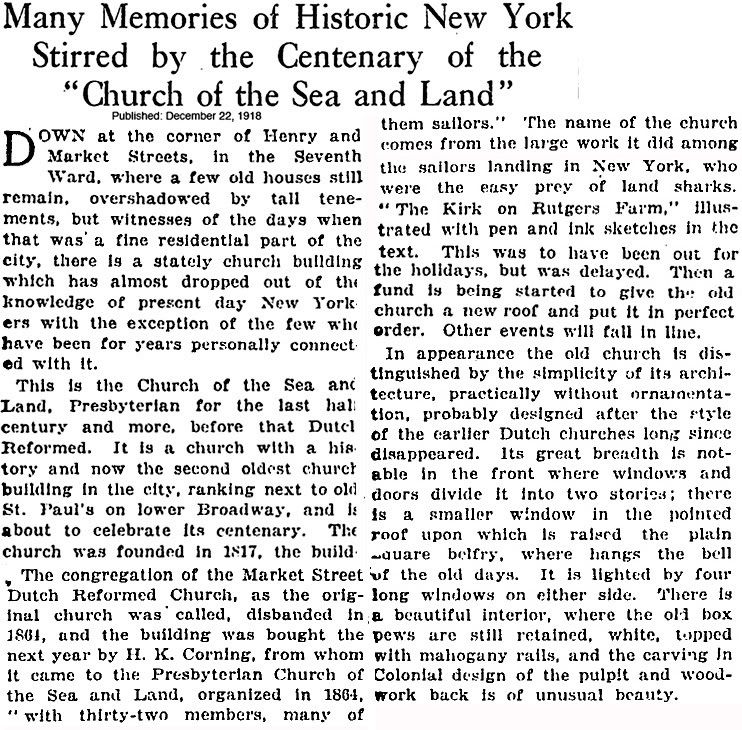 In 1917 the church celebrated its centennial. This article refers to the declining attendance in the late 1800's that led to its conversion from a Dutch Reformed Church to a Presbyterian one.
Christmas Gifts 1950's
I enjoyed the Garry Moore show from my Knickerbocker Village DuMont, but it's obvious
he wasn't much (along with Durwood Kirby) without his writers and ensemble cast.
Shtieblach Row On East Broadway
The pictures above I took in 2003 along the East Broadway block between Montgomery and Clinton. Rediscovering them now and linking them to the Knickerbocker Village-Epstein story gave me a good excuse to use an Ella track for a slide show movie. Looks like, as the song suggests, there's evidence my "cousins" crossed over to become Republicans.
Now that's blasphemous :)
 The block is known as Shtieblach Row(small private houses of study and prayer that operated independently of each other with no fixed schedule or curriculum). There are many still-active small Orthodox congregations found in these former row houses and tenements.
 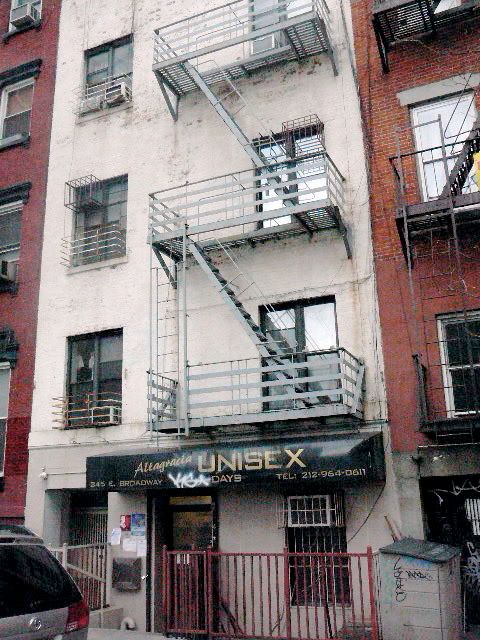 Several have been in existence for more than 100 years. On this block is found the tenement that the Epstein Brothers moved to after they left 78 Market Street.
 They're listed here in the 1920 census. While they are on Market in 1910.
From here they went to PS 147 just a block away on Grand and Scammel.
Ghost Ads: The Hieroglyphics Of A Bygone New York
This comes over from Knickerbocker Village
A viewing of this site's archival photos can't help but reveal all of the painted advertising on the building sides. It also reveals that people were pretty obsessed with "regularity" as Fletcher's Kastoria was dominant. Those painted on signs were the primary print media of the time. Many of those ads are still around, but they're fading fast. Sometimes "new" ones become revealed when an adjoining building is demolished, but now everything is getting demolished. The images from the above movie (the audio is Brenda Russell's) were taken over 5 years ago, mostly by Frank Jump, and some of them have vanished. BTW, the Zaccaro Real Estate Ad is from the family of John Zaccaro, Geraldine Ferraro's husband. I believe he owned property on Market Street at one time Frank Jump's site is an encyclopedic source of these ghost signs and there's plenty of accompanying history. The site loads slowly because of that. Frank now has a blog site as well. Here's a nytimes article about Frank from 2005:
Painted Signs, Relics of a Bygone New York, Become Even More Rare
By JOSEPH BERGER
They are hieroglyphics of a bygone New York, writings on walls redolent of a time when women wore corsets, nearly every parlor seemed to have a piano and buggies couldbe hired for a genteel ride up the avenue once a blacksmith shod the horses.
Signs painted on the sides of humdrum brick buildings advertised such wares and services, in bold block letters accompanied occasionally by an evocative sketch. Amateur archaeologists can still unearth them, faded and weathered as they are, by hey evoke the exuberant period of American capitalism," said Kathleen Hulser, public historian of the New-York Historical Society. "Consumer cultures were really getting going and there weren't many rules yet, no landmarks preservation commission or organized community saying: 'Isn't this awful? There's a picture of a man chewing tobacco on the corner of my street.' "
While a century ago, preservation groups viewed the signs as vulgar interlopers, some now want to sustain them. They seem like remnants of "a more civilized time," Ms. Hulser said.
The city's Landmarks Preservation Commission, however, has decided that it will not protect what it calls "ghost signs," according to Diane Jackier, a spokeswoman. "The commission protects architectural features and the commission does not consider the painted signs a significant feature," she said. No one has applied for a landmark designation for a painted sign in years, Ms. Jackier said.
Signs that are threadbare but still visible recall workhorse department stores like Gimbels and Hearns and men's clothing shops like Rogers Peet. They evoke a time when apartment buildings like the Warwick Arms at 101 West 80th Street trumpeted ULTRA MODERN APARTMENTS with GLASS SHOWER ENCLOSURES and when bowling alleys like McLEAN BOWL-O-DROME, which opened in 1942 along the Yonkers border, lured customers by boasting of air-conditioning.
At a three-story brick building at 109 West 17th Street that is now a Japanese furniture shop, wording painted on the exterior alerts buyers to a former incarnation of the building: TO LET /CARRIAGES COUPES HANSOMS VICTORIAS LIGHT WAGONS/ HORSES BOARD BY THE MONTH.
According to Walter Grutchfield, 69, one of three buffs who maintain Web sites devoted to photographs of the signs, the building was a livery stable from 1900 to 1905, owned by Patrick Logan, whose Irish roots are detectable in stone clover leaves set into niches in the building's facade.
Not too far away on the side of 151 West 19th Street is white Italic lettering alongside a sketch of a scissors for Griffon SHEARS SCISSORS. Griffon Cutlery Works, which also sold nail files, tweezers and manicure sets, used the building as its headquarters from 1920 into the 1960's.
The scissors suggest that homemakers typically did their own sewing well into the 1960's, an observation corroborated a few blocks north along Seventh Avenue with a sign for Necchi sewing machines, complete with a drawing of a machine with gracefully curving legs.
A sales office for Necchi, an active Italian company, opened at 154 West 25th street in 1949, but has long closed.
Charles Scribner III, whose family founded the legendary publishing house that bears his name, said that every time he drove down Ninth Avenue toward the Lincoln Tunnel, he delighted in the SCRIBNERS sign on the side of a 14-story red-brick building at 311 West 43rd Street.
For him, it recalls the glory days when Scribner's, now known as the Scribner imprint of Simon & Schuster, published Edith Wharton, Ernest Hemingway and F. Scott Fitzgerald.
The building, which opened in 1907, was the publisher's printing plant and warehouse - Hemingway's shotgun shells were also stored there - and Scribner's sold it 1955 when, like other companies, it found printing in New York too expensive.
"There were probably boxes of the first edition of 'The Great Gatsby' stored there that would now be worth more than the building itself," Mr. Scribner said, noting that a jacketed first edition of the book sells for $150,000.
The tearing down of old buildings in Times Square has given some once-obscured old signs a fleeting exposure. One of the last signs in the area - for J.A. KEAL'S CARRIAGE MANUFACTORY REPAIRING on Broadway and 47th Street - was suddenly revealed around 1998 when the adjacent building was torn down. But it was concealed again the next year once a new building began rising on the same spot.
The Bronx is still a gold mine, but construction to fill in the gaps in streets once plagued by arson is hiding or destroying many signs. Murals for the laxative Fletcher's Castoria were once ubiquitous in working-class areas and one in yellow lettering can still be seen on 134th Street between Alexander and Lincoln Avenues.
But an 80-year-old Castoria mural on 180th Street and Belmont Avenue is no longer visible. One of the quainter Bronx signs, NEMUTH BLACKSMITH WELDING, can still be glimpsed on a ramshackle garage-like building on Halperin Avenue in the Eastchester section.
Along Bruckner Boulevard, a handful of lingering signs, like the one for JEWEL PIANO CO., attest to the South Bronx's fame as a hub of piano manufacturing before World War I. According to the Bronx Historical Society Web site, piano manufacturing began to die off with the advent first of phonographs, then radio, then television. The last plant closed in the 1970's.
Until recent years, an ESTEY PIANO CO. sign just below the clock on a late 19th-century building popularly known as the Clocktower hinted at the lyrical age when every home seemed to have a piano. But the building has been rented out for residential lofts, and the Estey sign has been scrubbed away.
Older signs are being preserved, virtually, through the Internet. Frank H. Jump, a 45-year-old Brooklyn schoolteacher, sells photographs of the signs for $750 each through his Web site, www.frankjump.com. A favorite is the gold-on-blue sign at 147th Street and Frederick Douglass Boulevard for Omega Oil, a snake-oil concoction once used for sunburn, weak backs and stiff joints.
As someone who received a diagnosis of AIDS 22 years ago, he sees the painted signs as "metaphors for survival." So he was heartbroken to see another favorite, a spectral azure sign advertising a 19th-century laundry whitener, RECKITT'S BLUE/ THE PUREST AND BEST, on a three-story building at 622 Washington Avenue in Brooklyn, obscured by a new building. It had once been featured in articles about his curious obsession.
"That one hurt the most," he said.
Saturday, December 08, 2007
Day of Infamy Interviews and KV Protest In 1939
from the american memory collection at the library of congress. I added images
After the Day of Infamy: "Man-on-the-Street" Interviews Following the Attack on Pearl Harbor presents approximately twelve hours of opinions recorded in the days and months following the bombing of Pearl Harbor from more than two hundred individuals in cities and towns across the United States. On December 8, 1941 (the day after the Japanese attack on Pearl Harbor), Alan Lomax, then "assistant in charge" of the Archive of American Folk Song (now the Archive of Folk Culture, American Folklife Center), sent a telegram to fieldworkers in ten different localities across the United States, asking them to collect "man-on-the-street" reactions of ordinary Americans to the bombing of Pearl Harbor and the subsequent declaration of war by the United States. A second series of interviews, called "Dear Mr. President," was recorded in January and February 1942. Both collections are included in this presentation. They feature a wide diversity of opinion concerning the war and other social and political issues of the day, such as racial prejudice and labor disputes. The result is a portrait of everyday life in America as the United States entered World War II.
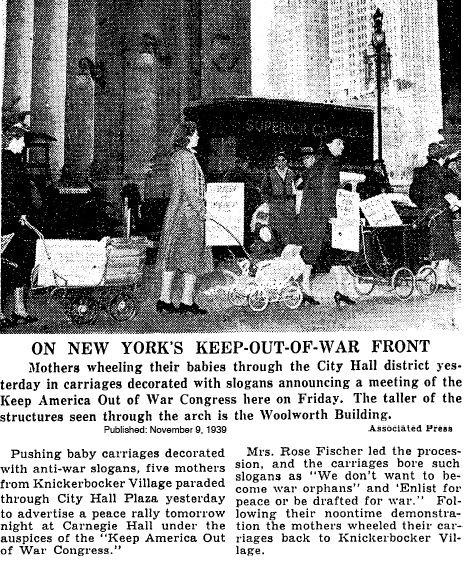
Meanwhile in November of 1939, Rose Fischer and other Knickerbocker Village mothers were campaigning, along with baby carriages, at City Hall against possible US involvement in a future war.
Thursday, December 06, 2007
I'm Spending Hanukkah In Santa Monica
I wish I was
I did this last year and it was a victim of my youtube "kristallnacht"
now there are about a half dozen lehrer adaptations on youtube (mine was the only one last year). I still think this one was better
I'm spending Hanukkah, in Santa Monica,
Wearing sandals lighting candles by the sea.
I spent Shavuos, in East St. Louis,
A charming spot but clearly not the spot for me.
Those eastern winters, I can't endure 'em,
So every year I pack my gear
And come out here to Purim.
Rosh Hashona, I spend in Arizona,
And Yom Kippa, way down in Mississippa.
But in Decemba, there's just one place for me.
'Mid the California flora,
I'll be lighting my menorah.
Every California maid'll
Find me playing with a dreidl.
Santa Monica, spending Hanukkah by the sea
Beyond Chutzpah
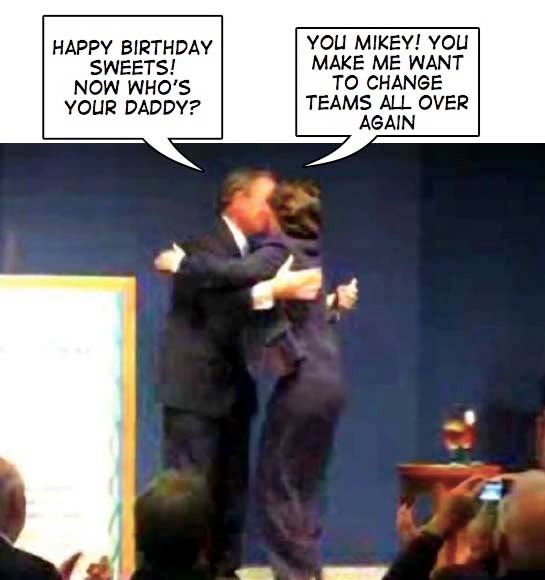
I took two youtube videos of the Mayor's roasting of Randi Weingarten and combined them into one. I really don't know what to say. I refer you to nyceducator where I discovered them
An excerpt
None of this is funny, of course, but it does go to show you just how chummy this "labor leader" is with the captains of industry, Wall Street types and politicians who see gutting union protections and Walmartizing public schools as a life's work.
In addition to Bloomberg, Quinn, Thompson and the rest of the elected political parasite class, Al Sharpton showed up looking spiffy (according to the Daily News) and Peter Yarrow of Peter, Paul and Mary sang Happy Birthday to Dear Leader.
You'll note that the one guest not at the party was a working teacher.
Oh, I'm sure there were plenty of Unity/New Action apparatchiks there to play the dutiful role of working teachers who are devoted to Ms. Weingarten, but they're just paying back the extra pensions, no-show jobs and other patronage gifts Ms. Weingarten and the UFT leadership hand out to people who do their bidding.
As for real working teachers like you and me, we were only there in spirit - and in the money used to pay for the building, the electricity, the food and drink and the party favors.
Remember, we paid for this abomination with our hard-earned money that we give to these crooks every two weeks out of our checks.
At the end of the day, the joke is really on us.
Peter Yarrow? If only I could erase one third of my PP&M records.
LES Tour: 1949 From Naked City
Quite a contrast from the previous video tour. Much of the same territory is covered.
I've tried to figure out Ted de Corsia's route here. He starts out near Houston and Stanton, then goes to the Essex Street Market, then across Rivington to Clinton, down Clinton to Delancy and then on to the Williamsburg Bridge. Obviously much scene splicing as the route is not direct. A great view of what the neighborhood looked like in that time
The Naked City
Criterion 380
1948 / B&W / 96 min. /
Starring Barry Fitzgerald, Howard Duff, Dorothy Hart, Don Taylor, Ted de Corsia, House Jameson, Anne Sargent, Adelaide Klein, Tom Pedi, Enid Markey
Cinematography William Daniels
Art Direction John F. DeCuir
Film Editor Paul Weatherwax
Original Music Miklos Rozsa, Frank Skinner
Written by Albert Maltz, Malvin Wald
Produced by Mark Hellinger
Directed by Jules Dassin
Reviewed by Glenn Erickson
Film Noir historians reserve a special place in their hearts for Mark Hellinger and Jules Dassin's The Naked City, a highly influential crime thriller filmed almost entirely in the streets of New York City. Malvin Wald's original story blends standard Hollywood storytelling with documentary techniques to produce a new kind of heightened reality. Cops go after a mysterious killer and viewers are shown a fairly accurate image of how real crimes are solved -- handsome private detectives are not part of the equation. Louis de Rochemont took his cameras to real locations for The House on 92nd Street but The Naked City adds a dimension of journalistic poetry by telling its story through an omniscient POV narrator, who seems to be the soul of the city itself. "There are eight million stories in the Naked City" has entered the language as an indelible catch phrase.
Synopsis:
The vicious murder of beautiful blonde Jean Dexter drives the tabloids crazy. Detectives Dan Muldoon and young Jimmy Halloran (Barry Fitzgerald and Don Taylor) go to work with an army of detectives and police forensic professionals to help. They locate Dexter's shifty boyfriend Frank Niles (Howard Duff), who has a bad habit of telling lies. His fiancée Ruth Morrison (Dorothy Hart) doesn't realize that Frank was two-timing her and giving her stolen jewelry. Following the clues of the jewelry, the detectives eventually puts the puzzle together -- but the unlucky family man Halloran encounters the dangerous killer on his own.
Outside descriptions of The Naked City may lead one to expect a movie of revolutionary dimensions. Mark Hellinger's film initiated a storytelling style and the entire 'police procedural' genre we know today from countless movies and TV shows, so one has to turn back the clock to appreciate its accomplishment. Crime films previously centered on heroic detectives and policemen that more often than not 'just happened' to uncover crimes while making time for romance and other pursuits. If the crooks didn't openly announce their guilt, they'd show themselves by kidnapping the hero's faithful girlfriend. "Clues" tended to be romantic items like perfumed silk scarves and elaborate extortion notes. Bad guys invariably confessed all as soon as the hero put the finger on them.
Part of the trouble was the Production Code, which made sure that the sordid realities of life were kept mostly out of the movies. Showing real crime meant showing how real people lived, and the Code decided long before that real audiences needed to be protected from reality.
The Naked City started with research into actual police methods. Lead detective Dan Muldoon (Barry Fitzgerald in perhaps his least cloying role) puts pressure on a shaky associate of the murdered woman, while his subordinates do the exhausting leg-work pursuing every possible lead: interviewing people, finding out where a pair of silk pajamas might have been bought. Forensic experts examine the body. Teams of detectives follow the suspects. Because it's a headline case, kooks show up at the precinct house to falsely confess.
Muldoon is the investigation's central brain but it's people like Halloran and Detective Perelli (the great Tom Pedi) that bring in the good information. Frank Niles trips up in his lies, which leads to more information. The cops uncover a messy crime story that involves not only the murder but a series of jewel robberies as well.
The film is given a refreshing structure through the narration of producer Mark Hellinger. Montages of relevant city life pop up, not quite in the mode of Berlin: Symphony of a City but sketching human details of New York life. Then the camera sweeps into a window where a sordid murder is being committed: A beautiful woman is chloroformed and then drowned in a bathtub. The narrator shows us incidental views of many people, including the actual killer, as the story ranges through the economic and social strata of the city. The killer may be a lowlife from the lower East Side, but his high-toned uptown associates are just as guilty: Liars and thieves compromising their values for money and sex.
Hellinger changes his tone as the net closes on the actual killer. Suddenly he remarks on how the killer is making mistakes and losing his grip ... and even offers unheeded advice. The famous "eight million stories" line is saved for the end, when the voice appears to meld with the identity of the city itself. With the crime solved the murdered girl's story will soon disappear from the headlines. She's last represented by the sight of some soggy newspapers being moved from the gutter into the trash. City poetry doesn't get better than this: Hellinger found his title The Naked City on a Weegee photo study of the streets of New York.
The Naked City is by no means a documentary. Barry Fitzgerald's 'cute Irishman' act enlivens and humanizes the police in approved dramatic fashion. The show also provides a bravura acting assignment for Howard Duff as the society cad who cons everyone but the cops. He fools two beautiful women, including a charming debutante-model (Dorothy Hart) unable to believe he could be so dishonest. The murder victim also fooled around, seducing a high society doctor (House Jameson) as part of a criminal scheme. Down on the docks, one of the hoods that do the actual burglaries (Walter Burke) gets cold feet over taking part in a murder. His partner wastes no time in murdering him, too.
The Naked City's back story is potentially more interesting than Laura Palmer's tale in the Twin Peaks saga. Jean Dexter starts out as the helpless victim of a ghastly murder. On the morgue slab she looks like a trampled angel. By the time we're finished we discover that the beauty was the ruthless center of a complicated burglary ring. She controlled men by sleeping with them. We're not sure if she was a victim or a predator.
In a scene filmed in a real morgue, Jean's small-town parents tell us that she changed her name and ran away to the big city. In the space of a few minutes, the mother goes from shouting that she hates Jean, to breaking down in tears over her body: "My baby!" Director Jules Dassin takes a moment to show the parents standing on a pier on the East River as the sun sets, mourning their loss: "Why wasn't she born ugly?" These 'unnecessary' tangents are what make The Naked City memorable.
Albert Maltz, one of the Hollywood Ten, co-wrote the script. Unlike Jules Dassin's other American noirs the political context is subdued. Brute Force was a hysterical scream against prison injustice and Thieves' Highway an indictment of racketeering as usual in the produce trade. A possible liberal agenda shows when the script sides with the salaried cops against the idle and narcissistic rich. The old matron admires her ring while flirting with Don Taylor's young detective, and Barry Fitzgerald definitely thinks that Howard Duff has to be crooked if he's spending $50 on a single evening's entertainment. The axe falls heavy on the foolish doctor who allows his social file to fall into the hands of crooks. Dan Muldoon says that jumping out of windows never solved anything, but in this town losing one's good name may be worse.
The Naked City delivers a bravura final chase onto the Williamsburg Bridge. As soon as the tables are turned the killer becomes strangely sympathetic. He's a vicious murderer, but when Jules Dassin isolates him in the towers of the bridge he personifies God's Lonely Man. The only witness to his personal agony is the unfeeling city.
Ted de Corsia plays a particularized brute, exercising constantly and boasting that he neither smokes nor drinks. He might have gotten away if he didn't choose the wrong moment to panic. Of special note are debut bits by many name actors, some of which were previously associated with Jules Dassin in left-wing theater groups. It was Walter Burke's first American film role, Paul Ford's third bit part, Kathleen Freeman's first bit and the first film of both James Gregory and John Randolph. It was the first non-Yiddish film for David Opatashu and Molly Picon (Fiddler on the Roof). John Marley and Tom Pedi's only previous roles had been in Paul Robeson's left-wing classic Native Land. Look close and you'll also see Arthur O'Connell, although he'd already been around in films for ten years.
Subscribe to:
Posts (Atom)

 Posts
Posts


