Friday, November 16, 2007

Thursday, November 15, 2007

The Seltzerman


The recent thread reminded me of this slide show that I made using the original audio
and finding images images that I thought matched. I think it goes back to 2003. I remember the seltzerman we had in Knickerbocker Village, he was Abe Berg. Years and years later I would spot Abe Berg bottles at flea markets or still in use with the few people left that had seltzermen. This article from 2002 describes the show and the wonderful series it was part of.
CRITIC'S NOTEBOOK; Hearing Heartbeats of Eccentrics and Troubled Youths
By JULIE SALAMON, nytimes
Published: January 22, 2002

Walter Backerman is a particular kind of New York character. But let him tell you.

''Let me start from scratch,'' he begins. ''My name is Walter the Seltzer Man. This is my truck. It has a little bit of everything. A bunch of old, old bottles. Office supplies. I've got some aspirin in case anyone who comes in the truck's got a headache. I've got flares. I've got a digital movie camera. I've got guide books, I've got tour books, in case I'm curious when I'm driving by I see an old building and I want to know a little bit about the history. I've got a truck that's extremely chaotic and to anyone else would appear to be a shambles. But to me it's semi-organized.''

Once this endearing eccentric would have been a New York cliché, but now -- not yet 50 years old -- he's as anachronistic as the seltzer bottles he delivers. ''The bottles are worth so much I'd be better off pulling all my bottles out of every customer's house and selling them slowly as antique collectibles,'' he says ruefully. He reports that his wife has told him, ''You're just a novelty.''

Mr. Backerman is a natural storyteller, perfect for radio, because the story inside the story inside a story can be hard for a camera to capture. He's part of a series of profiles called ''New York Works Stories,'' about people in vanishing professions, including a woman who runs a custom bra shop and a man who builds water towers. These charming portraits, produced by Joe Richman, will be playing weekly on public radio, through the end of February, weekends on ''The Next Big Thing'' on WNYC in New York (820 AM and 93.9 FM) and Wednesday afternoons on ''All Things Considered'' on National Public Radio).

Mr. Backerman's seltzer bottles may be, as he says, ''worth more dead than alive,'' but radio itself is more like the seltzer man himself, curious and still surprisingly vital. Personal stories, in particular, feel both more intimate and less intrusive on radio than on television, conversational rather than voyeuristic.

Mr. Richman has done more than his bit to keep the form kicking. He's produced more than 25 radio documentaries, including series in which teenagers and prisoners record their feelings in affecting glimpses of lives.

Mr. Richman will be sharing the public radio airwaves over the next several weeks with Sound Portraits, David Isay's radio documentary company, one of the few other entities that specialize in such audio intimacies. The latest Sound Portraits offering is ''Youth Portraits,'' the producer Stacy Abramson's swan song for the company. Ms. Abramson recently left Sound Portraits to become an executive producer at WNYC, where this series will begin on Jan. 28, at 4:30 p.m. and continue through Feb. 1.

This poignant collection of short features was reported, narrated and edited by young people from troubled backgrounds; all but one of them has done time at Rikers Island. Ms. Abramson found them through Friends of Island Academy, an organization connected with the high school on Rikers Island, whose purpose is to help lower the recidivism rate for its youthful alumni.

The novice documentary makers wrestle with making the hard facts conform to their desire to find redemption and hope in their stories. They bravely confront the most disturbing parts of their lives.

''I never write about my parents,'' says Bernard Skelton, a 24-year-old who loves to write rap music, adores his little boy and spent much of his own boyhood robbing cab drivers and deliverymen. ''They weren't there for me.'' When he does interview them, during a party for his son's third birthday, he is struck by the profound loneliness and sense of dislocation he's felt since their breakup, when he was a baby. When he says he wants to spare his son that feeling, his desire is palpable.

In his broadcast, Ariel Corporan, 22, takes his mother to task for not stopping his stepfather from beating him. She's unapologetic and unsympathetic toward her son, who became a schoolyard bully because, he says, ''at home I was alone and weak.''

Mr. Corporan offers a gripping description of his indoctrination into gangster life. He was sent as a teenager to a juvenile detention center, where he learned the art of being a delinquent. Back in school at 17, he met a boy in the cafeteria named Harold but called Bigs. ''If you'd seen the roll of money this guy pulled out, you'd have melted,'' Mr. Corporan says. Soon he had become a kind of Mr. Big himself, selling crack until he found himself facing several policemen and a barrage of bullets.

Yovani White, 20, describes how she'd go to school with a razor blade next to her gums to fool metal detectors. She became expert at talking with the blade in her mouth, so when she got into fights, she says, ''You spit the razor right out into your hand and you cut 'em and they won't know what happened.''

Ms. White and her friends chat about the process of cutting other girls in the park as casually as they might discuss a new CD. But eventually she touches her own vulnerability, as she talks about learning that her beloved grandmother had died while Ms. White was in jail.

The stories resonate with memories of abandonment -- actual and emotional -- but also with humor and romance, as the novice documentary makers interview their brothers, sisters and lovers. Andre Vaughn, 21, asks his sister to recall the first time she found their mother smoking crack (when Andre was 9). The sister also remembers when, exactly, she suspected her brother had started to steal. It was one Christmas when expensive gifts appeared in the house even though he didn't have a job.

Mr. Vaughn speaks with warmth, style and sincerity, and you want to believe him when he puts his criminal days in the past tense. His radio documentary is cut and polished, but he and the others remain works in progress.

WNEW, 1130 In New York: From 7/16/06


Writing about Louis Nye and Steve Allen along with working on the knickerbocker village site brought back memories of listening to the radio in the 50's and 60's. Michael Meeropol (Rosenberg) also talked about listening to the Lone Ranger when they came to arrest his parents back in July of 1950 (see the clip of Witness to Execution here) Anyway I wrote this in July of 2006. Now I have the option of putting the movie I made here (above) instead of just linking to it.
"The WNEW post jostled my memory. I started to remember (and I can picture) the radio situated in the kitchen, above the refrigerator, of 14 Monroe Street. It played WNEW all the time-Klavan and Finch, William B., Williams, Ted Brown and later Julius LaRosa. There was the Make Believe Ballroom and the Milkman Matinee and Ted Brown and the Redhead. That was one thing my mother and father agreed upon, the music of that era. Maybe that's why I listened faithfully to that old fashioned style, while the whole world around me went to rock and roll, folk and later the Beatles. Uncle Hy had his radio, same station, situated in the back of his store, Hi-Mart Pants And Tailors, near his sewing machines. When life was simple and I had time to do non-sensical things (now I have time, but life isn't simple). I once wrote a letter to WNEW management giving them advice on how to save the station. "Stop playing schlock like Jerry Vale and Frankie Laine, Instead mix Ella and Frank with classic jazz like Lester Young, Oscar Peterson, etc." I still think that would make for a great station. Jonathan Schwartz does it to some degree on WNYC , but then you have to suffer his bloated ego." Here's a WNEW slide show complete with theme music.

A Sunday Kind Of Love


Amazing what you learn via wikipedia. I looked up Louis Nye's biography and found out his wife wrote a great song, "A Sunday Kind Of Love."
Louis Nye (May 1, 1913 – October 9, 2005) was an American comedy actor.
He was born Louis Neistat in Hartford, Connecticut, the son of Joseph Neistat (May 18, 1881-September 1967) and Jennie Sherman (born 1890). His sister was Rose Neistat (born 1917). On the 1930 census when he was 16, enumerated April 3, they lived at 44 Baltimore Street.

Louis's parents were both Yiddish speaking Jews born in Russia. They emigrated to the United States in 1906, and became naturalized citizens in 1911. Joseph Neistat ran a small grocery store. Louis attended Weaver High School, but did not excel as a student. "My marks were so low," he said, "that they wouldn't let me in the drama club. So, I went down to WTIC Radio, auditioned and got on a show."

Nye never retired. He completed a 24-city tour of the country for Columbia Artists, ending the tour with a two-week stint at the Sahara in Las Vegas. At the age of 92, he continued to work, appearing in his recurring role of Jeff Greene's Dad on HBO's Curb Your Enthusiasm from 2000 to 2005.

Nye lived in Pacific Palisades with his wife, pianist-songwriter Anita Leonard, who wrote the standard, "A Sunday Kind of Love." Married since the late 1940s, they had a son, artist Peter Nye.
This version is by Martine Bond & Band. The song was first made popular in the late 40's by Fran Warren with the Claude Thornhill Band. Late it was a big hit by Etta James. Renee Olstead, a great newcomer, has an excellent version as well.
I could use thus (on any day)
I want a Sunday kind of love
A love to last past Saturday night
And I?d like to know it?s more than love at first sight
And I want a Sunday kind of love
Oh yea yea

I want a a love that?s on the square
Can?t seem to find somebody
Someone to care
And I?m on a lonely road that leads to no where
I need a Sunday kind of love

I do my Sunday dreaming, Oh yea
And all my Sunday scheming
Every minute, every hour, every day

Oh I?m hoping to discover
A certain kind of lover
Who will show me the way

And my arms need someone
Someone to enfold
To keep me warm when Mondays and Tuesdays grow cold
Love for all my life to have and to hold
Oh and I want a Sunday kind of love
Oh yea yea yea

I don?t want a Monday, Tuesday, or Wednesday, or Thursday, Friday or Saturday
Oh nothing but Sunday oh yea
I want a Sunday Sunday
I want a Sunday kind of love
Oh yea
Sunday, Sunday, Sunday kind of loooove

Hi Hi Steverino


The posting about Old Jewish comedians and Herbie Faye transitioned to this. Steve Allen's (he wasn't Jewish) show was so good and so far ahead of it's time. It was favorite in my household (we never watched Ed Sullivan, which was on opposite Steve for a while). So many of his ideas and skits have been recycled by today's comedians and sit-coms. It's so sad that hardly any of his remarkable ensemble; Louis Nye, Tom Poston, Gabe Dell, Bill Dana, Dayton Allen, Don Knotts, Pat Harrington, etc. are alive today. I just saw Louis Nye, funny as ever in his 90's, on a Curb Your Enthusiasm filmed in 2005. He died shortly after. The above clip makes fun of the 50's beatniks. That's something you would never see on Ed Sullivan.
a description:
Tom Poston MC's as Steve & the Gang play Bopper Hipster Musician Cats(complete with Dizzy Gillespie Beret's & Goatee's)Steve plays wrong way tuba or Sousa-phone,Louie Nye Plays Water with sink objects,Don Knotts-Snare Drum Flute,& Pat Harrington Jr.plays lawrence Well-ga(Welk)Champagne Bottle Trumpet,& "built in" Accordion. (less)

Wednesday, November 14, 2007

Bruges (Brugge) , Belgium


Bruges (Dutch: Brugge, stemming from Bryggja, which assumedly used to signify 'landing stage' or 'port') is the capital and largest city of the province of West Flanders in the Flemish Region of Belgium. It is located in the northwest of the country.

The historic city centre is a prominent World Heritage Site of UNESCO. It's egg-shaped and about 430 ha in size. The surface of the complete city amounts to more than 13,840 ha, including 193.7 ha off the coast, at Zeebrugge. The city's total population is more than 117,000, of which ca. 20,000 live in the historic centre.

Bruges has a significant economic importance, thanks to its port, and is also home to the College of Europe.

music:
Felix Mendelssohn - Songs without Words- Venetian Gondolied Op. 30, No. 6

Our man on the street:
"I am currently in Brugge in NW Belgium. It appears to be a quiet town with all old and small buildings, perhaps pre-Victorian, with a network of canals similar, but without the gondolas and singing rip-off-the-tourist gondoleers. I'll learn more tomorrow as we get a tour prior to dinner."

Thom Hartmann


This guy is excellent. He's on Air America, M-F from 12-3 PM. I highly recommend him

Fried Thinking


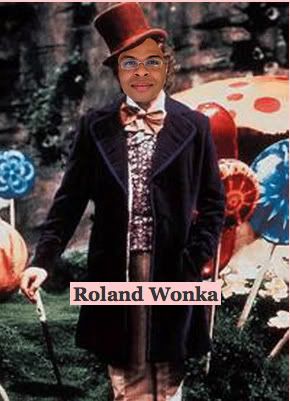
An article in the Times of 11/13/07 mentioned the latest nycdoe scheme to improve student success, giving them free phones with text messages from Jay-Z and Lebron James. This was dreamed up by Harvard Prof, Roland (Wonka) Fryer. (Graphic by Eduwonkette)
Some reactions:
From ednotes, featuring a pretty funny graphic
All it takes are a few messages from some rappers on a cell phone to motivate kids turned off by school. Jeez! Why didn't think of that when I was teaching? Oh, I forgot. In those days we used waxed string and milk containers to communicate. (Is there a way to send text messages that way?)

That DOE consultant Roland Fryer keep jumping from the fryer pan into the fire.

I was taken by these quotes in today's NY Times article:

“How do you get people to think about achievement in communities where, for historical or other reasons, there isn’t necessarily demand for that,” Mr. Klein said yesterday in an interview. “We want to create an environment where kids know education is something you should want. Some people come to school with an enormous appetite for learning and others do not — that’s the reality.”

"Mr. Klein said the effort was spurred in part by the results from focus groups performed by market research firms for the Education Department. That research found that black and Latino students from some of the city’s most hard-pressed neighborhoods had a difficult time understanding that doing well in school can provide tangible long-term benefits."

Duhhhhh!
They needed a focus group to tell them something teachers find out in their first 10 minutes of teaching?

You see, we have been telling Klein this all along and his response is that we are making excuses. Many of us actually know how to fix this problem. Engaging, exciting curricula, not test prep. And smaller class sizes so kids who do not come with an appetite for learning have more of an opportunity to be engaged. Hell, I do not remember my friends and I having that enormous appetite for learning - we were more afraid of our mothers' daily nag.

Now let's review, kiddies:

You have non-motivated students who are often struggling with academics. I have an idea. turn on the screws by threatening them with being held over on the basis of high stakes tests and then tell them they will get a cell phone and a text message from JB Cool if they can withstand the pressure. Pure Genius!

From inside schools blog
With text message plan, DOE reforms officially absurd
Posted by Philissa at 6:25 AM
"Is there any idea that wild and crazy Roland Fryer won't try? Last week the word was that he was arranging to give kids cell phones whose minutes would be dependent on school performance. This week's plan, according to the Times, is to have famous people, such as Jay-Z and LeBron James, send poor New York City kids text messages telling them to stay in school. Really. Because a rap artist who dropped out of high school and a basketball player who skipped college for a multi-million-dollar professional contract are the perfect figures to teach kids about the long-term benefits of doing well in school.

Even getting past the obvious ironies, this plan just seems weird. I have questions about why the program will roll out in KIPP charter schools, where students already have someone at home who recognizes the value of doing well in school enough to enter them in the lottery and make sure they are in uniform for each 9-hour day. And I'm not sure Fryer needed a focus group to find out that "reaching [teenagers] through a concerted campaign of text messages or through the Internet was far more likely to be effective than a traditional billboard and television campaign" — any parent or 9-year-old could have told him that. Finally, I wonder whether it's crossed Fryer's mind that one way to increase "demand" for education would be to make school enjoyable — by bolstering the quality of teaching, reducing the number of tests kids must take, and encouraging creativity in the classroom.

I don't think there's anything wrong, necessarily, with what's essentially a 21st-century version of this 1990 public service announcement. I just don't get it.

The text messages will start transmitting in January. I can already imagine one unintended consequence that could be a boon for DOE officials and cash-strapped parents. If their cell phones start spewing motivational messages, many kids might feel incentivized to leave their phones at home."
from san francisco
"just by promising to get a silly haircut?

Of course! Kids are paid to learn all the time and it works. Many parents reward good grades, while others emphasize the future benefits of education. That’s the reasoning behind Roland Fryer’s project called “Incentivising: An Experiment in NYC Public Schools,” where he has tried to set up an experiment where pupils are rewarded for standardized test performance. There are no reports posted yet, but the idea is promising and worth investigating.

Fryer is on the right track, but Machado’s strategy offers a bigger lesson most people have not yet appreciated about schools. You need incentives because most schooling is terribly boring and, frankly, often useless. Schools were designed to impart a one size fits all education in a factory style setting. That’s why kids need to be rewarded if they are to exert any meaningful effort. You have to compensate for the negative school experience.

Machado’s idea was to make the school itself more fun, if only by making the principal look funny for a few days. He didn’t need money, just the insight that you had to change school itself by making it a less tedious environment. I am not claiming that ridiculous antics should be the only way we get kids to learn, but too much focus on incentivizing education misses the point that the school itself discourages learning. There’s definitely a role for rewarding educational effort, as Fryer proposes, but the biggest changes will come when people rethink the school from the ground up so students actually want to be there, instead of a place you endure while waiting for that nice middle class job.

Tuesday, November 13, 2007

Old Jewish Comedians


I was looking for a picture of Herbie Faye (Fender from Bilko). He was born in NYC in 1899. I had found and photographed the building where he lived in Sunnyside, Queens in 1930. It's part of my "Houses of Famous People Who Lived In Queens" Google Map. (Tony Bennett, W.C. Fields, James J. Corbett, Phil Rizzuto, Judy Holiday, the Marx Brothers, etc.) That's different from my Queens Jazz Map. The search led me Drew Friedman's website. He's an incredible artist whose has a new book of sketches of Old Jewish Comedians. I found some of those sketches and added other images of great old time comedians (not all Jewish). I matched them with a portion of a podcast he did on get illuminated . Here's a link to the book on Amazon

Help


I made this business card for my wife. Too little, too late. I'm reminded of an Bob Newhart skit where he's dressed in a tattered box of Marlboro's (or Camels ?). Someone asks him what happened. He says, "Boy, it was murder in those corn fields today."
Anyway, go buy a shirt. I'll reimburse anyone the full cost.

Look At That Face


An email from a friend in Brussels sings the praise of the incredible facades of the buildings. Nothing like the schlock that developers are putting up here in the city.
Brussels? At the rate the exchange rate is going, I'll never afford it. I thought "Look At That Face" would be a good match. I was looking for Carmen McRae's version. I had to settle for Brooklyn's Barbra.
Look at that face just look at it!
Look at that fabulous face of yours,
I knew first look I took at it,
This was the face that the world adores,
Look at those eyes,
As wise and as deep as the sea,
Look at that nose,
It shows what a nose should be!
As for your smile, it's lyrical
Friendly and warm as a summer day,
Your face is just a miracle,
Where could I ever find words to say
The way that it makes me happy,
Whatever the time or place,
I will find in no book,
What I find when I look at that face!

Two Bag Designers


I got an inquiry recently as to what a two bagger is. I didn't know that there are new
companies now devoted to this phenomena.

Monday, November 12, 2007

Defonte's Disappointment


I went to Defontes for lunch the other day. It was an old favorite and I was telling some of my friends how great it is, rivaling Pete The "Hero King" of Market Street and "Uncle's Heroes" on Grand Street, the two champions of the Lower East Side of yesteryear. Last time I was there though (about a year ago) I was disappointed. I figured I'd try a hot sandwich instead of my usual cold. Another disappointment. To tell the truth, I like the sandwiches that Fairway in Red Hook makes better and it's a much better value. I was wired for sound to get an audio verite feel for the place. I added images.

After World War I: The Bonus Army & Hoovervilles


Remember the scene at the end of the Fighting 69th with the troops returning home to the cheering crowds? Well things didn't go too well for those veterans. In fact, unemployment and homelessness has been a recurring problem for veterans in history. All Things Considered had a segment on it today. I matched the audio with images of the Bonus Army and the Hoovervilles that cropped up all over the country in the early 1930's. A recommended site from the library of congress
About the Bonus Marchers:
The Bonus Army or Bonus March or Bonus Expeditionary Force was an assemblage of about 17,000 World War I veterans, accompanied by their families and other affiliated groups, who demonstrated in Washington, DC, during the spring and summer of 1932. The marchers were seeking immediate cash payment of Service Certificates granted eight years previously by the Adjusted Service Certificate Law of 1924. Each Service Certificate issued to a qualified soldier bore a face value equal to the soldier's promised payment plus interest. The sticking point was that the certificates, similar to bonds, were set to mature a full 20 years from the date of their original issue. Thus, under existing law, the certificates could not be redeemed until 1945.

The Bonus Army veterans were led by Walter W. Waters, a former Army sergeant, and were encouraged in their demand for immediate monetary payment by an appearance from retired Marine Corps Major General Smedley Butler, one of the most popular military figures of the time.

The Bonus Army massed at the United States Capitol on June 17 as the U.S. Senate voted on the Patman Bonus Bill, which would have moved forward the date when World War I veterans received a cash bonus. Most of the Bonus Army camped in a Hooverville on the Anacostia Flats, then a swampy, muddy area across the Anacostia River from the federal core of Washington. The protesters had hoped that they could convince Congress to make payments that would be granted to veterans immediately, which would have provided relief for the marchers who were unemployed due to the Depression. The bill had passed the House of Representatives on June 15 but was blocked in the Senate.

After the defeat of the bill, Congress appropriated funds to pay for the marchers' return home, which some marchers accepted. Some of the veterans stayed and continued to protest. On July 28, Washington police attacked the veterans. After many people got injured and two veterans died, the protesters assaulted the police with blunt weapons, wounding several of them. After the police retreated, the District of Columbia commissioners informed President Herbert Hoover that they could no longer maintain the peace, whereupon Hoover ordered federal troops to remove the marchers from the general area. James Quinn helped the veterans by donating food and supplies so that they could survive while they were camped outside of Washington D.C.

The marchers were cleared and their camps were destroyed by the 12th Infantry Regiment from Fort Howard, Maryland, and the 3rd Cavalry Regiment under the command of MAJ. George S. Patton from Fort Myer, Virginia, under the overall command of General Douglas MacArthur. The Posse Comitatus Act, prohibiting the U.S. military from being used for general law enforcement purposes in most instances, did not apply to Washington, DC, because it is one of several pieces of federal property under the direct governance of the U.S. Congress (United States Constitution, Article I. Section 8). Dwight D. Eisenhower, as a member of MacArthur's staff, had strong reservations about the operation. Troops carrying rifles with unsheathed bayonets and tear gas were sent into the Bonus Army's camps. President Hoover did not want the army to march across the Anacostia River into the protesters' largest encampment, but Douglas MacArthur felt this was a communist attempt to overthrow the government and thus exceeded his authority. Hundreds of veterans were injured, several were killed, including William Hushka and Eric Carlson; a wife of a veteran miscarried, and other casualties were inflicted. The visual image of U.S. armed soldiers confronting poor veterans of the recent Great War set the stage for Veteran relief and eventually the Veterans Administration.

Art Donovan Synchronicity


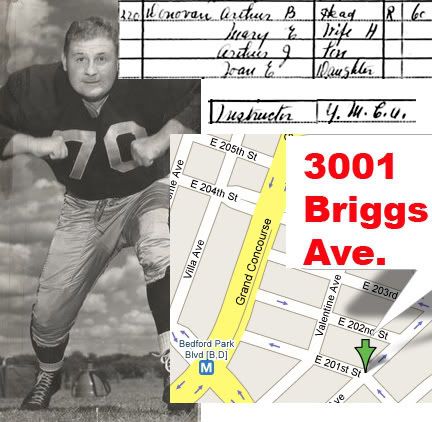
There hasn't been a synchronicity tag for a while. I was looking up info on Donovan and found he was born in the Bronx! I searched census records in 1930 and found him living at 3001 Briggs Avenue. The record notes that his dad was an instructor at the YMCA. I was probably within a mile of his house yesterday! Notice how almost all history defaults to NYC History.
Some of Art's bio
Art's grandfather, Professor Mike O'Donovan, was the world middleweight boxing champion in 1881 following a career as a teenage Civil War soldier. For 100 years combined, Art's father and grandfather held the position of boxing instructor at the New York Athletic Club. The Professor was Teddy Roosevelt's personal boxing coach.

Art's father, Arthur Donovan, Sr., was the most famed prize fight referee in the history of the game, presiding over eight world heavyweight championships and being the only referee inducted into the International Boxing Hall of Fame.

During his pro football years, Art Donovan was one of the true "Gentle Giants"--feared on the field, but admired everywhere else for his generous and outgoing personality. For more than a decade, the defensive tackle was unstoppable. On the field, his 265 pounds and 6'2" stature frightened the opposition off the field, however, his smile and jovial nature attracted thousands of fans.

Art Donovan joined the National Football League's Baltimore Colts in 1950. The team moved in 1951 to become the New York Yanks and relocated again in 1952 to become the Dallas Texans. The team returned "home" in 1953 as the Baltimore Colts.

During his 12-year tenure in the pros, Art Donovan was named Outstanding Defensive Tackle. Between 1953 and 1957, he was chosen to play in five pro games plus the World Championships in 1958 and 1959. Memories of Art in the "greatest game ever played," the Baltimore Colts vs. the New York Giants in 1958, will never be forgotten.

In 1962, the Colts retired Art's uniform number "70" when he departed from pro football. Five years later, he became the first Baltimore Colt to receive the sport's grandest honor--membership in the Pro Football Hall of Fame.

Fatso


No this entry isn't about me, although it could, after all a girl named Rosemary in the 4th grade used to call me Baby Hippo. It's about legendary Baltimore Colt player Art Donovan. Yesterday I was off on a mission to photograph homes of 1942 Sephardic Jews in the Bronx. I forgot about the big Giants-Cowboy game, so I listened on the radio, something I hadn't done in a long time. I was glad to hear Dick Lynch's familiar voice, but boy did I miss the Marty Glickman and Al Derogartis of my youth. Glickman, "There goes Webster off tackle for 3,4,5...6 yards and a first down." Donovan was part of the legendary team that battled the Giants in the late 50's. There was an article about him in the Baltimore Sun yesterday. I found the above clip from a 1990 Tonight Show:
"Art Donovan -- a guy famous for both playing football and being the worst wrestling announcer in wrestling history (in 1994) appears on Johnny Carson's Tonight Show in Jan 1990."
here's the Sun article:
The Throwback, By Mike Klingaman
November 11, 2007
Art Donovan saw a lot of stuff during his 12 years in pro football, but as the grizzled Hall of Famer settled in to watch the Ravens' game Monday night, something flashed on the TV screen that gave him pause.
"It was a picture of four players getting ready for the game by having their nails polished," Donovan said, shaking his head in disbelief.
"I said to myself, 'This is the beginning of the end.' "
But that wouldn't keep Donovan, the former Baltimore Colts great, from watching the game. When you're stuck in a hospital bed, you take your entertainment any way you can get it.
"C'mon in," Donovan said, beckoning a visitor into his room at Good Samaritan Hospital, where he is recovering from a broken right leg.
Donovan, 83, represents "The Throwback" - to the days when athletes played for love of game, for less money and for their teammates.
Not surprisingly, his 1987 autobiography is titled Fatso: Football When Men Were Really Men.
"Welcome, Fatso," a sign on the wall read. On the sill sat a bouquet from Frank Gifford, the former New York Giants star whose team Donovan and the Colts defeated for NFL championships in 1958 and 1959.
Now on the mend, the five-time All-NFL defensive tackle prepared to watch the Ravens play the Pittsburgh Steelers on Monday Night Football, a weekly ritual for millions. Here sat Donovan, in a wheelchair - his bum leg propped up with a pillow, a cup of ice water at his side and a look of disgust on his face.
"What a disgrace, watching a game without a Schlitz," he muttered. "Some S.O.B. is going to pay for this."
So, how did you bust the leg, Fatso?
"Broke my femur on a cruise with my wife, in Italy," he said. "I'd walked back to my cabin after dinner with half a plate of spaghetti when I leaned in to open the door. Turns out it was already open so I fell flat on my face like something from the Keystone Kops.
"They drove me to an American hospital in Rome, 3 1/2 hours away. Road must've had 15,000 potholes. I almost bounced out of the ambulance.
"At the hospital, when they lifted me into the bed they put my head halfway through the wall and knocked me out. So I said, 'Don't touch me. If I'm going to die, it'll be in the United States, not in the Middle East somewhere.' "
A week later, Donovan was flown home to Baltimore for surgery. He said he would have kissed the ground if he could have.
"I swear to God, I was so happy as we neared the airport that I didn't care if we crashed, as long as it was on American soil."
Since he retired in 1962, Donovan has been a yarn-spinning emissary for football and the cherub-faced visage of Baltimore, his adopted hometown. For nearly half a century, the Bronx-born raconteur has delighted fans with tales of yore - as Donovan remembers them - and his spin on the game today.
Ten times, Donovan has appeared on David Letterman's late-night talk show.
These days, he watches most Ravens games on TV, attending one or two each season. A rabid fan, he isn't.
"I'm not like some guys who, if the Ravens lose, are ready to jump off the top of M&M Stadium," he said, confusing the name of the facility. "There are other things in life besides pro football."
On the tube, the game began in a driving rain, reminding Donovan of the worst conditions in which the Colts ever played.
"It's 1954 and we're facing the Giants in the rain in an exhibition game in Louisville," he said. "The circus had been there the week before and nobody had raked the field. So every time you slipped and fell, you came up with a pile of elephant dung."
The Colts' linemen found a use for it, Donovan said.
"We flipped it at the other team."
On the screen, a Steelers defender breaks up a pass and catches the old-timer's eye.
"That's a great player, the guy with the long hair," Donovan said. "What's his name?"
Troy Polamalu, Pittsburgh's Pro Bowl safety.
Three times, Donovan tried to pronounce Polamalu's name, then quit.
"I almost lost my [dental] bridge on that one," he said. "I'll call him Samson."
The Ravens trail 7-0.
On the Ravens' side, running back Willis McGahee carries the ball for a short gain, then peers toward the sideline as if he wanted a rest.
"Look at that!" Donovan exclaimed. "Every second play, he [McGahee] is looking over there, like, 'Can I come out now?'
"Stay in there!" Donovan hollered. "You're making $50,000 a carry!"
McGahee gets the ball again and fumbles. The Steelers recover.
Penalties mount quickly for the Ravens. Officials, Donovan said, have taken over the game:
"One guy throws a flag, and then all eight have to hold each others' hands for five minutes to discuss the call. Then one of them says, 'The guy was offsides.' What, he can't tell that right away?"
Pittsburgh leads 14-0.
Somehow, talk turns to players' helmets.
"Ours had only two bars in front," Donovan said of the 1950s headgear. "Helmets today must weigh 75 pounds. If I wore one of them, I'd run the 40-yard dash in about two weeks."
Would he like to have played nowadays? Donovan shook his head.
"I wouldn't have any fun," he said. "These guys, they're all in love with themselves.
"In my day, we made lasting friendships. Who did I hear from today? [Alex] Sandusky calls from Florida, [Ordell] Braase from Naples. Jimmy Mutscheller comes to see me," he said, rattling off names of old Baltimore Colts.
"[Center] Dick Szymanski, who lives in Florida, always calls when the doctor is here so the cheap S.O.B. can hang up and doesn't have to pay."
Donovan laughs, then stops. The leg hurts.
The Steelers score again and again.
"This is ridiculous," he said. "Geez, [Steve] McNair can't throw the ball. Turn the camera around. I'd rather watch the announcers."
A nurse named Kim brings Donovan a soda.
"You're missing one of the greatest games of all time," he tells her.
"The Ravens? I can't watch them because my [blood] pressure would go up and I'd wind up in the ER," Kim said.
Finally, with 4 1/2 minutes left and the Ravens trailing 38-7, Donovan can't take it anymore. The former Marine asks for a pain pill.
His evaluation of the Ravens' performance?
"I looked better than that falling into my cabin in Italy."

Wings Of Glory


I didn't lie about the last of WWI, because I didn't realize that today is the day of the celebration of Veteran's Day. That gave me time (I'm in need of some kind of self-imposed limits) to look for a clip of one of my father's favorite films, "Wings." It was a silent era blockbuster with Buddy Rogers. No luck. But I found the above clip about the Computer Game. It reminded me that a good literacy connection to WWI would be to use a site like aerodrome to have kids do research on the different planes and the famed "aces" of that war

The Fighting 69th


I thought this would be an appropriate end to the WWI film marathon. There's nothing that can stir the cockles like "Garry Owen"
The Fighting 69th is a 1940 American war film starring James Cagney, Pat O'Brien, and George Brent. The plot is based upon the actual exploits of New York's 69th Infantry Regiment during the First World War. The regiment was first given that nickname by opposing General Robert E. Lee during the Civil War.

The plot centers on misfit Jerry Plunkett, played by Cagney, and his inability to fit into the unit due to a mixture of bravado and cowardice. O'Brien plays Father Francis P. Duffy, a military chaplain who attempts to reform Plunkett. "Wild Bill" Donovan, played by Brent, is the regimental commander, who ultimately orders Plunkett to be court-martialed. One of the characters portrayed in this film is Sgt. Joyce Kilmer, the poet. Alan Hale, Sr. plays Sgt Wynn, who loses both his brothers due to Cagney's blunders.

While Jerry Plunkett was a fictional character, Father Duffy, Colonel Donovan and Joyce Kilmer were all part of the actual regiment.

and here's a Joyce Kilmer poem for a little literacy connection
When the Sixty-ninth Comes Back

By Joyce Kilmer

The Sixty-ninth is on its way - France heard it long ago,
And the Germans know we’re coming, to give them blow for blow.
We’ve taken on the contract, and when the job is through
We’ll let them hear a Yankee cheer and an Irish ballad too.

The Harp that once through Tara’s Halls shall fill the air with song,
And the Shamrock be cheered as the port is neared by our triumphant throng.
With the Potsdam Palace on a truck and the Kaiser in a sack,
New York will be seen one Irish green when the Sixty-ninth comes back.

We brought back from the Border our Flag - ’twas never lost;
We left behind the land we love, the stormy sea we crossed.
We heard the cry of Belgium, and France the free and fair,
For where there’s work for fighting-men, the Sixty-ninth is there.

The Harp that once through Tara’s Halls shall fill the air with song,
And the Shamrock be cheered as the port is neared by our triumphant throng.
With the Potsdam Palace on a truck and the Kaiser in a sack,
New York will be seen one Irish green when the Sixty-ninth comes back.

The men who fought at Marye’s Heights will aid us from the sky,
They showed the world at Fredericksburg how Irish soldiers die.
At Blackburn Ford they think of us, Atlanta and Bull Run;
There are many silver rings on the old flagstaff but there’s room for another one.

The Harp that once through Tara’s Halls shall fill the air with song,
And the Shamrock be cheered as the port is neared by our triumphant throng.
With the Potsdam Palace on a truck and the Kaiser in a sack,
New York will be seen one Irish green when the Sixty-ninth comes back.

God rest our valiant leaders dead, whom we cannot forget;
They’ll see the Fighting Irish are the Fighting Irish yet.
While Ryan, Roe, and Corcoran on History’s pages shine,
A wreath of laurel and shamrock waits the head of Colonel Hine.

The Harp that once through Tara’s Halls shall fill the air with song,
And the Shamrock be cheered as the port is neared by our triumphant throng.
With the Potsdam Palace on a truck and the Kaiser in a sack,
New York will be seen one Irish green when the Sixty-ninth comes back.

Joyce Kilmer served with the 69th Regiment (165th Infantry) during World War I. He held the rank of Sergeant. He was killed in action on July 30th 1918, while gathering intelligence for the Regiment during the battle of the Ourcq. He wrote many poems about the Regiment including “Memorial Day," "Rouge Bouquet”. His most famous poem was “Trees”.

Sunday, November 11, 2007

Paschendale


The video portion comes from a 1980 remake of All Quiet On The Western Front.
If I had known this clip existed I wouldn't have gone to the trouble to find appropriate images to match the audio on this previous post

The Lafayette Escadrille


This is from a really good multi-part WWI documentary on youtube called The Great War In The Air. Notice how there's no mention of Eugene Bullard in this wiki entry:
The Lafayette Escadrille (from the French Escadrille De Lafayette) was a squadron of the French Air Service, the Aéronautique militaire, during World War I composed largely of American volunteer pilots flying fighters.

The squadron was formed in April 1916 as the Escadrille américaine (number 124) in Luxeuil prior to U.S. entry into the war. Dr. Edmund L. Gros, director of the American Ambulance Service, and Norman Prince, an American expatriate already flying for France, led the efforts to persuade the French government of the value of a volunteer American air unit fighting for France. The aim was to have their efforts recognized by the American public and thus, it was hoped, the resulting publicity would rouse interest in abandoning neutrality and joining the fight.

(In fact higher numbers of American volunteers served with the Royal Flying Corps, Royal Naval Air Service and Royal Air Force during the conflict.)

The squadron was quickly moved to Bar-le-Duc, closer to the front. A German objection filed with the U.S. government led to the name change in December over the actions of a supposed neutral nation. The original name implied that the U.S. was allied to France when it was in fact neutral like Sweden.

The planes, their mechanics, and the uniforms were French, as was the commander, Captain Georges Thenault. Five French pilots were also on the roster, serving at various times. Raoul Lufbery, a French-born American citizen, became the squadron's first, and ultimately their highest claiming, flying ace with 16 confirmed victories before his squadron was transferred to the US Air Services.

The first major action seen by the squadron was at the Battle of Verdun, being posted to the front in May 1916 until September 1916, when the unit moved to 7 Army area at Luxeuil. The squadron, flying the Nieuport scout, suffered heavy losses, but its core group of 38 was rapidly replenished by other Americans arriving from overseas. So many volunteered that a "Lafayette Flying Corps" was formed in part to take the overflow, many Americans thereafter serving with other French air units. Altogether, 265 American volunteers served in the Corps. Although not formally part of the Lafayette Escadrille, other Americans such as Michigan's Fred Zinn, who was a pioneer of aerial photography, fought as part of the French Foreign Legion and later the French Aéronautique militaire.

63 Corps members died during the war, 51 of them in action against the enemy. The Corps is credited with 159 enemy kills. It amassed 31 Croix de guerre, and its pilots were awarded seven Médailles militaires and four Légions d'honneur. 11 of its members were deemed flying aces, claiming 5 air kills or more. The core squadron suffered 9 losses and was credited with 41 victories.

The Escadrille had a reputation for daring, recklessness, and a party atmosphere.] Two lion cubs, named "Whiskey" and "Soda", were made squadron mascots.

Lufbery got into trouble for hitting an officer who was unwise enough to lay hands on him during an argument. He was rescued from jail by his squadron mates. He was a man after the heart of French ace Charles Nungesser who came calling on the escadrille during one of his convalescences. He borrowed a Spad and shot down another German plane even though he was officially grounded.

On February 8, 1918, the squadron was transferred to the United States Army Air Service as the 103rd Pursuit Squadron. For a brief period it retained its French planes and mechanics. Most of its veteran members were set to work training newly-arrived American pilots. The 103rd PS claimed a further 49 kills up until November 1918.

Members

* Hobey Baker
* Clyde Balsley
* Courtney Campbell
* Victor Chapman (1890-1916) The first American aviator to be killed in World War I
* Elliot C. Cowdin
* Marsh Corbitt (1890-1988) Ace
* Edmond Genet The first American flier to die after the United States declared war against Germany
* Bert Hall (1885-1948) Film Director, Actor, Writer & Lieutenant. Wrote two books about being a "Flyboy" in the Lafayette Escadrille.
* James Norman Hall (1887-1951), co-author of Mutiny on the Bounty
* Willis Haviland
* Walter Lovell
* Raoul Lufbery (1885-1918), an ace who died in combat
* Didier Masson (1886-1950)
* James R. McConnell
* Edwin C. "Ted" Parsons
* Norman Prince (1887-1916), Founder and ace
* Frederick H. Prince, Jr. (1885-1963)
* Kiffin Rockwell
* William Thaw
* Gill Robb Wilson


* A statue by the sculptor Gutzon Borglum titled The Aviator (1919) was erected on the grounds of the University of Virginia in Charlottesville, Virginia in the memory of James R. McConnell, a member of the squadron who was killed during the War. Before he was killed McConnell wrote a first-hand account of the war, Flying in France, that gives the reader invaluable insight into the war in France from 1915 until his death in 1917. Letters added to the end of the book include an account of McConnell's demise.

The story of the Lafayette Escadrille has been adapted into two films: Lafayette Escadrille (1958), a William A. Wellman movie starring Tab Hunter, and Flyboys (2006), directed by Tony Bill and starring James Franco. The Lafayette Escadrille also appears in "Attack of the Hawkmen," an episode of The Young Indiana Jones Chronicles in which Indy is temporarily assigned to the group as an aerial reconnaissance photographer.

The exploits of the Lafayette Escadrille are also captured in several works of historical fiction including: To the Last Man by Jeffrey Shaara,Valiant Volunteers by Terry L. Johnson (2005), and An Ace Minus One by Timothy Morrisroe (2006).

The Lost Battalion


Today is the final day of my Veteran's Day movie marathon. Now if I was working someplace where they were actually doing units on World War I, I'd be putting up suggested questions and links for these movies besides summaries. This is the only clip I could dig up on the Lost Battalion, obviously from a foreign version. There was another Lost Battalion in WW2 that was rescued with great loss by an all Japanese-American unit. This was featured in Burns' PBS Special.

The Lost Battalion is the name given to eight American units of the 77th Division, roughly 550 men, isolated by German forces during World War I after an American attack in the Argonne Forest in October 1918. Roughly 197 were killed in action and approximately 150 missing or taken prisoner before 194 remaining men were rescued. They were led by Major Charles White Whittlesey.

On October 2, the division quickly advanced into the Argonne, under the belief that French forces were supporting the left flank and two American units were supporting the right flank. Unknown to Whittlesey's unit, the French advance had been stalled. Without this knowledge, they moved beyond the rest of the allied line and found themselves completely cut off and surrounded by German forces. For the next six days, the men of the division were forced to fight off several attacks by the Germans, who saw the small American units as a threat to their whole line. The battalion suffered many hardships. Food was short, and water was available only by crawling under fire to a nearby stream. Ammunition ran low. Friendly artillery fire was dropped on their position, which was surrounded by the putrefying corpses of fallen comrades. Communications was also a problem, as every runner dispatched by Whittlesey either became lost or ran into German patrols. The only reliable mode of communicating with headquarters was through the use of carrier pigeons, but this was both time consuming and they could only send messages, but not receive. Because of this, at times, they would be bombarded by shells from their own artillery, which was unaware of the exact location of the battalion. Despite this, they held their ground and caused enough of a distraction for other allied units to break through the German lines, which forced the Germans to retreat.

Of the over five hundred soldiers that entered the Argonne Forest, only 194 were able to walk out unscathed. The rest were killed, missing, captured, or wounded. Major Whittlesey, along with several other officers received the Medal of Honor for their valiant actions. Whittlesey was also recognized by being a pallbearer at the ceremony interring the remains of the Unknown Soldier. However, it appears that the experience weighed heavily on him. Whittlesey disappeared from a ship, in what is believed to have been (and was reported as) a suicide, in 1921.

An account of the Lost Battalion was given in a 2001 film, The Lost Battalion, directed by Burton L. King. A&E made a television movie based on the exploits of The Lost Battalion during the Battle of the Argonne in 1918, directed by Russell Mulcahy, also entitled The Lost Battalion. Major Whittlesey was played by Rick Schroder.

Cher Ami was not the only pigeon used but is by far the most famous. His stuffed body is still displayed today at the Smithsonian. In his last mission, he delivered a message despite having been shot through the breast. The bird was awarded the Croix de Guerre, for heroic service delivering 12 important messages in Verdun.

Saturday, November 10, 2007

Eugene Bullard


The story of Eugene Bullard, whose WWI experiences were used as a basis for Flyboys,
is a fascinating one. I wrote about it in May.

Flyboys


Flyboys is a 2006 drama film set during World War I, starring James Franco, Martin Henderson, Jean Reno, Jennifer Decker, David Ellison and Tyler Labine. It was directed by Tony Bill and written by David S. Ward, based on an original screenplay by Phil Sears and Blake Evans

The film follows the enlistment, training and aerial combat service of a group of young Americans who volunteer to become fighter pilots in the Lafayette Escadrille, the 124th air squadron formed by the French in 1916. The squadron consisted entirely of American volunteers who wanted to fly biplanes and fight in the First World War during the early years when the United States remained neutral.

The film was shot on location in the United Kingdom in Spring 2005 . The trench scenes were shot in Hatfield, Hertfordshire, the same location used for Band of Brothers and Saving Private Ryan. The airfield and aerial shots were filmed on and above RAF Halton (near Aylesbury) where hangers, mess rooms and officers quarters were built adjacent to Splash Covert woods. All were removed when filming ended.

The film was financed privately outside the standard Hollywood studio circuit by a group of filmmakers and investors, including producer Dean Devlin and pilot David Ellison, son of Oracle Corp. founder Larry Ellison; both spent more than $60 million of their own money to make and market Flyboys.

The Nieuport 17s featured in the film were built by Airdrome Aeroplanes, an aircraft company based outside of Kansas City, Missouri.

A group of young Americans go to France, for different personal reasons, and volunteer to fight in the French Air Service, the Aéronautique militaire, during World War I prior to America's entrance into the war. During the training period, the film mostly follows their personalities and developments; later, the focus shifts to the art of the aerial dogfight. Themes of revenge and love are also explored. The film ends with an explanation of what happened to each character, as the movie was based on real occurrences.


This film has been widely criticized for its lack of historical accuracy, anachronisms, and prochronisms. Various major details of World War 1 fighter aircraft technology shown in the film were highly inaccurate, even beyond typical Hollywood standards of accuracy. For example, the aircraft engines in the CGI scenes are pictured as not moving. The rotary engines used in early aircraft rotated along with the propeller at the same speed. The anti-aircraft artillery shown in use by the Germans was not of any type used by any side in the First World War, and those that did exist were not nearly as accurate as that shown. In reality, had any of the portrayed flak burst as close as it appeared in the film, the aircraft would have been most likely destroyed.[citations needed] One major point of contention in the film is the wide usage of Fokker Dr.I triplanes. Not only was the Dr.I not in usage at the time the film supposedly took place, when it was used it was not in such a large role, nor was it regularly painted red.In the film, the RMS Aquitania is depicted as a luxury liner, however, in early 1914 she was converted to use as an armed merchant cruiser, and by 1915 had been put into use as a troop transport ship and painted with dazzle style camouflage. Also, one scene describes the Germans as using a new 9mm caliber "Spandau" machine gun, even though no German machine gun was ever produced in 9mm, but rather in 7.92mm.

The Blue Max


A WWI film from the German point of view and one with an interesting major theme of class conflict. The following, just stressing that theme, comes from wikipedia which has a most extensive entry on the film
The Blue Max is a 1966 British World War I film directed by John Guillermin and starring George Peppard, James Mason, Ursula Andress, Karl Michael Vogler, Derren Nesbitt, Harry Towb and Jeremy Kemp.

Stachel comes from a humble background, serving two years in the infantry and attaining the rank of corporal. The opening scene depicts Stachel as a steel-helmeted landser (footsoldier) in 1916, running through no-man's land, evading enemy machinegun fire. As his fellow soldiers fall, Stachel leaps into a muddy trench for cover, barely escaping death. It is here that he gazes skyward and sees two planes engaged in aerial combat. His eyes are wide and his mouth agape at the wonderment of singular aerial combat in stark contrast to the ignominious death of an infantryman.

As a newly commissioned officer, Stachel is driven to his airfield while weary infantry soldiers lie beside the road. He tosses a nearly full bottle of Schnapps to a soldier (alcohol is expensive and hard to find). His driver remarks, "That was a full bottle, Herr Leutnant," to which Stachel replies with a wry smile, "Yes, I know." This scene demonstrates Stachel's generosity and empathy with the common man, a characteristic that the driver finds unusual and remarkable in an officer.

The German officer corps had historically been composed of wealthy aristocrats. As the war lingers and the need for aviators increases, they begin to draw from the enlisted ranks composed mostly of the lower classes; this is how Stachel attains his commission.

When he arrives at his unit, Hauptmann Heidemann asks him, "What made you transfer to the Air Corps?" Stachel answers genuinely, "To fly, Herr Hauptmann," which is regarded, judging by the facial expression of Heidemann, as phony. Heidemann, baiting Stachel to reveal false humility, asks, "Are you a good flyer?" Stachel responds humbly, "I'm...comfortable in the air, Herr Hauptmann," naively avoiding the trap he did not know had been set for him. Heidemann reacts, "Comfortable, are you? Interesting."

The film immediately breaches the issue of social standing. Noting in his file that Stachel is from Wiesbaden, Heidemann says, "I've done some hunting around there. Who are your people?" presumably indicating familiarity with other aristocrats in the area. Stachel does not initially understand. Heidemann clarifies, "I want to know something of your background. What does your father do?" The other officers and enlisted are quiet and lean forward, awaiting his answer. Stachel (noticeably uncomfortable) replies that his father works for a small hotel (then, turning his head to look directly at the others)...with five bedrooms. Heidemann takes Stachel into his private office and says, "I'm sorry if it bothers you, what your father does." Stachel says, "It doesn't bother ME, Herr Hauptmann." Heidemann retorts, "Then why are you so touchy about it," as Stachel snaps to attention. Heidemann follows up: "Well, you're an officer now....your social problems are of no concern to us." Later, in Stachel's absence, the other pilots joke about his low status. Willi says, "Of course he could have been lying about the five bedrooms." Another pilot remarks: "Willi, there's something I haven't told you. I have an uncle in the hotel business. I admit he's a Baron, and the hotel has 500 bedrooms, but you do see the position this places me in. (All the pilots laugh)

While many who view the film see only Stachel's obsessive attempt to earn glory at any cost by attaining the Blue Max, this is a common misunderstanding. Stachel is trying to gain respect from the aristocrats by proving himself to be just as good a pilot and a man. If the setting were, instead, the Tuskegee Airmen interacting with white pilots during WWII, there would probably be no such misunderstanding. The theme, though, is the same: class distinction and prejudice.

Willi von Klugermann, an arrogant, aggressive aristocrat, immediately engages Stachel. As Stachel reports to the unit, Willi flies low over his head, driving Stachel down into the mud - a metaphor for their continuing relationship. Later, he brushes the mud off Stachel's coat in a faux apology, "Sorry about that." Willi recognizes Stachel's intention to prove himself an equal man after two incidents: an obsessive attempt to locate an unconfirmed kill, and the subsequent shooting down of a British aircraft directly over the airfield. Willi (smugly) agrees to fly with Stachel, when no other pilot volunteers. This is not an act of "friendship" as some have described it, but rather a meeting of Stachel's challenge (although the novel, in contrast to the movie, does show a burgeoning friendship between the two). Their rivalry extends not only to flying, but to the affections of Willi's aunt Kaeti, with whom Willi is having an affair.

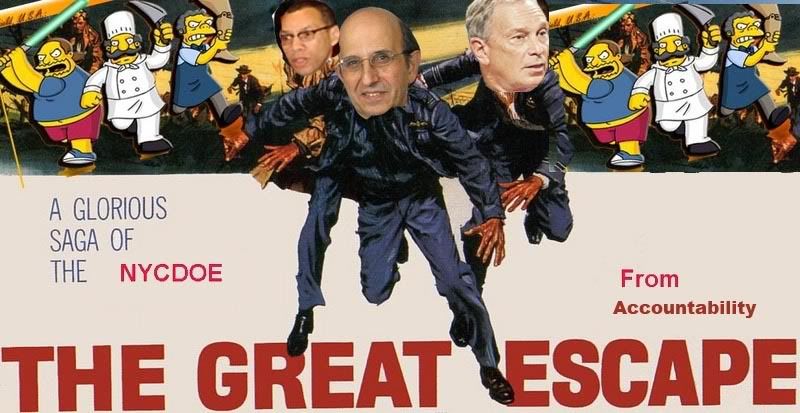
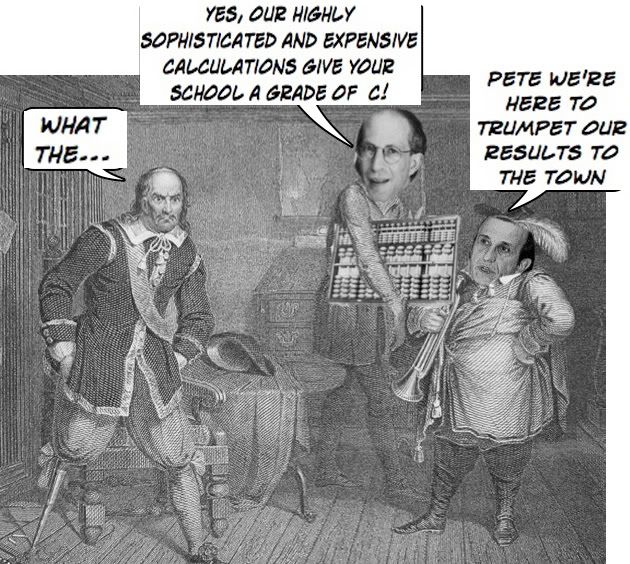
Pegleg Pete Pops


Seems that one of the nations best and most highly desired schools (and my alma mater)
almost got a C rating. This according to an article in this weeks Village Voice:
Stuyvesant, Bard Just Missed Mediocrity

Stuyvesant High School was almost given a C in the news public school grading system announced this week, according to sources.
By John DeSio

Were the reputations of two of the City's top public high schools nearly destroyed by the Department of Education? According to reports making their way around top education circles in the City, yes indeed. But city Department of Education spokesman denies the charge.

On Tuesday the Mayor Michael Bloomberg and Schools Chancellor Joel Klein announced with great fanfare the first-ever “school progress reports” for public schools. The reports measure school progress based on a variety of factors, with an especially heavy emphasis on overall student improvement. Many have already complained that the formula puts high-performing schools at a great disadvantage, since they are unlikely to see real improvement from year to year.

Stuyvesant High School, considered possibly the best public high school in the world, and Bard High School Early College, a school highly sought after by City parents, almost found out first-hand just how that lack of year-to-year improvement can damage a school within the new “progress report” system. According to multiple reports from insiders within the education community both schools were initially given a “C” grade under the new system, a mark that by no means reflects their actual academic achievement.

An aggressive reworking of the grades over the weekend changed Stuyvesant’s “C” to an “A,” said two high-level education officials. Sources even report that Leon Botstein, president of Bard College, made a personal appeal to Klein, urging him to reconsider the grade for his college’s namesake high school. The Department of Education’s website indicates that Bard High School Early College’s progress report is still “undergoing review.”

A Department of Education spokesman denied that Stuyvesant had its grades changed and said Bard was simply late in filing the necessary paperwork.

“Any suggestion that Stuyvesant or Bard were given preferential treatment is entirely mistaken," said DOE spokesman David Cantor." Stuyvesant never scored below an A in an version of its progress report. Anyone can look at the data online and see that it scores just where you’d think: among the very best schools in the city. Bard, like nearly two dozen other high schools, does not yet have a grade because it did not make data available in a timely way.”

Bronx City Council Member G. Oliver Koppell has already come out swinging against the Department of Education, calling for the department to withdraw and revise the progress reports for every school. “Although I believe that schools who have improved the performance of traditionally low performing students should be acknowledged, I do not believe this should be done at the expense of outstanding schools,” said Koppell. “If schools already have high student scores, it’s almost impossible for these schools to get an ‘A.’”

Koppell pointed out that several schools in his district where fewer than half of their students have passed their standardized reading and math tests were given “A’s,” while other schools where 80 percent of their students passed the same tests got lower grades.

“I believe the report cards should be revised to differentiate between schools who are doing well with struggling students and those who have high levels of student achievement, so as not to cause parents to lose confidence in neighborhood schools that have traditionally had excellent academic results,” said Koppell.

What's Left Behind In No Child Left Behind


from youtube and I found it on the district one parents' blog:
These concluding remarks by Dr. Jim Horn were offered to the Jersey Shore Chapter of PDK and community memebers at the September 27 presentation of the 39th PDK Gallup Poll findings. Location: Pollak Theatre, Monmouth University, West Long Branch, NJ.

Dr. Jim Horn is the force behind the excellent schoolsmatter blog which has a very insightful commentary on the real privatization plan for nyc public schools:

"Whoops! The cat is officially out of the bag, with the account of how Bloomberg & Klein plan to privatize the New York City Schools.

It will not be simple sell, however, to convince the public to turn over the Schools to the corporate curriculum writers bought by Eli Broad, Bill Gates, and the Walton family, in schools where tenure is abolished and teachers do test score piece work, where the civic responsibility of providing for our children's educations has been relinquished to those who have have reduced the value of life to the formulae provided by consumer capitalists and their mantra of global competitiveness, where a child becomes a "scholar" in the bogus data factory that has replaced the idea of school, where she works overtime toward a future that poverty and racism will most likely disallow.

To get this charterising done, Bloomberg and Klein must hold up an example to show a skeptical public how they can tame poor black children while choking high test scores out of them. This is the miracle of KIPP, where children and parents must sign a contract that assures compliance and no complaining if a child is to be allowed to be brainwashed into believing that his future simply depends upon how hard he works, how nice he is. Otherwise, complainers or behavior problems or slackers are booted out, and in comes the next eager face from the waiting list of children whose parents are desperate for something other than the standard fare that Bloomberg and Klein provide to the poor of NYC. And if the child remains compliant, by the time he comes to see through the illusion, he will have learned that he, himself, must have not worked quite hard enough or that he was somehow less than nice to deserve the fate that he, indeed, could not have created."

Lawrence Of Arabia: The Attack On Aqaba, Film vs Reality


from wikipedia:
Following an unsuccessful attack on Medina, forces of the Arab Revolt under Emir Faisal I were on the defensive against the Turks. Lawrence, sent by General Archibald Murray, commander of the Egyptian Expeditionary Force, to act as a military advisor to Feisal, convinced the latter to attack Aqaba. Aqaba was a Turkish-garrisoned port in Jordan, which would threaten British forces operating in Palestine; the Turks had also used it as a base during their 1915 attack on the Suez Canal. It was also suggested by Feisal that the port be taken as a means for the British to supply his Arab forces. Though he did not take part in the attack itself (his cousin Sherif Nasir rode along as the leader of his forces), Feisal lent a large number of his men to Lawrence. Lawrence also met with Auda ibu Tayi, leader of the northern Howeitat tribe of Bedouin, who agreed to lend himself and a large number of his men to the expedition.

Aqaba was not in and of itself a major military obstacle; a small village, it was not actually garrisoned by the Turks, though the Turks did keep a small garrison a short way from the town to protect from landward attack via the Sinai Peninsula. The main obstacle to a successful landward attack on the town was the large Nefud Desert, believed by many to be impassable.

The expedition started moving towards Aqaba in May. Despite the heat of the desert, the seasoned Bedouins encountered few obstacles aside from occasional harassment from small bands of Arabs paid off by the Turks; they lost more men to attacks by snakes and scorpions than to enemy action. During the expedition, Auda and Lawrence's forces also did severe damage to the Hejaz Railway.

Auda and his men reached the Wadi Sirhan region, occupied by the Rualla tribe. Auda payed 6,000 pounds in gold to their leader in exchange for allow his men to use Wadi Sirhan as a base.

Lawrence's plan was to convince the Turks that the target of his attack was Damascus, rather than Aqaba. At one point in this expedition, he went on a solitary reconnaissance expedition, destroying a railroad bridge at Baalbek. Lawrence did this largely to convince the Turks that the Arab force - of which they had received vague reports - was moving towards Damascus or Aleppo.

The expedition then approached Daraa, and captured a railroad station nearby. This action confirmed for the Turks, who had heretofore been misled as to the Arab army's intentions, that Aqaba was indeed their target. A squadron of 400 Turkish cavalry was sent after them, but Auda's men were easily able to avoid them.

The actual battle for Aqaba occurred for the most part at a Turkish blockhouse at Abu el Lissal, about halfway between Aqaba and the town of Maan. A group of separate Arab rebels, acting in conjunction with the expedition, had seized the blockhouse a few days before, but a Turkish infantry battalion arrived on the scene and recaptured it. The Turks then attacked a small, nearby encampment of Arabs and killed several of them.

After hearing of this, Auda personally led an attack on the Turkish troops there, attacking at mid-day on July 6. The charge was a wild success. Turkish resistance was slight; the Arabs brutally massacred hundreds of Turks as revenge before their leaders could restrain them. In all, three hundred Turks were killed and another 150 taken prisoner, in exchange for the loss of two Arabs killed (a small number were also apparently wounded in the action). Lawrence was nearly killed in the action; he accidentally shot the camel he was riding in the head with his pistol, but was fortunately thrown out of harm's way when he fell. Auda was grazed numerous times, with his favorite pair of field glasses being destroyed, but was otherwise unharmed.

Meanwhile, a small group of British naval vessels appeared offshore of Aqaba itself and began shelling it. At this point, Lawrence, Auda, and Nasir had rallied their troops; their total force had been quadrupled to 2,000 men by a local Bedouin who, with the defeat of the Turks at Lissal, now openly joined Lawrence's expedition. This force manuveured themselves past the outer works of Aqaba's defensive lines. approached the gates of Aqaba, and its garrison surrendered without further struggle.

The seizure of Aqaba allowed for the transport of Feisal's army further north, where it could again begin operations with the logistical support of the British military. It also relieved pressure on British forces in Palestine and effectively isolated the Turkish forces in Medina, and opened a pathway for possible military operations into Syria and Jordan.

The campaign and battle were depicted in the film Lawrence of Arabia, though the film's depiction of a sweeping charge by the Arabs against Aqaba itself is quite false.

Lives In The Balance


Remember a recent lunch with Miguel and Max? (a link to that posting) Miguel still keeps in touch with many of his students. They are like family along with Max. He asked me to help him try to get a transfer for one of his kids now in high school. Here's a transcript of their conversation. PS, I made some inquiries, Francis Lewis is at 250% of capacity. The transcript is a vivid example of the kind of instruction Lin (a pseudonym here as well as the pic) is getting in the current "turn and talk" world of social studies instruction:
Just thought you should read what my top student wants me to do for
her. How do you get a child trans to another school (Francis Lewis) which is in her
neighborhood, from Manhattan to Queens where she lives?


From: Lin
To: Miguel
Sent: Mon, 5 Nov 2007 12:03:32 -0800 (PST)
Subject: Re: Hi
please Mr. Figueroa can u help me transfer school? i really don't like
the school i am in. many of my friends also want to transfer. do u
think u can help me transfer to Francis Lewis? i don't know how. i
haven't learned anything in these three months of school.

Miguel wrote: What are you doing in social studies? Are you
still doing ancient civilizations? Do you remember the things we studied in sixth grade? How do you like about your high school now? Do you know anyone from
134? I had lunch with Max. He asked about you. I told him you were
unhappy there. You should have gone to Francis Lewis HS near where you
live. My friends children, who are from India, did quite well there.
One is now in college. She wants to be a doctor. They even had AP
courses there. My parents are well. My mother always asks for you. How
are your dad and brother? Does your brother go to the same school as
you? How are the other girls from our class doing? Thank you for
keeping in touch.

From: Lin
To: Miguel
Sent: Thu, 1 Nov 2007 05:02:50 -0700 (PDT)
Subject: Re: Hi
i'm doing fine. who is Marsha? don't worry, the chinese won't take
over that fast, it'll take a while. this saturday i'm going to retake
the specialized high school exam again. i have a feeling i won't do so
well. i heard it's going to be hard. anyway, wish me luck. so, how r
u and ur family doing? r u still in NY?

Miguel wrote: No, I really don't know about scholarships. I
don't ever want to see anything that resembles a school for the rest of life. I get panic attacks. I hope to be long gone before the Chinese take over. We've
allow all this insanity in this country. How are you doing, and how's
Marsha?
From: Lin
To: Miguel
Sent: Sat, 27 Oct 2007 07:51:58 -0700 (PDT)
Subject:
Re: Hi
i totally agree with you, in the future i think everyone will be
speaking Chinese, maybe because the chinese population is growing? i'm
taking Chinese this semester and it's pretty hard. luckily i got away
with a 97, 85.5, and 90 for the tests we took - it was hard!
do u know how i can apply for schlorships? or when?
aol.com wrote: It's the new way, and unfortunately it will
make America dumber and dumber. Some of the teachers only know their own subjects, if at all. They know nothing about anything else. It's not a wonderful world. I believe in the the future all of us will be speaking
Mandarin. How is school coming along?

From: Lin
To: Miguel
Sent: Sat, 20 Oct 2007 05:57:07 -0700 (PDT)
Subject: Re:
Hi
i don't like this new way of education.is this true that there might be a world war 3??my brother told me -he's talking about these thing in Global Class.?I don't understnad why
the people from the country fighting each other, don't get together to
settle things down.?i don't understand why can't they just each other
alone.?it's so stupid going into a war just to gain land.?----- Original Message ----
From: Miguel
To: Lin
Sent: Sunday, October 14, 2007 9:34:55 PM
Subject: Re: Hi
mOst students are being taught the way you are. That's the new way.
They're doing that at 134 and throughout all the public schools in NYC.
In some JHS they've even done away with foreign languages. I call the
new of teaching, "The Dumbing of America". Teachers don't have to
teach. They just hand students projects upon projects. Students
are suppose to learn this way.

Original Message-----
From: Lin
To:Miguel
Sent: Sun, 14 Oct 2007 08:10:47 -0700
Subject: Re: Hi
I think it holds true for only some school because i know that in
Brooklyn Tech. they are learning from the textbook. My school is
okay.?i don't like it that much and i kind of want to transfer only i
don't know how and i'm not sure if that would be the right thing to
do.....i mean, wat if the school i transfer to is worst? The good
school won't be easy to get into so if i transfer, i would probably go
to a bad school.?My dad and brother are doing fine.?I don't really
care if others do worst than i do because even if i did better than
most and
got a not so great grade, i won't be happy.?i have my
individual grade so my goal is to get 90s, not having a higher grade
then?most.?Beside,?wat would it do for me to get higher grade than
others??It would just make me conceited.?lHow are
you spending your time, now that you don't teach??i hope
you're doing well.?----- Original Message ----
From: Miguel
To: Lin
Sent: Saturday, October 13, 2007 5:38:22 PM
Subject: Re: Hi

I warned all of you when you left me that the new way was crazy.
Teachers don't teach. They make the students research everthing with
buddies and/or groups. This is very sad, but true. Do the things we
covered help at all? How do yo like your school? How are your dad and
brother doing? Don't worry I'm sure you'll do better than most. Good
luck!!!!!
From: Lin
To:Miguel
Sent: Sat, 13 Oct 2007 09:45:38 -0700 (PDT)
Subject: Re:
Hi
i am so sorry for not e-mailing you earlier.?i'm kind of
stressed out because of a presentation i have on MOnday.?MY previous presentation went horribly - i memorized the whole speech and
got nervous.?you know, what u said was true, my history teacher is not teaching us - she is making us do research on a topic she gives each table, and then
present it to the class.?WHat's worst is that we have a test base on what others taught us (and some people speak very low and sputter a lot!).?luckily we did the Sumerians last week - i got away with a 80 - that was the highest! - this week we're learning about the egyptians.?lt;br>i cannot believe that we're learning a new
civilization every 1 - 2 week.?School isn't that hard though.?i'm doing good in all my?classes but Manderin and global history.?Manderin is too hard
and the teacher cannot teach!?she gave us a test with things she never taught
us.?Can u believe this????i'd rather study from a textbook in history
than doing presentations. oh, that guy (Gavin),your former student,
i've talked to him - he don't take school seriously at all.?he skips school a lot.? so,
how r u doing??Tell Max and your mother that i said hi.
----- Original Message ----
From: Miguel
To: Lin
Sent: Friday, October 12, 2007 9:40:47 PM
Subject: Hi
How are you doing? How is school coming along? Hope all is well. We are
doing OK. My mom and Max asked for
you.
__________________________________________

Friday, November 09, 2007

How Can I Connect Your Call?


The old phone numbers of some of my Knickerbocker Village pals
Bob: Be-3-8260, Rich:WOrth-2-7617, Marty: BEekman-3-0873, Al: BE-3-4319, Me:BE-3-1628, Murr:CO7-5397, Marty's Aunt Esther:BE-3- 0874 (An explanation from Marty) "These were the last four digits of my late Aunt Esther Odze whose husband, Lou, had a face that looked like the inside of a boiled grapefruit. It's that hard to describe. She was the one with the 4 at the end of her number. Trust me I often confused the two and would end up calling home for an increase in my allowance only to hear Aunt Esther hem and haw and finally tell me she'd get back to me in the morning. No. When we get the opportunity to go back in the time machine please dial me with a 3 at the end unless you want to talk to the Odze couple."
Howie corrects his brother Al:
"Also for those of you keeping score at home, our KV phone number was BE(ekman)3-1649 (BE 3's were the coolest exchange, and did anyone know that with the old rotary phones, instead of dialing '1', you could press the button down instead and it registered as a '1' - which we did for years thinking the call would not count) .... David Aaronson's number was BA(rclay) 7-8753....

Armistice Day, aka Veteran's Day


With all these posts on Veteran's Day I haven't put this within the proper context.
Here's some background from wkipedia:
Armistice Day is the anniversary of the official end of World War I, November 11, 1918. It commemorates the armistice signed between the Allies and Germany at Compiègne, France, for the cessation of hostilities on the Western Front, which took effect at eleven o'clock in the morning — the "eleventh hour of the eleventh day of the eleventh month." While this official date to mark the end of the war reflects the ceasefire on the Western Front, hostilities continued in other regions, especially across the former Russian Empire and in parts of the old Ottoman Empire.

The date was a national holiday in many of the former allied nations to allow people to commemorate those members of the armed forces who were killed during war. After World War II, it was changed to Veterans Day in the United States and to Remembrance Day in the British Commonwealth of Nations. Armistice Day is an official holiday in France. It is also an official holiday in Belgium, known also as the day of peace in the Flanders Fields.

In many parts of the world, people take two minutes of silence at 11:00 in the morning as a sign of respect for the roughly eight million who died in the war, as suggested by Edward George Honey in a letter to a British newspaper though Wellesley Tudor Pole established two ceremonial periods of remembrance based on events in 1917. Beginning in 1939, the two-minute silence was moved to the Sunday nearest the 11th, in order not to interfere with wartime production should the 11th fall on a weekday. This was stopped at some point and many people observe silences on the actual 11th.

Here's a list of top WWI movies from amazon's listmania:
1. Paths of Glory - Kirk Douglas
2. The Lost Battalion-Rick Schroder
3. Gallipoli (Special Edition) DVD ~ Mark Lee
4. All Quiet on the Western Front DVD ~ Richard Thomas
5. Behind the Lines DVD ~ Jonathan Pryce
6. Breaker Morant by Edward Woodward, Jack Thompso Bryan Brown
7. A Farewell to Arms (1932)
8. Howard Hughes' Hell's Angels ~ Ben Lyon
9. NIEMANDSLAND (No Man's Land--Hell On Earth) DVD ~ Hugh Douglas; Geroge Paclet;
10. Sergeant York (Two-Disc Special Edition) DVD ~ Gary Cooper
11. Wings
12. What Price Glory? DVD ~ James Cagney
13. Lawrence of Arabia (Limited Edition) DVD ~ John Dimech
14. The Fight 69th-James Cagney
15. Men of Bronze-William Miles director

A list with some detail (I didn't include those films whose summaries I had already posted with clips, ie. Lighthorsemen, Paths of Glory, Lost Battalion, Sergeant York):
All Quiet on the Western Front
Remake of the all-time great war story based on the pacifist novel by Erich Maria Remarque. The tragic tale of a group of German recruits during World War I.


World War 1 on Film - All the Kings Men All the Kings Men
The Royal British Army's Sandringham Company, led by Captain Frank Beck (Jason), was a unit comprised entirely of servants, grooms and gardeners from King George V's Norfolk Estate. On August 12, 1915, the company marched into battle against the Turkish forces at Gallipoli and vanished into thin air, never to be heard from again. Through this drama, the details of the Sandringham's fateful, misconceived campaign are brought to life, reconstructing the true story of a group of gentile, amateur soldiers who valiantly marched to their doom.


World War 1 on Film - Behind the Lines Behind the Lines
A psychiatrist (Pryce) in a military mental institution during World War One is responsible for treating shell-shocked soldiers and returning them to battle. He's tormented with the morality of this task upon hearing first hand graphic war stories from his patients. The situation brings him dangerously close to the edge of a mental breakdown. An emotional tale of wartime heroism and sacrifice based the true story and the novel REGENERATION by Pat Barker.
Click Here

World War 1 on Film - The Blue Max The Blue Max
WWII. The "Blue Max", a coveted medal for achievement in flying, is ruthlessly sought by Peppard, a poor-boy German soldier who climbs out of the trenches and into the aristocratic air force. He is met with prejudice by the other contestants, wealthy snobs who look down upon his low economic stature. When he claims the title, he earns the respect of the General and the General's wife (Andress), who wants to repay him in ways that the General might not appreciate. Peppard, on the other hand, does. Fantastic aerial combat highlights the film, although the scenes between the two lovers don't hurt matters much.

World War 1 on Film - The First World War The First World War
This thorough and stimulating 10-part series provides a comprehensive narrative of World War I. Documentary filmmaker Jonathan Lewis attempts to fill in small gaps and create a cohesive timeline of the war from a global perspective. Fresh accounts provide insights and a context from which to consider the war's affects on human history. Episodes include "To Arms," "Under the Eagle," "Global War," "Jihad," "Shackled to a Corpse," "Breaking the Deadlock," "Blockade," "Revolution," "Germany's Last Gamble," and "War without End."


World War 1 on Film - Gallipoli Gallipoli
"Gallipoli" relates the events surrounding the ill-fated World War I battle, in which Australian and New Zealand troops set out to capture Istanbul. But mistakes made by upper-echelon military commanders led to disaster -- in which the army grunts suffered the most. The film, however, focuses not only on epic clashes, but on the friendships that developed between the soldiers on the field.

A profound study of the friendship of two young Australian men caught up in the murderous First World War. Set on the Turkish front in 1915, this film effectively combines history and drama.


World War 1 on Film - Grand Illusion Grand Illusion
Jean Renoir's brilliant farewell to Europe's ancient regime, GRAND ILLUSION, set during WWI, stars Jean Gabin as Marechal and Marcel Dalio as Rosenthal, French prisoners of war who constantly escape from prison only to be recaptured. Along with the gracious aristocrat de Boldieu (Pierre Fresnay), they're moved to the fortresslike Wintersborn prison, from which no one has escaped. The commandant of the prison is the ace German pilot von Rauffenstein (Erich von Stroheim), now grounded by injury. Despite humane treatment, the Frenchmen plan to escape once again.

Calling on his own experiences as an aviator in WWI as well as those of his comrades, Jean Renoir's antiwar masterpiece bids farewell to the class constrictions of European society and calls for the unity of humankind across class and national boundaries. Set in the German prison camps of WWI, the film stars Jean Gabin as Marechal, and Marcel Dalio as Rosenthal. Like the charming aristocrat de Boldieu (Pierre Fresnay), these two French aviators were shot down and now spend most of their time escaping from German prison camps before inevitably being recaptured. Between escapes, they do what they can to amuse themselves, which includes running a talent show, but after a tunnel they've dug is discovered, the three are sent to Wintersborn, a forbidding fortress of a prison, which is commanded by former ace pilot von Rauffenstein (Erich von Stroheim). The humane commandant practices noblesse oblige toward de Boldieu, hoping for an alliance across national lines. But he comes to learn that this phrase has a different meaning for the Frenchman. One of the great films of all time, GRAND ILLUSION perhaps most purely embodies director Jean Renoir's characterstic humanism, manifested less here in camera technique than an instinctive ability to educe truthful performances from his cast.


World War 1 on Film - King and Country King and Country
An army lawyer must defend a young private charged with desertion during World War I. As the lawyer learns more about what actually happens on the front line, he's compelled to do whatever it takes to spare the boy from the firing squad. KING AND COUNTRY is a powerful fable concerning the evils of war and the nature of duty.

Joseph Losey takes an unadorned look at the realities of World War I trench warfare in his jarring military courtroom drama KING AND COUNTRY. Tom Courtenay stars as Hamp, the muddled, Cockney private who, at his wit's end, deserts his post, attempting to escape the ever-present sound of guns and walk home. Dirk Bogarde is Captain Hargreaves, an aristocratic, no-nonsense British Army lawyer who must defend Hamp before the army tribunal, for whom the crime of desertion carries a nasty stigma and the penalty of execution. The action is confined to the mud-entrenched, rat-infested confines of the barracks, creating a stifling atmosphere, which is only amplified by Losey’s masterful scenes exposing the dry cruelty and unnerving boredom of army life. Initially, Hargreaves approaches Hamp’s case with disdain; however, upon learning that Hamp volunteered for duty on a dare, that he is the sole survivor of his unit, and that his wife has been unfaithful in his absence, his efforts on Hamp's behalf become more impassioned and earnest. Faced with the unfeeling face of the army bureaucracy, Hargreaves's arguments fall on deaf ears as Hamp becomes a tool of morale boosting on the eave of the troop’s dispersal into an impending bloody battle.


World War 1 on Film - Lawrence of Arabia Lawrence of Arabia
This classic film was based on the real-life exploits of legendary British scholar and soldier T.E. Lawrence. Stationed in Cairo in 1916, Lawrence languished in the mapmaking department of British Intelligence until he was asked to find and gather information on Prince Feisal, leader of the Arab Allied forces in World War I. His desert journey inspired his first military success when he led a small contingent of Arabs against the Turkish stronghold of Aqaba. Lawrence's military career flourished as he attempted to forge a new, united Arab nation out of squabbling tribes.

David Lean's masterpiece, perhaps the greatest of screen epics, stars Peter O'Toole in one of the most electrifying debuts in film history. The film is less an ordinary adventure than an experience that leaves an overwhelming sense memory of the struggle between two powerful forces: the Arabian deserts, immense, intractable, ever-shifting, punishing; and T.E. Lawrence, humble as a monk, flamboyant as a rock star, protean, polymathic, heroic, enigmatic, mad. While working on the staff of British Intelligence in Cairo in 1916, Lawrence's fluency in Arabic earns him a post on a mission sent to establish contact with Prince Feisal (Alec Guinness), leader of the Arab revolt and ally of the British against the German-sponsored Turks in WWI. Impressed by Lawrence's knowledge of their culture, the prince allows the young officer to join his staff, and Lawrence quickly earns the Arabs' respect after he executes acts of extraordinary heroism. As the Englishman's genius for guerrilla warfare becomes evident, he assumes the role of de facto leader of the Arab revolt, uniting the heretofore warring tribes into a devastatingly effective weapon. But the chaos of war also unleashes the repressed officer's powerful need for self-abasement and mortification of the flesh. A visionary work that unfolds one indelible image after another, LAWRENCE OF ARABIA fuses the conflict of man against man, man against nature, and man against himself into a sublime poem of force. The film features a literate script by Robert Bolt and an outstanding cast, which also includes Claude Rains, Jack Hawkins, Arthur Kennedy, Anthony Quinn, Jose Ferrer, and Omar Sharif in his unforgettable desert-crossing debut.


World War 1 on Film - The Trench The Trench
THE TRENCH tells the story of a group of young British soldiers on the eve of the Battle of the Somme in the summer of 1916, the worst defeat in British military history. Against this ill-fated backdrop, the movie depicts the soldiers' experience as a mixture of boredom, fear, panic, and restlessness, confined to a trench on the front lines. At the center of the troops is 17-year-old Billy MacFarlane (Paul Nicholls), who alongside his older brother, Eddie (Tam Williams), has volunteered for service. Like their fellow squad members, they are boys dressed as men. Their survival is in the hands of war-hardened Sergeant Winter (Daniel Craig) and bookish Lieutenant Hart (Julian Rhind-Tutt). However, when word comes that the squad will join the first wave of the attack, they all face an equal fate. Novelist and screenwriter William Boyd's directorial debut steers clear of epic pronouncements about the pointlessness of war. Instead, he illuminates in glowing detail the characters perched at the edge of the abyss. With a minimum of bloodshed, the movie seeks to capture a momentous event through a narrow lens. Watching the men march stiffly into battle, it becomes clear there is no such thing as "modern" warfare.
Click Here