Thursday, May 04, 2006

Immigrants and Flag Waving

The two can sometimes be mutually exclusive, but I found this scene striking. The cemetery containing heroes and heroines of the revolution in Carmel, NY is in the middle of a small grouping of houses inhabited by Mexican immigrants. I ran them together in a slide show with a Revolutionary era midi from a great site, contemplator.com.
Here's some background on the song, "Free America":These words are by Dr. Joseph Warren, of Boston. Warren was one of the original Minute Men. Warren was Chairman of the Committee of Safety in Boston in 1775 and the man who sent Paul Revere to Lexington to warn John Adams and John Hancock of the British advance, setting Revere off on his famous ride. Warren was commissioned a Major General by the Massachusetts Provincial Congress and was killed in the Battle of Bunker Hill.
Warren set the words to the English song British Grenadiers. The origin of that tune is unknown and variants have become popular several times. The commonly known words cannot predate 1678, as that was when the regiment was created. William Chappell's Popular Music of the Olden Time places the tune in the Elizabethan era, but notes that the current words and music for British Grenadiers were found on a manuscript of the 18th century. Here's the karoake slide show

It's A Small World After All


I began my collaborative LES/Harlem project today at one of Caroline Kennedy's favorite public schools, PS42. Looks like things may work out well. One of the kids overheard my discussion with one of the teachers and went down to the school library prior to lunch, borrowed, "Dave At Night" and was up to chapter 11 by the end of lunch. Later a girl comes over to me and casually says, "Hi, Mr.Bellel." It was Wendy from Mr. Louie's class at PS20. She transferred to PS42 in December. What a small world. Her transfer is reminiscent of the great migration theme of the Harlem Renaissance. Also by coincidence, the guidance counselor at PS42 is a good friend of Shifra Levin, the guidance counselor at Harlem's PS149. Shifra and I worked with each other going back maybe 15 years ago at PS397 in Brooklyn. The same guidance counselor at PS42 began her teaching career many years ago at PS20 and has fond memories of "father time" Arnie Messinger. Arnie has been at 20 for about 40 years. He's probably seen about 73 chancellors come and go during that time. With luck he may see Joel Klein's departure. (From my mouth to God's ears). Here's a slide show of the experience Did someone say Kevin Bacon?

Tuesday, May 02, 2006

Passionate Kisses And The Desperate Blogger

Last night while looking for the name of the quaint Lake Carmel hot dog stand I stumbled upon a roadfood review of Magnolia's. Lo and behold we now have a face to go with "What size coffee?'" from 4/19/06. Renowned food critic Michael Stern gave the place a good review. I don't know what he was smoking, maybe he was enchanted by other things?

Monday, May 01, 2006

Looking For Art In All The Weird Places

Hey, Warhol made it big with Campbell Soup Cans. When my daughter Emma pointed out this old fashioned outdoor hot dog/ice cream stand I immediately saw something podcastworthy. Unfortunately, it caused her embarassment because she thought my stealth recording and picture taking would be noticed. I wouldn't equate it, however, with my father's insistence on singing with the band at every wedding and bar mitzvah that I ever went to. The teenage girls yapping away in the background weren't discussing Stephen Colbert-something about a party at a friend's house where they played hide and go seek and someone wore pigtails. Here's the result

More LES Movie Memories: Courtesy of Jack Karney

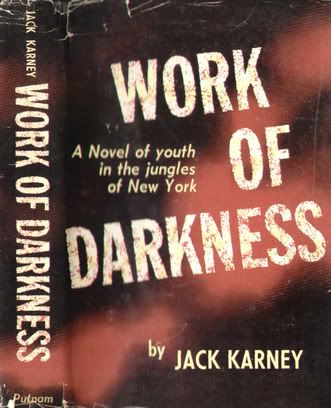
Jack Karney was my friend Richard's father. He wrote several pulp type detective and suspense novels.
It was a big deal for me as a kid to go to the Chatham Square Library on East Broadway and see Mr.Karney's book "Cop" right there on the shelves. The dedication of the book was to Richard. I never read "Cop." The only books I was interested in reading were the John Tunis books, "The Kid From Tompkinsville," etc. I'm making up for it now by reading Karney's 1956 "Work of Darkness." It's no "Striver's Row," but it's very good. It takes place on the LES and in the scanned pages that make up this slide showhe mentions other LES movie houses, the Apollo and the Academy.

Loew's Canal Memories

Last week while I was down on the LES I stopped by the Tenement Museum. In the window of 97 Orchard Street was a poster that was a sampling of a placematters exhibit that is being done in collaboration with City Lore.
It showed a 1939 photo of the Loew's Canal, my "home" movie theater of my childhood. I remember that one of the first movies I saw there was "How To Marry A Millionaire" with my mother. It must have been in 1952-3. I also remember, I think, seeing the Blob there with my childhood flame, Nancy Bueller, aka "The Most Beautiful Girl In Knickerbocker Village." This was I think in 1958. The Blob was scary, but it was nothing compared with some other movie where some aliens drag you into some underground cave. I had nightmares about that movie well into my adulthood. Here's some more info on the Loew's Canal from cinedmatreasures:"The Canal Theatre opened in New York City on September 8, 1927. Designed in the popular Spanish baroque style, it was one of the first movie palaces to feature the “Atmospheric” style in its auditorium. Theatre seated almost 2,400 and featured a Wurlitzer organ. In 1957, the curtain came down on the Canal’s last show and theatre closed. It's interesting to go into that store it is now because, much of the ceiling plasterwork is still there. I didn't even kow it was a theater when I first went in the store, but once inside it was screaming "theater", that's how I discovered it. I already sort of picked up on it in the former lobby area. I guess the owners of the store were wondering why I was constantly looking at the ceiling instead of their merchandise! A lot of the ornamentation still exists in both the lobby and what was the small auditorium. When I went back outside, sure enough, there was a marquee too (which I totally didn't notice), that's how I really knew I was just in a theater."
Here's a slide show with "now and then" pics of the canal along with the weird Blob soundtrack, by a young Burt Bacharach.

Little Senegal


Colbert inspired me to create some original "art." Going back to my audio verite project: Last week I parked a few blocks away from my school on 116th Street, between St, Nicholas and Frederick Douglas. It was an amazing block-all African stores and restaurants. When I was going home I "strapped on" my mp3 recorder and tried to immerse myself. I was thirsty and got a drink in one of the stores. That's me sneezing as the heavy scent of the spices hit me. Then I took some photos when I got back to my car. In order to bolster the sparse sound track I mixed the ambient noise with a segment of a Senegalese song, "Manu Chao Amadou et Mariam-Senegal Fast Food." My research found that the African flavor of the block is largely Senegalese. I also found some additional images and info on the web. The Little Senegal movie seems interesting, but it's unavailable. Here's the resulting slide show. Here's some additional info from an nyu little voices interview project done a few years ago:"The following information is a case study on Mrs. Madjiguene she is a Senegalese native who moved to the United States in 1989. Upon arriving in America Mrs. Madjiguene moved to the African neighborhood in Harlem mentioned above. This interview discusses Mrs. Madjiguene's linguistic history, her experiences in Senegal and her experiences in America.
Question: What is your linguistic background? What languages did your parents use and teach you while growing up? 
Answer: I was born Senegalese so the language I grew up speaking was Wolof. There are many ethnic languages in Senegal, however Wolof is the main/national language. Since Senegal was a colony of France the official language of Senegal which is taught in school is French. Senegal gained independence from France on April 4, 1960. My mother spoke Wolof and my Father who is from Mali (a neighboring country) spoke Bambara, French and Fulani. My father spoke to us in French because children needed to know French before they went to school. French is taught in kindergarten, so if you had educated parents they would speak to you in French. If your parents were not educated then you would speak only Wolof until you learned French in school.
Question: Can you explain the linguistic situation in Senegal? What is the communication like between Senegal and other countries?
Answer: Well, there is French Africa and English Africa they are called Franco-Africa and Anglo-Africa. West Africa which includes the countries of Senegal, Ivory Coast, Guinea, Mali, Togo and Benin were all French colonies so French is the official language. Countries like Nigeria, Ghana, South Africa, Kenya and Tanzania were British colonies so their official language, in addition to their national languages, is English. We can all communicate in French and English, but communication is rather difficult among Africans because there are many ethnic groups. For example, the Ivory Coast has about one hundred ethnic groups, Nigeria has a little more than one hundred ethnic groups and Senegal has about five main ethnic groups. These ethnic groups are the Bambara, the Jola, the Fulani, the Wolof and the Hassaniyya. In Senegal, English is mandatory but I am not sure if French is mandatory in Nigeria. In Senegal you learn French and English in school, so before I came to United States I was already speaking English.
Question: Do you ever hear Wolof spoken in this community?
Answer: Yes, all of the time I hear Wolof spoken in the streets, on the trains, downtown and at the supermarkets.
Question: Do you label the languages based on the ethnic groups? Are the ethnic languages described by the area where the ethnic group is historically from?
Answer: Yes, in Senegal labeling is easy because when you have a country with a national language like in Senegal everyone speaks Wolof. For example, the Jola, the people from the south and the people from the north all speak Wolof and they also speak French. However, in the Ivory Coast (a neighboring country) the people have to speak French because they don't understand each other. The people develop a type of urban French they call it Le Petit Biyan which is like a creole. This urban French is spoken in the markets and in the streets and it is not educated French. They have this problem everywhere in Franco-Africa except for Senegal. The other Franco-African nations have to speak the official language to understand each other.
Question: Does your son speak Wolof?
Answer: Yes he does, but it is a type of Wolof I don't understand very well because he has an accent. I tell him 'this is not how you speak Wolof you're losing your Wolof accent' but what can I expect he was born in America and lives in the American enviroment.
Question: Does your son speak French?
Answer: No, he doesn't speak French anymore. He used to but I no longer speak French with him. I shout to him English and whenever I speak French to him he answers me in English. So, I say to myself teaching him French is too difficult so I should forget about it. I also have not been speaking a lot of Wolof with him...I should not be doing this. [laughs]
Question [To Son]: In your school are there a lot of people who speak Wolof or does everyone speak English?
Answer: A lot of people in my school are in the International class. A few of my friends are from the Wolof ethnic group and are in the International class. [He attends The Booker T Washington Junior High School which is located on 108th Street and Amsterdam Avenue.

Stephen Colbert: The Titanium Kahones Award

Early on in this blog there was an occasional "LES Hero" feature. Stephen Colbert is far beyond that. He gets the titanium kahones award. From salon.com: "The White House Correspondents' Association Dinner was televised on C-Span Saturday evening. Featured entertainer Stephen Colbert delivered a biting rebuke of George W. Bush and the lily-livered press corps. He did it to Bush's face, unflinching and unbowed by the audience's muted, humorless response. Democratic Underground members commented in real time (here, here, and here). TMV posted a wrap-up. On Colbert's gutsy delivery, watertiger writes, "Stephen Colbert displayed more guts in ten minute of performance at the White House Correspondents Dinner than the entire Bush family. He, along with the ever-feisty Helen Thomas, deftly exposed the "truthiness" to the world (or at least those who were watching) that Bush AND the D.C. press corps are indeed a naked emperor and his gutless courtiers." Mash at dKos says, "Standing at the podium only a few feet from President Bush, Colbert launched an all out assault on the policies of this Administration. It was remarkable, though painful at times, to watch. It may also have been the first time that anyone has been this blunt with this President. By the end of Colbert's routine, Bush was visibly uncomfortable. Colbert ended with a video featuring Helen Thomas repeatedly asking why we invaded Iraq. That is a question President Bush has yet to answer to the American public. I am not sure what kind of review Stephen Colbert's performance will get in the press. One thing is however certain - his performance was important and will reverberate." Here's a link to a site called thankyoustephencolbert where you can view the video.

Sunday, April 30, 2006

Bob Newhart, My Father, Cousin Jerry, Unity House And A Tisket a Tasket


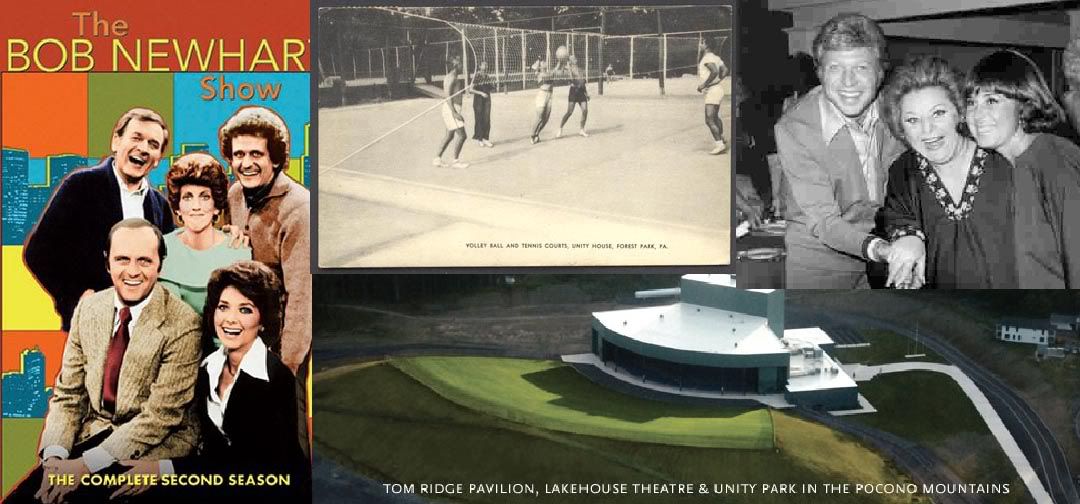
Quite a collage here, yet there's a logic. I caught a recent PBS repeat of an American Master's treatment of Bob Newhart. I like Newhart and I loved the first series, especially the gorgeous Suzanne Pleshette. My father also loved Newhart. I remember a spoof he did on an old Chesterfield or Pall Mall commercial. I think the original had some beautiful rustic scene of the Chesterfield man smoking and everyone in the scene happy. Newhart appears on tv all beat up with a Chesterfield sandwich sign and simply says, "Boy, it was murder in the cornfields today." My father couldn't stop laughing. Newhart's humor was a real subversive poke on the myth of the capitalist dream and its amazing that he was so popular with so many people. We are a lot dumber now. Anyway, Newhart reminded me of my father and so did my wife's cousin Jerry when I posted his piece that mentions his parents meeting at the ILGWU resort, Unity House. My parents and I would go to Unity House for our weekly summer vacation. I enjoyed it. I remember seeing big name stars like Ella Fitzgerald and Totie Fields and Eddie Fisher at the beautiful concert hall which was on the premises. I remember my father shouting out loud in the theater for Ella to sing A Tisket A Tasket and she did. Of course, I found his outburst embarrassing, he was always a big egomaniac. I compare it to Jerry's description of his embarrassments with his father: "I, too, have a strong association with "All the Things You Are." It was my father's favorite song. During my childhood he oftentimes crooned it to me when we walked together. Since I worshipped him, that was most welcome. The trouble is that after "All the Things..." he placed an arm around one of my shoulders and went into "Yes, My Darling Daughter." When he finished that one he invariably asked me if I was his darling daughter. Most times I agreed that I was; on some occasions I remained silent. Always, I resented representing daughterhood to him." And to think I though my father screwed me up. Here's what happened to Unity House:"Unity House was a resort in the Pocono Mountains of Pennsylvania, operated by the International Ladies Garment Workers Union and used as a vacation destination and educational center for its members. It was purchased by Locals 22 and 25 in 1919, and consisted of a lake and 750 acres of land. In the 1920s the locals sold the resort to the international organization. Unity House prospered after World War II, but attendance dropped throughout the 1960s and continued to dwindle in the 1970s and 1980s. The ILGWU closed the resort in 1990. In 2000 it was purchased by a subgrantee of the Mountain Laurel Center for the Performing Arts.

A 107 Year Old Church And The Taft Houses

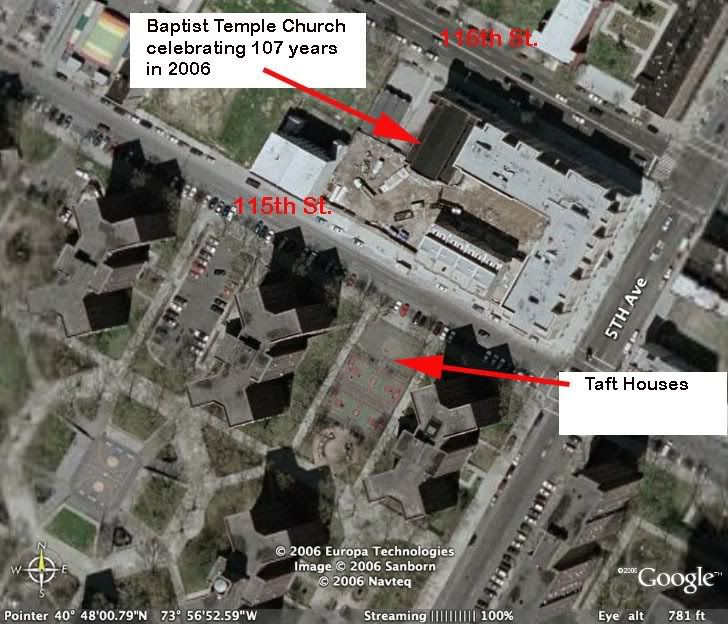
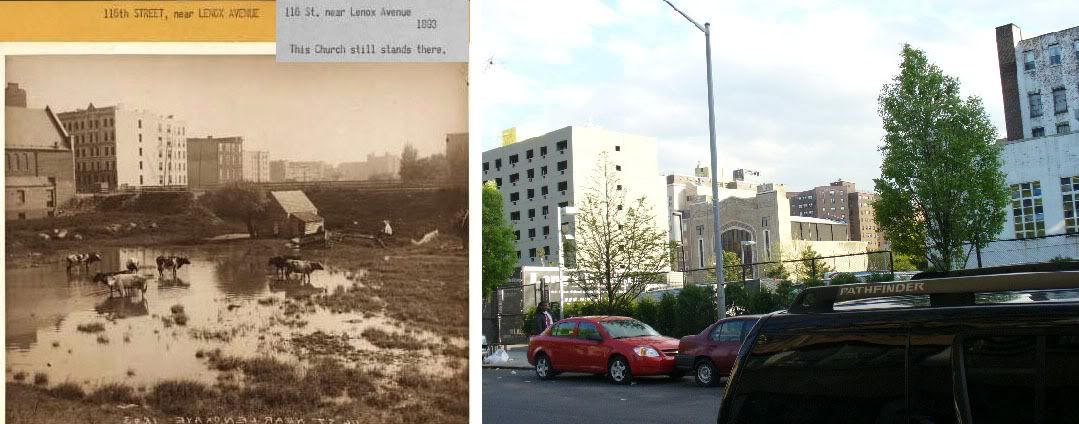
I went to take a closeup picture of the church on 116th Street last Friday. There is some discrepancy to the Sperr image notation which is on the previous post. A sign on the building says the church is celebrating its 107th anniversary, which means it goes back to 1899. I think Loomis photo says 1893, although it is hard to make out. There can be some differences as to when the structure was built and how old it is in existence as a Baptist Church. I gathered some more photos of the area. They come from A9.com Maps, (a great source), google earth and a wikipedia article on public housing) to create a slide show.

116 Street Then And Now, Part 2

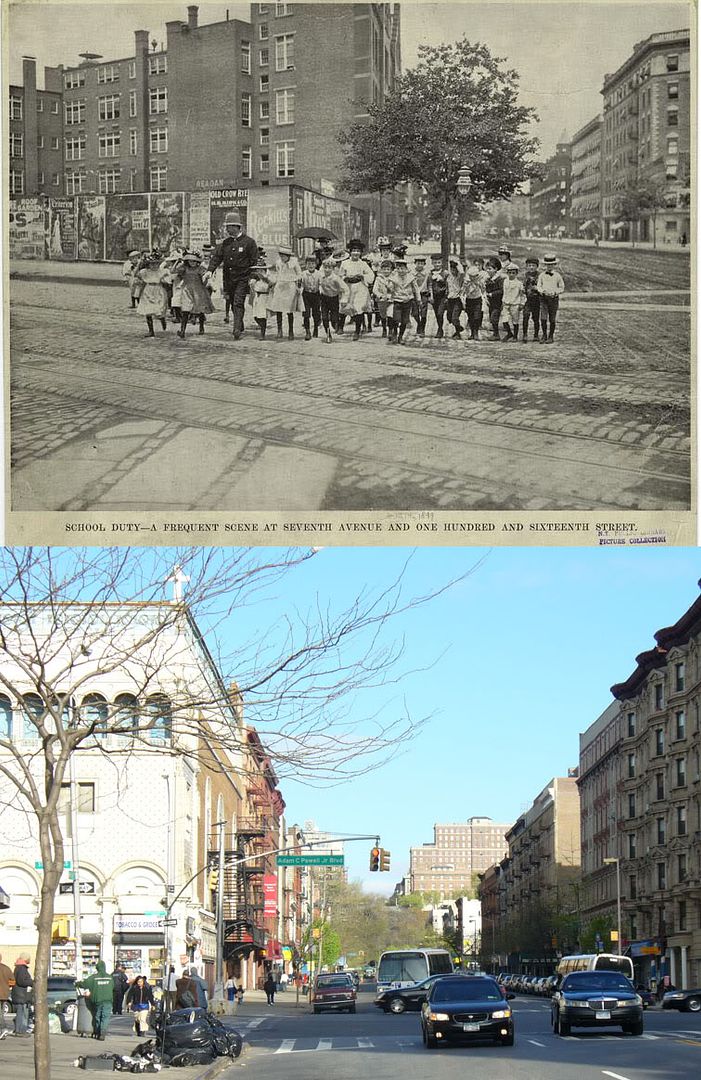
I mentioned the NYPL's Loomis Sperr collection back on 8/24/05. In created the 4/24/06 I remembered there was also a 116th St photo there, circa 1893. I matched it up with the same vantage point today. When I showed it to some 4th graders they were fascinated that were once cows grazing across from where their school is now. Some of the kids live in the projects on the block (115th Street, between 5th and 6th Ave) south of the church.

Podcasting Verite

Beware of pseudo intellectuals like myself with mp3 players, they might be recording. I'm experimenting with this technique where I wander into a situation with my recorder on. I attempt to capture the "feel" for the setting by capturing ambient noise along with bits and pieces of conversation. Then I backtrack and try to unobtrusively take pictures of the scene I just captured in audio. Finally I combine the two. Where necessary I gather a missing image from some other source to make the movie more cohesive. Here's my first attempt at it in Pawtucket, R.I.

The N Word, Small Victories and Therapeutic Communities

As a quick aside: For those who think things are better now in the city, especially in economically and socially depressed areas, you're wrong. Just as many years ago the media portrayed a more dangerous city than actually existed, now it is underplayed. Bloomberg is succeeding only because he is forcing problems out to other parts of the country by eliminating and lessening the safety net. I saw first hand evidence of a "take or leave it" apartment situation offered to a family being pushed out of a shelter. The apartment was riddled with mold. It's the beggar thy neighbor process-just like it is being done in education. Charter schools are created with zero tolerance manifests and they pick and chose their students. The neighboring schools become a dumping grounds because they have no jurisdiction to exclude. Very clever and the union is complicit as well.
Next: Last week there was much ado about an episode on "All About Us" that dealt with the controversial use of the N word. It was directed by Will Smith. Will has lost his West Philly hood "chops" (actually his family was middle class), because the episode was lame. Try Boondocks for a much more authentic version. The kids love it. I was invited to bring my podcasting to a therapeutic community. I can't adequately explain the benefits, but my pals Shifra and Marty can. Prior to the boys' weekly meeting we agreed on a common discussion thread and Boondocks was enthusiastically selected. The kids were much more animated and focused in their talk. Next I'll show them the piece I created and we can discuss new possibilities. Eventually I can teach them the process of matching the conversation with the images. I just happen to have most of the series already digitized and I extracted stills from the movies and tried to align them with their talk where possible. This became too much of a stretch for Live Slide Show, probably iMovie or Final Cut would be more suited. Anyway, here's a portion of our talk

Thursday, April 27, 2006

It Just Doesn't Matter

Once again we look to Bill Murray for inspiration: "And even if we win, if we win, HAH! Even if we play so far above our heads that our noses bleed for a week to ten days; even if God in Heaven above points his hand at our side of the field; even if every man woman and child joined hands together and prayed for us to win, it just wouldn't matter because all the really good looking girls would still go out with the guys from Mohawk because they've got all the money! It just doesn't matter if we win or if we lose. IT JUST DOESN'T MATTER! Rest of group: IT JUST DOESN'T MATTER! IT JUST DOESN'T MATTER...Farina's going-good riddance, but Alonso, with no real credentials-other than cohorting with lobsters at Harvard will be even worse. Klein & Co. and the corporate right just want to destroy public education and then privatize it.

Wednesday, April 26, 2006

Unce Hy and PS 42

I mentioned on 1/13/06, about a month before his passing, that my Uncle Hy attended PS 42. Many Sephardim, such as the tenement Museum Confinos also did. Here's an excerpt from a recent rememberance piece from the sephardiccouncil.org: "Hy Genee, the spiritual leader and president of Kehila Kedosha Janina, the Romaniote synagogue in New York City, passed away on February 13, 2006 at the age of 83 leaving the 100 year old congregation in tears. Kehila Kedosha Janina was founded by Greek Jewish immigrants in 1907, and named after the city of Janina (Ioannina), from where they came. The dignified old synagogue built in 1927 at 280 Broome Street remains, it is the only Romaniote synagogue in the Western Hemisphere. In addition, it stands as one of the last old synagogues on the Lower East Side of New York City, still in operation.Although it is often called Sephardic, the congregation that Hy led for many decades was made up of Romaniote Jews. These are neither Ashkenazic nor Sephardic Jews; they are Jews with their origins in ancient Greece, arriving there after the destruction of the first Beit HaMikdash (Temple) in Jerusalem. They have their own nusah (rite), an orthodox tradition similar but different than the Sephardic tradition. Similarities between the Romaniote and Sephardim indeed exist, because both groups spent hundreds of years together while Greece was under Ottoman Turkish rule. Yet, the Greeks are proud, and rightly so, of their unique traditions." I hope my Uncle can forgive me for being such a lapsed Jew, Actually, in his generosity of spirit he always did. Here's the full article

An Anatomy Of A Podcast Story

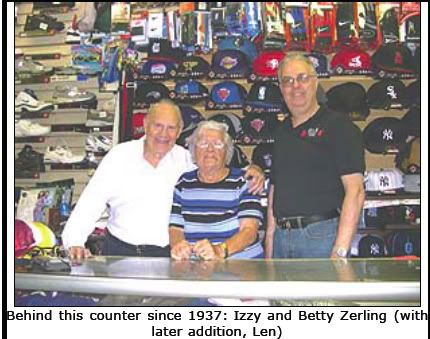
Here's something they don't teach you at Columbia. I was down on the LES yesterday to visit with one of the systems best principals, Rosa Casiello O'Day of PS42. I had put together the pieces of my LES-Harlem project and was giving her some of my resources. I decided to stop in on an old acquaintance, Len Zerling, of G and S Sports. I had seen an article in the Times that would interest him and wanted to pass it along. I also had another secret agenda, which I can't reveal here. I also thought, as I always seem to think about now, "I wonder whether there's a digital story here." G and S has a lot of LES history. But it wouild have been awkward to come in a say, "Hey Len, how about an interview?" However in the course of our conversation he wanted a phone number that I thought I had on my computer and I whipped it out (the computer, that is). While it was open I showed him the story I did on the Mets with Ms. Rizzo's class. He then seemed intrigued about how I was able to do that, so I started a mock interview and the story took off. Afterwards, as I listened to the tape at home, I started looking for images online that our talk suggested. I also had taken pictures at the store. When I googled his father's name, Izzy Zerling, I found all this interesting stuff on his boxing career. I even found a transcript of an oral history of his World War II experiences that he provided for some college in Virginia! The story can go in a million different ways and each way opens up new intriguing pathways. It's exhilarating. It's almost like being a jazz musician improvising on a theme. Anyway, here's the story. Postscript, while I was at PS42, who should show up to see Rosa, none other than Caroline Kennedy. Now there's a whole other story possibility. By the way, the prices at G and S are very reasonable. Official team jersey shirts that I've seen well over $100 at other stores are about $80-85. Those nice team jackets, by Adidas, were only $50. The store is on Essex Street, between Hester and Grand.

Tuesday, April 25, 2006

All The Things You Are

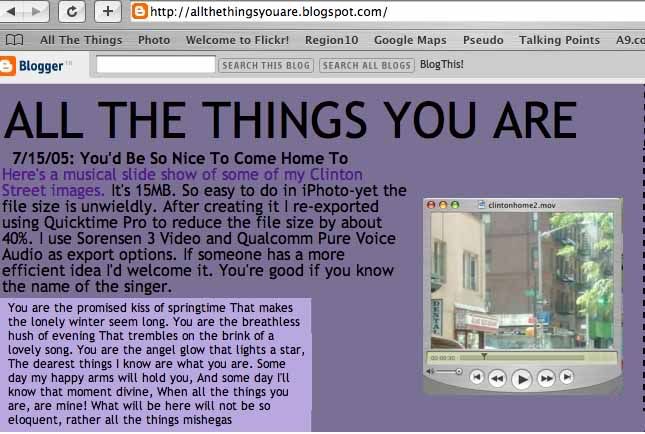
Pseudo Intellectualism needed streamlining. Its size made uploading and editing slow. It's themes, though clear to me, are probably confusing to anyone else. I decided to start another blog and dedicate that one to podcast type posts. I've been going back and deleting parts of pseudo to put on the new blog. I called it "All the Things You Are" in honor of one of my favorite songs by Kern and Hammerstein (Hey, just because I like that kind of music doesn't mean I'm gay, not that there's anything wrong with that). It was "the" song at my wedding (#2). I wonder if it's a wise choice for a title because marriage #2 is hanging by a thread. Here's the link to it.

Counterpunch

I've been so obsessed with other topics that I've neglected checking on my favorite links. Counterpunch has some great stories that enable me to patch together a post on 2 favorite topics, history and education reform. A recent gem from its website of the day feature has a civics flash movie called "you're an asshole." There's also an education story on school privatization: What Billionaires Mean by Education Reform By SETH SANDRONSKY "Recently, talk show host Oprah Winfrey focused on "America's Education Crisis." Bill Gates, Microsoft co-founder, and his wife, Melinda, were guests. Stand Up is their national campaign to improve education for youth. Does Oprah know that the $27 billion Bill and Melinda Gates Foundation also gave $4 million dollars to the Sacramento City Unified School District for "educational reform?" For the context of this donation we turn to the district's Sacramento High School. There, students, scores on standardized tests were low. Officially, such exams are the best measure of what modern education can provide to the nation,s youth. Crucially, the SCUSD had taken state funds to improve SHS students, test scores. Subsequently, the scores lacked the desired improvement. SHS risked becoming a "failed school." Later to avoid state sanctions, the district decided to close SHS, located in the low-income, largely nonwhite neighborhood of Oak Park. Against that backdrop, Starbucks Corp. and inflated home prices are sprouting in this gentrifying area. Meet former NBA star Kevin Johnson of the Phoenix Suns, a SHS grad, and a guest on Oprah's recent show. Retired from pro hoops, he was tapped to improve the education of SHS students, heading up the St. Hope Development Corporation. SHS was re-opened by KJ's corporation, which has run it as a charter school, praised on the Winfrey show. Significantly, many SHS parents and labor union members opposed the school's privatization. Parents formed the Sacramento Coalition to Save Public Education. Some SHS teachers did not want to work without a union contract for a corporation. Legitimizing the drive to privatize SHS was The Sacramento Bee, the city,s one daily paper for over a decade. The McClatchy Co. publishes The Bee. The Sacramento-based publisher is also the pending buyer of Knight Ridder Inc., the 12 union papers of which are on the selling block. KJ's corporation, in the context of "seed money" taken by the SCUSD from the Gates Foundation, took over a public high school and weakened labor unions. In the language of the market, non-union labor is more "flexible," making it is easier for bosses to fire workers. This flexibility also weakens the political power of teachers' unions. Oprah's recent two-part "special report" on the crisis in U.S. public schools included this gem: "I've often said that I believe that education is freedom." Presumably, this includes freedom for billionaires to shape school reform as they see fit. But freeing public education by turning it over to corporations is no freedom at all."

A Hot Time In The Old Town

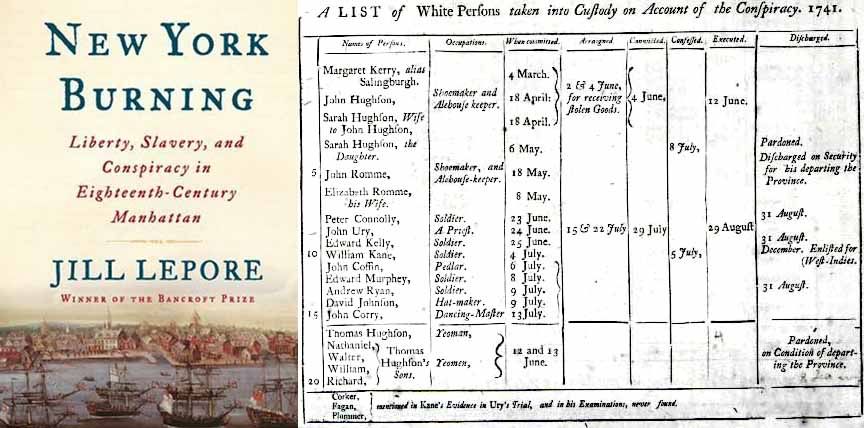
The definitive book on the 1741 slave rebellion in NYC is by Jill Lepore and it's called "New York Burning" (a great primary document is contained in the image attached-double click to enlarge) It's interesting how she told the story using the backdrop of the post 9/11 hysteria. From the Nation:"The basic facts are these: In March and April of 1741, a series of ten fires erupted in Lower Manhattan, the most significant one within the walls of the fort at the southern tip of the island, the center of power in the British colony of New York. A plot was uncovered: Slaves, together with some downtrodden whites, were found to have conspired to burn down the whole city and murder the white population. Arrests were made: 152 blacks and twenty whites. A trial was held; people were convicted and sentenced. Thirty black men were hanged or burned at the stake; two white men and two white women were hanged. The bodies of two supposed ringleaders, one black and one white, were gibbeted, the corpses left to rot for weeks on public display. One resident called the episode the "Bonfires of the Negros.".....The word "unfair" can hardly do justice to the treatment visited upon New York's slave population in the aftermath of the fires. The episode might be dismissed as an outcome of a cruder age were it not reminiscent of more recent terrorist detainments. Literally every lawyer in New York was engaged on the side of the prosecution, while the defendants--the city's official nonpeople--had no representation at all. Confessions were extracted at the stake. And as the confessions piled up, they lent themselves to a conspiracy theory of fantastical proportions. The richest white New Yorkers were to have been murdered; the slaves would become the masters. The royal governor of New York was to be replaced by a slave--named Caesar, no less.......The chain connecting the Salem witch trials and the "Bonfires of the Negros" (not to mention the 2001 Patriot Act) is mass hysteria: the conviction that a dark enemy lurks among us and extraordinary measures must be taken to defeat it. Some in 1741 saw the connection to what was then a shameful occurrence in the not-so-distant past, and regretted it. The events surrounding the Zenger trial, meanwhile, bear directly on 1741, in Lepore's reckoning, and amplify what has long seemed a grim but small event in American colonial history." Attached here is the full review along with a piece on another 1741 story (historical fiction) called "Forever," by a guy I used to admire, Pete Hamill. Some day I'll tell the details of that.

Monday, April 24, 2006

Closer To The Truth With Some Rough (Accountable?) Talk

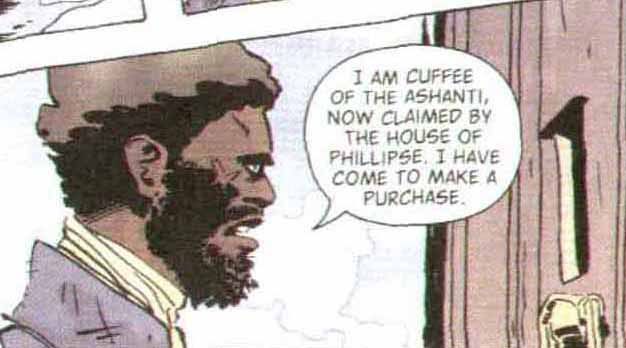
Over the Easter/Passover break I paid a visit to NY's premier comic book store, "Forbidden Planet." I was searching for some history related titles and discovered Constantine Hellblazer Papa Midnite. Amazon reviews: "Papa Midnite collects the five issue mini-series into trade paperback format featuring the sometimes ally, sometimes adversary of John Constantine. The book relates the origin of the Voodoo master and crime lord as well as his curse of immortality. Midnite is visited by the spirit who is the son of a 18th century slave named Cuffee. The story moves back and forth from present day to early 1700's New York when the young Midnite and his sister were still children yet already he was knowledgeable in the dark arts of Africa, if not entirely wise in their use. The slave Cuffee is planning a revolt against their "pink-skinned" masters and comes to Midnite to buy guns. Midnite tricks the man with a parlor trick into believing he has a magic powder than can repel bullets. This of course leads to tragedy as the rebellious slaves challenge their masters, falsely believing they are protected. As revenge, Cuffee forces Midnite to kill his own sister as the rest of the slaves commit mass suicide in a powerful blood sacrifice to curse Midnite. He is doomed to live forever until he can lead his people to control of the city. The only survivor of the suicide is the infant son of Cuffee named Fortune, who is now the spirit that haunts midnite. Several decades later, Fortune is now an adult slave and Midnite is now even more versed in the native arts and calls upon the Trickster God named Anansi (who arrives in the form of a giant and rather deranged looking rabbit) to assist his people in yet another revolt against their slave masters. John Constantine makes only a brief appearance in the story but one of his ancestors from the 1700's takes a central role as a tavern owner who tries to help the slaves. Writer Mat Johnson based the events in his story on actual slave uprisings in New York in 1712 and 1741. In fact even the notion of a power to protect against bullets is supposed to be factual. The story humanizes Midnite and turns what had been a pretty stereotypical character into one of real depth with human emotions, ambitions and failings. Now, almost 300 years later Midnite is confronted with these specters of the past and realizes that he's spent his many years doing nothing to forward the cause of his people. Mat Johnson, who himself is black, seems to be taking aim at certain public figures in the black community who themselves have been criticized for not being more socially conscious. Johnson makes no attempt to tone down the subject matter. Slaves are shown being beaten, sexually assaulted, hung, and burned alive. Perhaps most damning is their being treated as mere property...and investment...as opposed to a living, free-thinking person. About the only downside is that in the end there isn't much of a payoff for Midnite. He's confronted with his sins of the past but there doesn't seem to be much remorse on his part, and certainly no resolution to try to mend things. The story ends quite abruptly and I felt as though I had perhaps missed something." Here I put together a slide show from the beginning sequence of Papa Midnite. I did some censoring of some rough dialogue

Strange Truth: Rough Crossings


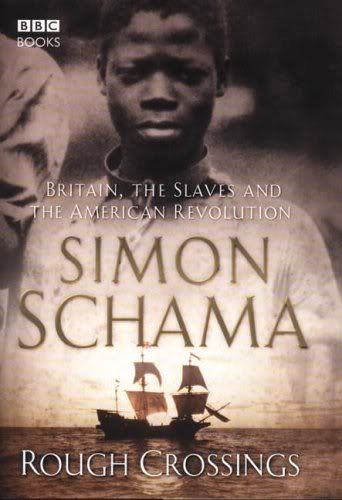
I read in the Times that "Rough Crossings" is scheduled for US release tomorrow. From Adam Hochschild's Amazon review:"distinguished historian Schama has found a little-known story from this era that makes the Founding Fathers look not so glorious. The Revolution saw the first mass emancipation of slaves in the Americas—an emancipation, however, not done by the revolutionaries but by their enemies. Many American rebel leaders were slave owners. To hit them where it most hurt, Britain proclaimed freedom for all slaves of rebel masters who could make their way to British-controlled territory. Slaves deserted their horrified owners by the tens of thousands. One, who used his master's last name, was Henry Washington; another renamed himself British Freedom. The most subversive news in this book is that the British move so shocked many undecided Southern whites that it actually pushed them into the rebel camp: "Theirs was a revolution, first and foremost, mobilized to protect slavery." Even though they lost the war, most British officers honored their promise to the escaped slaves. The British commander in New York at the war's end, where some 3,000 runaway slaves had taken refuge, adamantly refused an irate Washington's demand to give them back. Instead, he put them on ships for Nova Scotia.And there, nearly a decade later, another saga began. More than a thousand ex-slaves accepted a British offer of land in Sierra Leone, a utopian colony newly founded by abolitionists, which for a few years in the 1790s was the first place on earth where women could vote. Sadly, however, financial problems and the British government's dismay at so much democracy soon brought an end to the self-rule the former slaves had been promised. Schama once again gives his readers something rare: history that is both well told and well documented. In this wonderfully sprawling epic, there are a few small errors about dates and the like, and perhaps a few more characters than we can easily keep track of, but again and again he manages to bring a scene, a person, a conversation dramatically to life. Would that more historians wrote like this." I have been reading an interesting book I got at Strand's recently called "Roots and Branch" (a history of African Americans in NY and NJ from 1613-1863) by Graham Hodges and was aware of the British offer. God knows, it would have been a smart move for any slave at the time. It's a wonder that so many African Americans fought on the Patriot side. RE the reference that Hochschild makes "would that more historians write like this"- How true. Yet the Dept of Education is giving away tons of Teaching American History grant monies to hacks and bores teaching "traditional" American History. You can bet Rough Crossings won't be on the reading list or anything by Howard Zinn. Another generation is getting brainwashed

116 Street Then And Now

The views are of 116th Street and St. Nicholas (7th) Avenue looking west. The top half of the picture was taken in 1899. The prominent building in the modern day half is the First Corinthian Baptist Church. It has an interesting history, from cinematreasures.com: "One of the most ornate structures in Harlem, this church was built in 1913 as the Regent Theatre. The design is based on the Doges'Palace in Venice, evident in the thin columns and arches of the facade. Architect Thomas W. Lamb went on to design a series of Italian Renaissance-style movie theaters, including the Roxy, the Rivoli, and the Regent. Located in what was then a German-American section of Harlem, the Regent was architect Thomas W. Lamb's first large "all picture house" and first opened in February, 1913, with "Pandora's Box". Behind the Regent's Venetian palazzo exterior was a Spanish-Moorish auditorium, decorated in gold, blue and red, with satin wall panels and dark blue carpets. A ceiling mural above the proscenium depicted "The Surrender of Granada", as envisioned by painter Francisco Pradillo. Despite its opulence, the Regent was an almost instant disaster, causing owner Henry Marvin to summon up-and-coming impresario S.L. Rothafel to the rescue. 'Roxy's' innovative taste and showmanship had already helped to save unsuccessful theatres in other parts of the USA, but this was his first chance to prove himself in the "big time". He closed the Regent for several months while he changed some of the interior furnishings, installed potted plants, new stage lighting and curtains, and hired a symphony-sized orchestra to play music that was specially arranged to match the movies. When the Regent re-opened in December with "The Last Days of Pompeii", the 'Roxy'-produced programs became the talk of New York, and soon earned him a better offer to take over the direction of the Strand on Broadway in the midtown theatre district. But the Regent continued to flourish and benefited from a take-over by B.S. Moss, who added Keith-Albee vaudeville to support the movies. Due to that connection, the theatre eventually became the RKO Regent, and went through some minor "modernizations" in 1939 and 1944. Some sources say it closed in the late 1950's, but the RKO Regent was still listed in Film Daily Year Books as late as 1964. But in any case, the Regent was taken over by an evangelical church, and remains one to this day. In recent years, the church has tried to restore some of the Regent's original glory, and it probably looks better than it did under the neglectful RKO regime. To promote his new film "The Ladies Man," Jerry Lewis appeared on stage at this theater on July 12, 1961. "

Sunday, April 23, 2006

Old World Family History Smuggling Tips

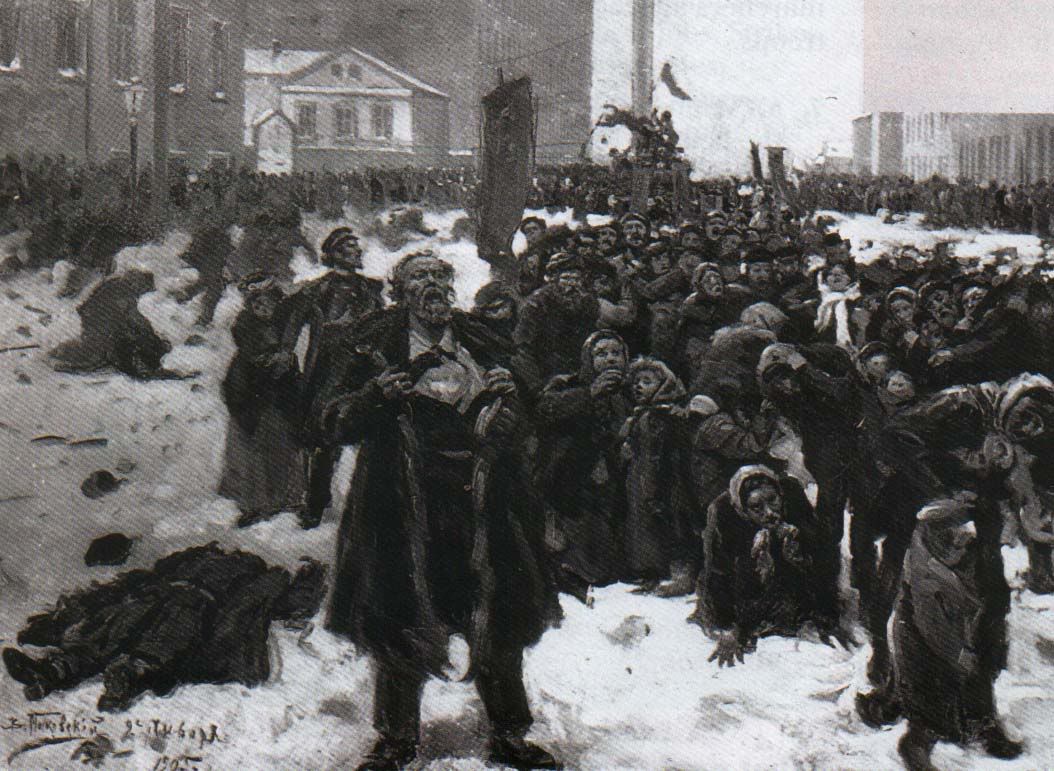
From a 2001 Rootsweb Odessa History listserve post of cousin Jerry: "Thanks for the information on Jewish owner-Jewish worker exploitation in Odessa at the time of the Revolution of 1905. My paternal grandmother, to whom I refer as Baba Rosa, was one of the female workers at Wissotzsky that you mention. She told me that she had been a leader of a strike there and after the revolt was put down served 6 months in an Odessa jail - presumably the Arestovannyy Dom - as payment for her doings. She was escorted to the lockup on foot, across town from Slobodka, commonly called Krasnaya (red) Slobodka, by two soldiers with bayonets fixed to their rifles. As a contemporaneous map of Odessa shows, the military engineer barracks was right next door to the House of Detention. (Both are now demolished and replaced with an engineering college and dwelling units. During my trip to Odessa I stood on the former site of the jail.) She was not yet married when she did her time, and her intended, my grandfather Osip Bratslavskiy, sent her letters that were smuggled into the jail in the bellies of herrings. I saw the letters in the early 1950s. They had purplish-brown stains which Baba Rosa attributed to the herrings’ juices. She also ran across an uncle of hers who, too, was an inmate. He was what we term a trustee, doing handyman jobs. "What was he in for, Baba?", I asked. "He made money" was her reply.I went on with her about how extraordinarily difficult it must have been for Jews to survive in the Tsar's Russia if they got jailed for making a living. "No, no", she said. "He made money!" After a little while I caught on to what you no doubt have already grasped. The man had been a counterfeiter. Here's a link to the complete article

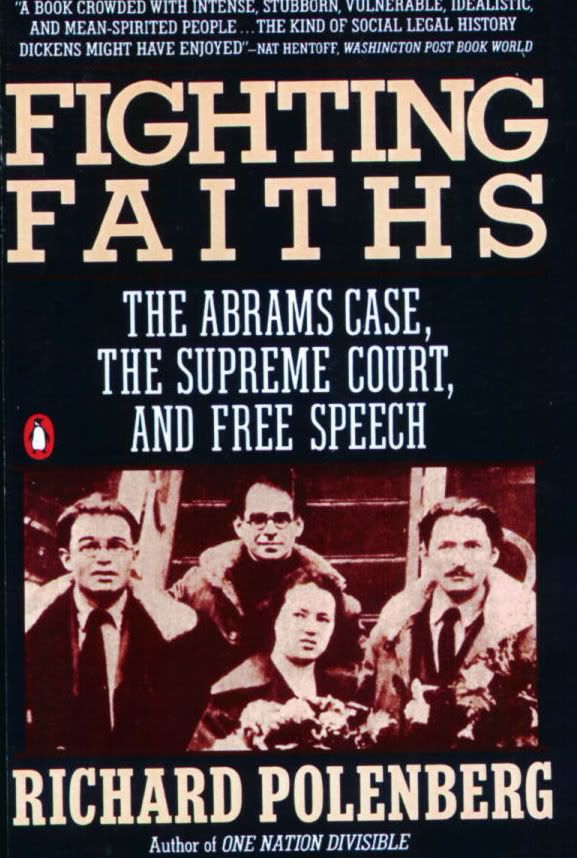
Fighting Faiths

Cousin Jerry referred me to this book. It was depressing learning how those who were arrested
(one died as a result of beatings during his arrest) suffered the rest of their lives. Are we so far away from those times in the current Patriot Act Era? Here's a review: "When it reached the Supreme Court in 1919, the case of Jacob Abrams and four other Russian-Jewish immigrant anarchists who were convicted and eventually deported in 1921 became a precedent-setting test of the First Amendment. In an impressively researched and comprehensive summary of this extraordinarily complex case, Polenberg, author of One Nation Divisible, focuses on the Supreme Court's "clear and present danger" criterion determining limits of free speech, and the reasoning behind the dissents of Justices Holmes and Brandeis, which continued to influence the extent of freedom of expression until the 1969 adoption of the broader "likeness to incite" lawless-action interpretation of the First Amendment. The author recalls the motives that led the individual immigrants to espouse anarchism and what they suffered for their beliefs. He also compares U.S. surveillance, headed by the young J. Edgar Hoover, and prison conditions with the violent confrontations and more brutal treatment to which anarchists were subjected in Russia at the hands of the Cheka (and later PGU) secret police, which disillusioned even such staunch American radicals as Emma Goldman and Alexander Berkman. However, he notes, both governments favored deportation of anarchists."

The East Harlem Connection

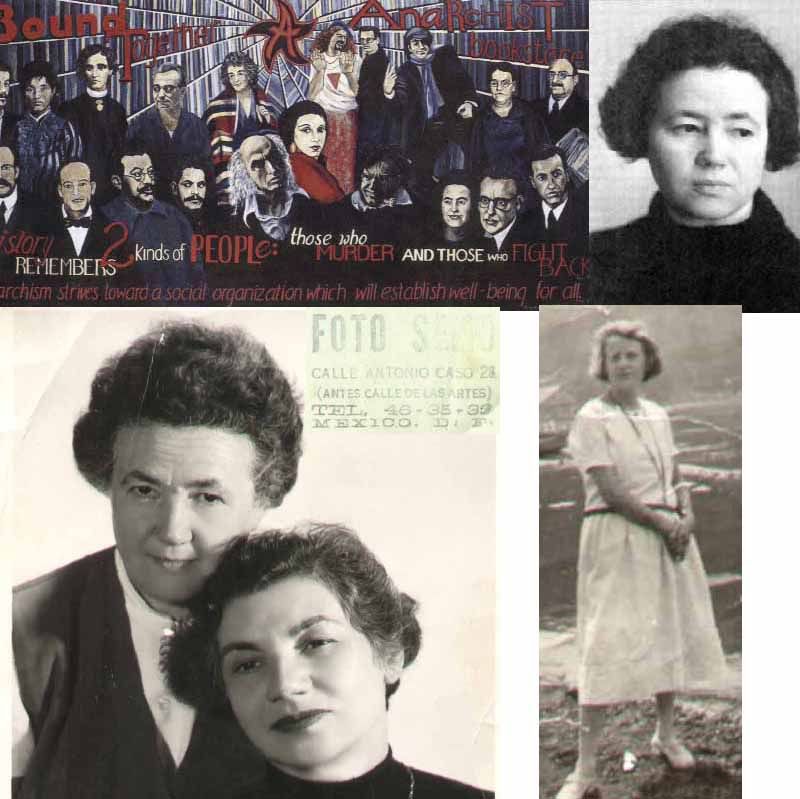
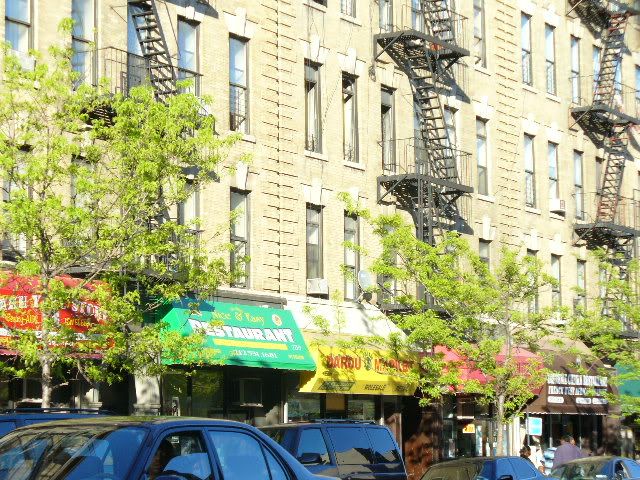
I have no historic "play" in East Harlem, but my wife does. Re famous anarchist Mollie Steimer: "Mollie Steimer was born in Dunaevtsky, Russia, on 21st November, 1897. When she was fifteen her family emigrated to the United States and settled in New York. Steimer found work in a garment factory and soon became involved in trade union activities. This led to her reading books on politics including those by August Bebel (Women and Socialism), Mikhail Bakunin (Statehood and Anarchy), Peter Kropotkin (Memoirs of a Revolutionist) and Emma Goldman (Anarchism and Other Essays). In 1917 Steimer joined the Frayhayt, a group of Jewish anarchists based in New York. Steimer shared a six-room apartment at 5 East 104th Street in Harlem with members of the group. This also became the place where the Frayhayt held its meetings and published its newspaper, Der Shturm (The Storm). The Frayhayt group were opposed to the United States becoming involved in the First World War. On 23rd August, 1918, six members of the group were arrested for publishing articles that undermined the American war effort. This included criticizing the United States government for invading Russia after the Bolshevik government signed the Brest-Litovsk Treaty. One of the group, Jacob Schwartz, was so badly beaten by the police when he was arrested that he died soon afterwards. The others, charged under the terms of the Espionage Act, appeared in court and on 25th October, Steimer was found guilty and sentenced to fifteen years imprisonment. Three of the men, Samuel Lipman, Hyman Lachowsky and Jacob Abrahams received twenty years. Many people in the United States were appalled by these sentences. This included people such as Roger Baldwin, Norman Thomas, Felix Frankfurter, Margaret Sanger and Lincoln Steffens. A group, the League of Amnesty of Political Prisoners was formed and it published a leaflet on the case, Is Opinion a Crime? Steimer and the the other three anarchists were released on bail to await the results of their appeal. Over the next few months Steimer was arrested seven times but after being held in various prisons was always released without charge. On the 30th October, 1919, she was arrested she was taken to Blackwell Island. While in prison the Supreme Court upheld her conviction under the Espionage Act. Steimer was now transferred to the Jefferson City Prison in Missouri. During this period A. Mitchell Palmer, the attorney general and his special assistant, John Edgar Hoover, used the Sedition Act to launch a campaign against radicals and their organizations. Using this legislation it was decided to deport immigrants from Europe who had been involved in left-wing politics. This included Steimer, Emma Goldman, Alexander Berkman and 245 other people who were deported to Russia. Deported to Russia on the Estonia, Steimer arrived in Moscow on 15th December, 1921. The Bolshevik government hated anarchists and soon became a target for the Russian Secret Police. On 1st November, 1922 she was arrested with her partner, Senya Fleshin and charged with aiding criminal elements in Russia. Sentenced to two years in Siberia, Steimer managed to escape and return to Moscow where she worked for the Society to Help Anarchist Prisoners. She was soon arrested and on 27th September she was deported to Germany where she joined Emma Goldman and Alexander Berkman in Berlin. With Senya Fleshin Steimer opened a photographic studio in Berlin. Steimer was also active in the Joint Committee for the Defense of Revolutionaries (1923-1926) and the Relief Fund of the International Working Men's Association for Anarchists (1926-32). When Hitler came to power Steimer and Senya Fleshin were forced to flee to Paris. When France was invaded by the German Army the couple moved to Mexico where they ran a photographic studio. Mollie Steimer died in Cuernava, Mexico, on 23rd July, 1980."
It is more than likely that my wife's great aunts, Fannie and Lisa Luchkovsky were members of the Frayhayt group. They were long time anarchist activists. Perhaps they had spent considerable time at the Easy Harlem location. Last year at a memorial service in Los Angeles I spoke to Fannie's son, Jerry, about some lost family history. (Jerry is a veritable walking treasure trove of history, baseball especially). Jerry told me about the story of Mollie Steimer. Evidently, Fannie and Lisa had to go on the lam during that time because they had also been distributing pamphlets against WWI participation. He said later in their lives they had visited Mollie Steimer in Mexico. I was going through some old pictures we had of Fannie and Lisa and I found one of Fannie with a woman who definitely looked like an older Mollie Steimer. On the back of the photo was a logo from the SEMO Studio in Mexico. SEMO must have been an abbreviation for Senya Fleshin (SE) and Mollie (MO). If you double click on the picture it will enlarge to a size where you can see it clearly. Fannie is pictured separately to the right.

Read Aloud Spartacus


The Putnam Valley library had a copy of Howard Fast's "Spartacus." I scanned one of the segments and then added a narration to it and made it into a quicktime movie. I figured I would give the kids a taste of the inspiration for the movie. One possible online assignment they could do is to try and match the story text with images they could find online. Here's my template version of it as a pdf I found the image above when I did a search for "Capua." I was also surprised to find the following on, of all places, channel4.com/realstories: "Contrary to the celebrated sequence in Stanley Kubrick's 1960 film, Spartacus, the survivors of the battle were never asked to identify Spartacus; he had died on the battlefield. The subsequent mass crucifixion scene, however, is historically accurate: Crassus had 6,000 men crucified along the Appian Way between Capua and Rome – a distance of about 200 kilometres." I'd like to still believe to in the Howard Fast version. After all, who was there doing the reporting, Fox News?

East Harlem History: The Good, The Bad, The Ugly


The good: The late, great Vito Marcantonio, the area's long time progressive Congressmen and a person deserving of a documentary movie treatment. He's pictured in the left of the picture attached. The bad, certain elements surrounding Rao's (the trendy restaurant) and the underbelly of Pleasant Ave. Pellegrino, a Rao's co-owner, is often seen as a FBI agent pursuing Tony Soprano. The ugly? Maybe Ms Maurer once did a workshop there. I've been looking for a family East Harlem connection in vain, but I think I've got something-coming soon. Here's more on the bad: The 1910 king of East Harlem rackets, Giosue Gallucci, ran a number of businesses along this stretch of East 109th Street. At 318 E 109th sat a bake shop owned by Gallucci, who lived in the apartments upstairs and used the shop's backroom as a headquarters. Gallucci also ran a coffeehouse at 336 E. 109th Street. It was there that Aniello "Zopo" Prisco allegedly gunned down Tony Zaccaro and Giuseppe Jacco and that, in later years, Gallucci and his son Luca were themselves killed by rivals. A gambling establishment at the corner of 109th Street and First Avenue was also reportedly the property of Gallucci. In addition to these business ventures, Gallucci extorted protection money from produce merchants on 109th and 110th Streets and ran a lottery. Also here's a recent voice article on east harlem controlled labor corruption by the Voice's Tom Robbins.

Strange Fruit


Listening to Strange Fruit reminded me of some very powerful passages from Striver's Row where Kevin Baker provides the background for Elijah Muhammed's conversion to the Muslim faith. The scenes take place in Elijah's (born Elijah Poole) hometown of Sandersville, Georgia where he comes upon the sights of ritualistic lynchings. Later he would see postcards of these lynchings along with packets of fabric of the clothing of those murdered and other "memorabilia" for sale in local stores. It provides the impetus or his move to Detroit. I combined some of these archived images with Billie's version of Strange Fruit. Beware of the graphic nature. Many of the images come from this excellent sight called withoutsanctuary. The images include lynchings of perceived non-black outside agitators as well. There is also a new powerful film on the murder of Emmett Till (emmetttillstory). The library of congress has series on the anti-lynching crusades of the early 1900's.The pbs site also has a story on the show it produced on the fasscinating history of the song Strange Fruit

Lena Takes The Lead


Yesterday I saw Take The Lead with my daughter Emma. Formulaic, "Fame Redux," but I really enjoyed it. Boy would I like to be Antonio Banderas ("I got plenty of play") for a day. I especially enjoyed hearing the
gorgeous Lena Horne and June Christy getting some play. Whatever happened to Lena after her Broadway special 20 years ago? I think my late friend Janie Miller saw it 5 times. Lena's almost 90 now. This is what I found out, "In 2003, ABC announced that pop star Janet Jackson would star as Horne in a television biopic. In the weeks following Jackson's so-called "wardrobe malfunction" debacle during the 2004 Super Bowl, however, Variety reported that Horne demanded Jackson be dropped from the project. "ABC executives resisted Horne’s demand," according to the Associated Press report, "but Jackson representatives told the trade newspaper that she left willingly after Horne and her daughter, Gail Lumet Buckley, asked that she not take part." Oprah Winfrey told Alicia Keys during a 2005 interview on The Oprah Winfrey Show that she might possibly consider producing the biopic herself, and casting Keys as Horne.

Saturday, April 22, 2006

Synchronicity: Billie Holiday, Knickerbocker Village, House I LIve In


The 2006 PS20 learning fair theme that I worked so diligently on (look in the August archives) for Dr.G (for naught) was to be centered around "Home." It would be a good all purpose unit, cutting across grades and curriculum themes. I even scoped out grade level fiction to support the project. I liked the title, "The House I Live In," from the Sinatra recording. Who wrote that flag waving anthem? Who wrote the lyrics to Billie Holiday's famous song decrying southern lynchings (a song counter to the flag wavers) It was Abel Meeropol, aka Lewis Allan. From spartacus.net: "In 1937 Abel Meeropol, a Jewish schoolteacher from New York, saw a photograph of the lynching of Thomas Shipp and Abram Smith. Meeropol later recalled how the photograph "haunted me for days" and inspired the writing of the poem, Strange Fruit. Meeropol, a member of the American Communist Party, using the pseudonym, Lewis Allan, published the poem in the New York Teacher and later, the Marxist journal, New Masses. 
After seeing Billie Holiday perform at the club, Café Society, in New York, Meeropol showed her the poem. Holiday liked it and after working on it with Sonny White turned the poem into the song, Strange Fruit. The record made it to No. 16 on the charts in July 1939. However, the song was denounced by Time Magazine as "a prime piece of musical propaganda" for the National Association for the Advancement of Coloured People (NAACP). Meeropol remained active in the American Communist Party and after the execution of Ethel Rosenberg and Julius Rosenberg he adopted their two sons. He taught at the De Witt Clinton High School in the Bronx for 27 years, but continued to write songs, including the Frank Sinatra hit, The House I Live In.Abel also wrote the lyrics for Billie's famous record, "Strange Fruit." The Meeropols adopted the former Rosenberg children (10 Monroe St., Knickerbocker Village). The lyrics to Strange Fruit: Southern trees bear strange fruit, Blood on the leaves and blood at the root, Black bodies swinging in the southern breeze, Strange fruit hanging from the poplar trees. Pastoral scene of the gallant south, The bulging eyes and the twisted mouth, Scent of magnolias, sweet and fresh, Then the sudden smell of burning flesh. Here is fruit for the crows to pluck, For the rain to gather, for the wind to suck, For the sun to rot, for the trees to drop, Here is a strange and bitter crop.
You can be sure if Meeropol was alive today he wouldn't be a union sellout to the fascistic Tweed steamroller.