Showing posts with label there will be blood. Show all posts
Showing posts with label there will be blood. Show all posts
Sunday, January 27, 2008


There Will Be Blood 2
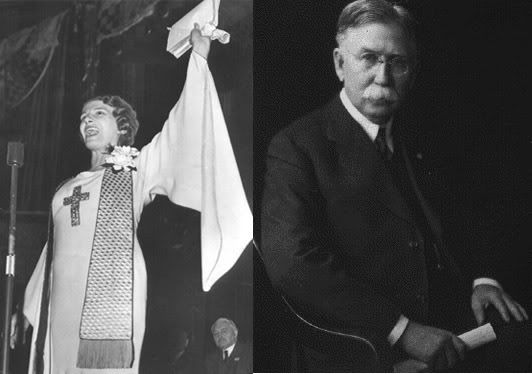 That's Aimee Semple McPherson and Edward L. Doheny in the picture. I found someone who has explained my reservations about There Will Be Blood in a way that I was unable to.
 What's Wrong With There Will Be Blood A blown chance to say something big about money and power in America By Timothy Noah
I half-agree with the near-unanimous praise for There Will Be Blood, Paul Thomas Anderson's loose adaptation of Upton Sinclair's Oil! The headline accompanying my Slate colleague Dana Stevens' review calls the film a "masterpiece." I would call it a halfterpiece. The first half of There Will Be Blood, and especially the film's dialogue-free first 20 minutes, ranks among the most thrilling moments I've witnessed on film. About midway, though, I felt that There Will Be Blood lost its clarity, for reasons that say something about the impoverished state of political discussion in the movies generally.
I haven't read Sinclair's 1927 novel, but I gather (from this Web site and others) that Anderson took from it the story of a California oil wildcatter, his son (who serves as the book's narrator), and a Holy Roller minister (who in the book is a bit more obviously a fraud and, apart from his sex, is modeled on Aimee Semple McPherson). What Anderson left out of There Will Be Blood was the son's development as a socialist in reaction against his father's corrupt capitalism. In the film, the wildcatter acquires drilling land through deception and cheats the minister out of $5,000, but in the book, he is also a systematic dispenser of bribes to politicians. Sinclair based his wildcatter on Edward L. Doheny, a fantastically successful oil tycoon in Los Angeles (Doheny Drive in West L.A. is named for him) who was disgraced in old age by the Teapot Dome scandal. Doheny, along with Sinclair Oil founder Harry Sinclair (no relation to Upton), paid hundreds of thousands of dollars to President Warren G. Harding's interior secretary, Albert Fall, in order to secure drilling rights on federal lands. Fall and Harry Sinclair went to prison, but with a team of high-priced lawyers Doheny somehow beat the rap. The Teapot Dome scandal, which first surfaced in 1922, is apparently what inspired Upton Sinclair, himself an active socialist, to write Oil!, and a fictionalized version of the scandal figures prominently in the narrative. Teapot Dome plays no role at all in There Will Be Blood.
Anderson acknowledges the Doheny link by making his wildcatter (who in the film bears the deliciously ironic name Daniel Plainview) a native of Fond du Lac, Wis., which was Doheny's hometown. Like Sinclair's fictionalized Doheny (whom Sinclair calls Joe Ross), Plainview is mostly admirable at the start of the narrative, as he builds up his oil empire, and mostly corrupt at the end. But Plainview's corruption is less well-defined than Ross'. Ross has yielded to capitalist imperatives and eventually gives up his company's independence to join a corrupt syndicate. Plainview, on the other hand, is aloof both personally and in his business (his refusal to sell out to Standard Oil is portrayed mainly as a manifestation of his mental instability); his evil is innate. The moment There Will Be Blood began to lose me can be found on Page 73 of the shooting script. "I have a competition in me," Plainview tells a man he thinks is his brother.
I want no one else to succeed. I hate most people. … I've worked people over and gotten what I want from them and it makes me sick. Because I see that all people are lazy. They're easy to take. I want to make enough money that I can move far away from everyone.
It's no small credit to Daniel Day-Lewis' extraordinary acting performance that he's able to make even these mustache-twirling lines halfway convincing. But the scene is a sign of desperation on Anderson's part. From this point in the film on, his subject ceases to be the acquisition of money and power in America and starts being the madness and cruelty of Daniel Plainview. For all I know, this shift from the physical to a psychological landscape makes Plainview a richer character than Sinclair's Joe Ross. (To repeat: I haven't read the novel.) To my mind, though, what's extraordinary about There Will Be Blood isn't the film's characters at all; it's the painstaking way Anderson lays out how the oil business works and how Plainview gets rich in it. The viewer anticipates that grand political themes will play out, but these never come to fruition.
I can understand why Anderson wouldn't necessarily want to adopt Sinclair's leftism or any sort of didacticism. It's a movie, after all, not a political tract. But in the past, movies from Intolerance to It's a Wonderful Life to Chinatown have routinely been built around the question: How does the world we live in work? The filmmaker's stance could be that of a despairing (if somewhat hypocritical) prophet, like D.W. Griffith's, or cornball-hopeful, like Frank Capra's, or darkly nihilistic, like Roman Polanski's and Robert Towne's. But one left the theater feeling that some idea about the larger society the film's characters inhabit was being set forth. In There Will Be Blood, by contrast, a promisingly broad canvas shrinks. Anderson has a little to say about the conflict between God and Mammon—his film's title is derived from Exodus 7:19 (though not the King James version, which states, less dramatically, "there may be blood")—but since the minister, Eli Sunday, and Plainview are both compromised figures, their mutual hatred carries little thematic weight. Also, Anderson never shows how Sunday becomes the big-time minister he's evolved into at the end of the movie, so the "God" end of this smackdown lacks heft.
Anderson's failure to say anything interesting or even coherent about the structure of American society is not unusual. I can't remember the last time I saw an American movie that did (excepting documentaries; gangster movies, which inherited this function from The Godfather; and the occasional movie promoting ethnic, sexual, religious, or some other form of tolerance and inclusiveness). Consider Lions for Lambs, one of the many 9/11-inspired movies that flopped recently. As Slate's Stevens pointed out in her review, that film promoted, in a lame be-true-to-your-school sort of way, greater civic involvement. But when the idealistic professor played by Robert Redford was asked by his frat-boy screw-up student why he should bother to engage when all efforts were bound to fail, professor Redford mysteriously declined to respond as any real-world political activist would, i.e, "Sometimes people like us can make a meaningful difference." Instead, he coughed up, "At least you can say you did something."
Time to film Middlemarch, shifting the locale to modern-day Cleveland?
Saturday, January 26, 2008
There Will Be Blood
An interview with Daniel Day Lewis from national public radio combined with archival photos of California oil well history
His acting was incredible, but there was something that didn't quite work with the story line. From npr:
He spent weeks in a wheelchair to prepare for his Oscar-winning performance in My Left Foot and learned how to hunt for his role in The Last of the Mohicans.d have very much to offer if my experiences really were taken from other movie sets."
Day-Lewis prefers not to break character on set and admits that it can take him weeks — if not months — to leave a part once the cameras stop rolling.
So it's no wonder that he makes so few films. His fourth in 10 years opens Wednesday. In There Will Be Blood, directed by Paul Thomas Anderson, Day-Lewis plays Daniel Plainview, an obsessive loner who hits it big in California's turn-of-the-20th-century oil rush.
Day-Lewis tells Robert Siegel that he discovers a character's voice from research, from working with the director and from just immersing himself in the screenplay.
"I'm not entirely sure how it works. Probably because there's some part of me that prefers to let it remain a bit of a mystery," he says.
"It can fray the nerves a little bit because months could go by and no voice comes to you, but at a certain moment — I might be listening to tapes, listening to different voices, allowing things to just run though me … but at a certain given moment, if I'm lucky, I begin to hear a voice and then the work becomes about trying to reproduce the sound that I hear."
While searching for Plainview's voice, Day-Lewis says he remembers "a quickening of the pulse when a sound began to resonate."
In the film, Plainview is a maniacal brute who says, "I look at people and I see nothing worth liking. I want to earn enough money I can get away from everyone." But it's not unusual for Day-Lewis to play a character whom the audience views with, at best, mixed feelings.
"I daresay, because the unconscious plays such an important part in the work, the imagination being on the front line of that … what could be more liberating than to explore with impunity the darker recesses of one's imagination and psyche?" Day-Lewis says. "I suppose that has always appealed to me, and I always am most often intrigued by lives that seem very far removed from my own. [With] Plainview, [it] wasn't the violence of the man or the misanthrope of the man that attracted me particularly, but just that unknown life in its entirety."
Day-Lewis compares the relationship he forms with his characters to a partnership in which he is the silent partner. He says he becomes the character "as far as I'm able to delude myself, believing that if I can't create that illusion for myself, then it's unlikely I'll be able to create it for anybody else."
In 2002, Day-Lewis told an interviewer, "In those quiet months before you approach the dreaded beast, you begin to enter into a world that isn't yours. People are always reading some sort of craziness into that, but it seems logical to me." He says he often feels that he has to justify what appears to others as a sort of "self-inflicted insanity."
"For me, the work is really pure pleasure," he says. "I do the work because I love to do it, not because I feel the need to punish myself. I'd do something else if I needed to punish myself."
In fact, Day-Lewis cites his love for the craft as the reason he doesn't make more movies.
"I couldn't love it as much if I did it more often, as simple as that," he says. "It's not in retreat from that work that I go in search of other things. It's with the very positive feeling that I would like to learn about other things for a while.
"And I personally believe those two lives go hand in hand. They need each other. I don't think I'
Subscribe to:
Posts (Atom)

 Posts
Posts


