Showing posts with label mountain greenery. Show all posts
Showing posts with label mountain greenery. Show all posts
Monday, June 02, 2008
Knickerbocker Village-Al Smith Greenery
Last but not least in the "May, Mountain Greenery" series of slideshow movies (in total there were 16).
I exhausted my soundtracks. I found this one in the itune store. It's by an excellent Austin based singer named Mady Kaye. She used lyrics for the song I had never heard before. Next month's theme is "I Like New York In June, How About You"


Thursday, May 29, 2008
Bushwick Greenery
Every Tuesday Knickerbocker's "Son Of Seth" joins me on walking tours of New York neighborhoods in an attempt to recapture the magic of Knickerbocker Village.
Using information from Adrienne Onofri's Walking Brooklyn we traversed the path indicated., an excerpt:
In tracing the history of Bushwick, one of the five original Kings County towns founded by the Dutch (as Boswijck in 1661), two words are bound to come up: beer and blackout. Bushwick’s brewing industry, which before Prohibition accounted for 1 in 10 beers drunk in the country, may have begun with Hessian soldiers who stuck around after aiding the king’s army in the Battle of Brooklyn, but it burgeoned in the mid-1800s, when thousands of German immigrants moved in. After World War II, Bushwick started losing both its economic linchpin and middle-class stability. Beer companies consolidated production at plants outside New York, and families fled to the suburbs. The biggest blow occurred in July 1977, when looters and arsonists laid siege to ghettos like Bushwick during a 26-hour citywide blackout. By the time the lights came on, some 35 blocks in Bushwick had been nearly destroyed and $300 million in damage done. Within a year, 40 percent of businesses shuttered; the population fell considerably

Wednesday, May 28, 2008
Northern Liberty (Philadelphia) Greenery
An interesting neighborhood in Philadelphia that my family explored over Memorial Day.
A highlight (besides the snoozing cat in the window) was the food at Honey's Sit & Eat on 800 North Fourth Street
This American Southern and Jewish fusion restaurant is a paradise for vegetarians and health-conscious individuals. It features tofu, veggie sausages, free-range eggs, organic fair trade coffees, and locally-grown produce. The dinner menu is equally good with a BYOB policy and items such as Honey’s homemade veggie burger and Honey fried chicken fingers served with scallion hushpuppies. The décor is country kitchen: hard wood floors, light green walls trimmed with flowered wallpaper and adorned with old-fashioned photos, accessorized with red and white checkered lamps. Excellent service, fantastic food, fresh ingredients, and a relaxing atmosphere are the reasons why Honey’s takes top honors in the city of brotherly love.
Mountain Greenery by Pennsylvania's own Perry Como
Merchant's Concourse Greenery
#11 in the May "Greenery" series. Visual highlights include Target and Famous Dave's BBQ. Several ex KVer's live in close proximity to this shopping mecca in Nassau County
Mountain Greenery soundtrack from
2 March 1967 (Season 1, Episode 20)
Salute to the songs of Richard Rodgers and Lorenz Hart. All music program with no spoken dialogue. Songs include:
I Could Write A Book / The Lady Is A Tramp / Little Girl Blue / I Wish I Were In Love Again - Bobby Darin, Falling in Love With Love - Bobby Darin and The Supremes, Lover / With a Song in My Heart / My Romance / Blue Moon / Manhattan - The Supremes, Where or When / Thou Swell / Spring is Here / On Your Toes - Petula Clark, Any Old Place with You - Darin and Clark, My Heart Stood Still / Glad to Be Unhappy / Here in My Arms / Sing for Your Supper - The Mamas and the Papas, Slaughter on Tenth Avenue - The Doodletown Pipers with Count Basie and His Orchestra, Dancing on the Ceiling / Give It Back to the Indians - Peter Gennaro, Johnny One Note -Peter Gennaro with Count Basie and His Orchestra, Wait till You See Her - The Doodletown Pipers, Mountain Greenery - Cast. Quincy Jones was the musical director.
Saturday, May 24, 2008
Peter Nero: Mountain Greenery
from wikipedia:
Born in Bernard Nierow i Brooklyn, New York, Nero started his formal music training at the age of seven. By the time he was fourteen, he was accepted to New York City's prestigious High School of Music and Art and won a scholarship to the Juilliard School of Music. Constance Keene, his teacher and mentor, once wrote in an issue of Keyboard Classics, "Vladimir Horowitz was Peter's greatest fan!"
Nero recorded his first album in 1961, and won a Grammy Award that year for "Best New Artist." Since then, he has received another Grammy, garnered ten additional nominations and released 67 albums. Nero's early association with RCA Records produced 23 albums in eight years. His subsequent move to Columbia Records resulted in a million-selling single and album - The Summer of '42.
His first major national TV success came at the age of seventeen when he was chosen to perform Gershwin's Rhapsody in Blue on Paul Whiteman's TV Special. He subsequently appeared on many top variety and talk shows including 11 guest appearances on The Ed Sullivan Show, and numerous appearances on Johnny Carson's Tonight Show.
Hailed as one of the premier interpreters of Gershwin, Nero starred in the Emmy Award-winning NBC Special, S'Wonderful, S'Marvelous, S'Gershwin. Other TV credits include performances on PBS-TV Piano Pizzazz and with the National Symphony in Washington, D.C. on its July 4th special titled A Capitol Fourth. Nero served as music director and pianist for the PBS-TV special The Songs of Johnny Mercer: Too Marvelous for Words with co-stars Johnny Mathis, Melissa Manchester and many members of The POPS.
Friday, May 23, 2008
Owl's Head Park Greenery
music by the Martin Hand Quartet
from nycparks
27 acres-Theories abound as to the origin of the name Owl's Head Park. The geographic explanation is that the land was once shaped like the head of an owl. Some insist that owls formerly lived here, but there is no survey or record to confirm this. A local journalist remembers a swank hotel of the same name on the corner of Third Avenue and 69th Street. The last theory derives from the fact that the estate which once nestled into the hillside had a pair of stone owls framing its entrance gate. Despite its uncertain source, the name has withstood the test of time.
Canarsie Indians, who were part of the Mohegan Nation and spoke Algonquin, lived in and around present-day Owl's Head Park. They fished in the Hudson River and New York Harbor, collected oysters on the shore, and farmed the fertile outwash plain. The first Europeans to settle this land were of Dutch descent. They established Yellow Hook, an agricultural community named for the yellow clay which leached from the shore into the water. Among these farmers, Swaen Janse, a freed slave, purchased land that included what is now part of the park.
In 1853 a group of citizens, concerned that Yellow Hook reminded people of the yellow fever epidemic, renamed the community Bay Ridge for the prominent geographic features of the area. Owl's Head Park is located on a terminal moraine that extends from New Jersey to the end of Long Island. A moraine marks the place where a glacier (in this case the 10,000-year-old Wisconsin glacier) deposited boulders, rocks, soil, and debris.
A native of Brooklyn, Henry C. Murphy (1810-1882) built his estate along the glacial ridge. The son of Irish immigrants, Murphy's political career included terms as Mayor of Brooklyn, U.S. Representative, U.S. Minister to the Hague, and New York State Senator. As Senator, Murphy drafted the bill which authorized the construction of the Brooklyn Bridge, and in 1866 he signed the bill at his mansion. He also founded The Brooklyn Eagle and was one of its first editors. Considered a founding father of Brooklyn, Murphy translated colonial sources and documented Brooklyn's Dutch heritage. Senator Street, which begins at the park, was named in his honor.
The Murphy estate was purchased in 1866 by Eliphalet W. Bliss (1836-1903). This wealthy manufacturer made his fortune by introducing and implementing techniques of mass production to the pressed metal industry. Bliss refurbished the mansion and built a horse stable and observatory tower from which one could view the bay, Staten Island, and the Orange Mountains of New Jersey. In his will, Bliss offered his million-dollar property to New York City for $835,000 with the stipulation that it would be used solely for parkland. In 1928 the land was designated a park upon acquisition of the remaining corners of the site. Although quite impressive at the time, Owl's Head Park fell into neglect, and the mansion, stables, and tower were demolished by 1940.
Owl's Head Park is now one of the premier parks in Brooklyn. Families picnic at the park in the summer, and children sled down its hill in the winter. The vista remains unmatched for watching ships enter and leave New York Harbor. Owl's Head Park also boasts an extensive collection of trees, including pines, locusts, oaks, maples, corks, beeches, and one S-shaped tulip poplar that defies gravity. In 1994, Borough President Golden and Council Member Sal Albanese, funded a $396,690 restoration which provided new playground equipment, landscaping and paved paths. What was once only the preserve of wealthy families, Owl's Head Park is now available for all visitors to enjoy.
Thursday, May 22, 2008
Wednesday, May 21, 2008
Greenpoint Greenery
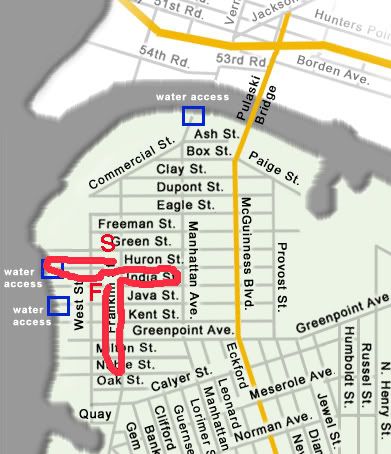 KV author and 59.5 year celebrant joined me on a Greenpoint walking tour. Using information from Adrienne Onofri's Walking Brooklyn we traversed the path indicated. Highlight's included the view from the pier, the Astral Apartments, the Mechanics and Trader's Bank and great coffee and dessert at the Brooklyn Label.
from greenpunkt
A Short History of Greenpoint Brooklyn
In 1645 the streets of New Amsterdam, at the southern tip of Manhattan, were muddy and raucous with the sound of livestock and fowl. On a small path, north of town, young girls washed linen in a stream where today Maiden Lane crosses lower Manhattan. And, after three long years of bloody conflict with the Algonquin Indian tribe, a peace settlement had finally been achieved between the Indians and the Dutch Colony.
It was in that year (1645) that Dirck Volckertsen bought a peninsula of salt marsh, meadows and sandy beachline from the Dutch West India Company. Volckersten, known as “Dirck the Norman”, built a house atop a small knoll which stood just west of the present day intersection of Calyer and Franklin Streets. The house, as was typical of early Dutch settlements, bore the influences of contemporary Dutch architecture. Construction materials were limited, and so Dirck Volckersten took the stones from the fields, and the wood from a nearby forest to build the house.
By 1777, as the American Revolution raged, four new homesteads were built on the quiet and isolated land. Two homesteads were owned by brothers (Abraham and Jacob Meserole), while the other homes were owned by Jacob Bennett, Jonathan Provoost, and Jacobus Calyer. Each of these houses abutted a plot of farm land, and their harvests were brought by family boat to market at the southern end of Manhattan.
The landscape of the point, in these early years, was significantly different than it is today. Steep bluffs, some 100 feet tall, dropped into the East River between Java and Oak Streets. Just north of present day Huron Street, formed by the outflow of Newtown Creek, a scraggly point of marsh grass extended out into the river, giving the point its name. That point is now gone, as are the many streams, with fish and blue crabs, that drained the marshes and fed Newtown Creek.
Much of this change can be attributed to the arrival of Neziah Bliss, a resolute visionary. In 1834, after having purchased some 30 acres of land, Bliss had this southern portion of Greenpoint surveyed. Although surveyed for streets and lots, the first house was not constructed until late fall 1839. The interim between survey and construction might best be explained by the isolation of Greenpoint. Prior to the completion of what was named the Ravenswood, Green-Point and Hallet’s Cove turnpike, access to the land of Greenpoint was, at best, inconvenient. The turnpike ran along present day Franklin Avenue. As with the land survey, the turnpike was predominantly funded by Neziah Bliss.
Across the river, New York City was a burgeoning metropolis. Beginning in 1820, an enormous and overburdening influx of foreigners poured into the United States, and the preferred port of entry was New York Harbour. With the vast influx of foreigners, as well as a depression settling on the cities inhabitants, crime and poverty skyrocketed. By 1832, cholera joined the army of ills besetting Manhattan. Cholera was shortly followed by fire and insurection. It is of no surprise then, that following completion of the Ravenswood, Green-Point and Hallet’s Cove turnpike that Greenpoint's population rose rapidly.
With the opening of the turnpike in 1839, Neziah Bliss next set out to establish a ferry service between Greenpoint and Manhattan. Up to this point, all conveyeance between Greenpoint and New York City, was conducted on a system of privately owned skiffs. By 1848, Bliss had procured a lease from the City of New York, and by 1850 an established ferry system departed from the base of Greenpoint Avenue to 10th street on Manhattan.
Concurrent with the opening of the turnpike and the ferry service, the formerly isolated community of Greenpoint transformed into a center for shipbuilding and shipwrights. Shipbuilding facilities sprouted all along the Greenpoint waterfront, as did houses to house the shipwrights that worked in them. By 1850, twelve seperate shipyards lined the Greenpoint waterfront, employing thousands of workers.
In response to the turnpike, shipyards, and the influx of new inhabitants, the town of Greenpoint soon developed. In 1848 the first school of Greenpoint opened near Kent and Manhattan Avenue. The first general store opened on the turnpike (present day Franklin and Freeman streets) in 1850, with the installation of gasslights to the town in 1854. Saint Anthony's church, which stands as a kind of emblem of Greenpoint, was erected in 1874.
In 1862, the most famed of all the ships assembled in Greenpoint was launched from the Continental Iron Works yard (located at Calyer and West Street). This was the USS Monitor, the world's first ironclad, turreted warship, measuring 173' long and displacing over 900 tons. On March 9th, 1862 the USS Monitor engaged with the CSS Virginia in one of the most significant naval battles of the Civil War. Although niether side decisively won the battle, naval warfare was forever changed: the history of wooden warships had ended.
Other industries established themselves contemporaneous with the shipbuilding industry in Greenpoint, including printing, pottery, gas, glass, rope, pencil and iron manufacture and production. In 1867, the Astral Oil Works refinery was built (the Astral Apartments were later built to house its employees). Soon followed the American Manufacturing Company, with its interconnecting pedestrian bridges that still cross above West street today. In 1872, Faber Pencils also opened a factory in Greenpoint (between Greenpoint Avenue and Kent Street, on Franklin).
Although the Greenpoint shipbuilding industry declined following the Civil War, other industries remained, and bouyed its economy.
Friday, May 16, 2008
Tompkins Square Park Greenery
I took these photos last May. The version of Mountain Greenery by Patti Page
Thursday, May 15, 2008
Red Hook Greenery
Most of these were taken in Red Hook Park. They were used to make the panorama in the following post. The version of Mountain Greenery is by the Joe Loss orchestra, a Great Britain based band with a long history
Subscribe to:
Posts (Atom)

 Posts
Posts


