Showing posts with label ww2. Show all posts
Showing posts with label ww2. Show all posts
Thursday, March 18, 2010
Guadalcanal Diaries 2
with the Pacific being shown on HBO. I thought I'd post this, which I never did to accompany part 1 from 3 years ago. Jon Seda plays John Basilone who was a medal of honor winner
audio from: http://www.npr.org/programs/re/archivesdate/2002/aug/guadalcanal/index.html
great image source
http://www.guadalcanal.homestead.com/
Siege Marked First American Offensive of World War II
Aug. 7, 2002 -- Sixty years ago today, thousands of U.S. Marines splashed ashore on a remote island in the southwest Pacific, called Guadalcanal. The first American offensive of World War II, their mission was to seize an airfield. What followed was six months of desperate struggle against not only the Japanese military, but heat, jungle, rain, disease and hunger.
In a two-part series for NPR/National Geographic Radio Expeditions, Neal Conan visits some of the famous battle sites and talks with veterans about the crucial struggle.


Saturday, March 01, 2008
Saturday, December 08, 2007
Day of Infamy Interviews and KV Protest In 1939
from the american memory collection at the library of congress. I added images
After the Day of Infamy: "Man-on-the-Street" Interviews Following the Attack on Pearl Harbor presents approximately twelve hours of opinions recorded in the days and months following the bombing of Pearl Harbor from more than two hundred individuals in cities and towns across the United States. On December 8, 1941 (the day after the Japanese attack on Pearl Harbor), Alan Lomax, then "assistant in charge" of the Archive of American Folk Song (now the Archive of Folk Culture, American Folklife Center), sent a telegram to fieldworkers in ten different localities across the United States, asking them to collect "man-on-the-street" reactions of ordinary Americans to the bombing of Pearl Harbor and the subsequent declaration of war by the United States. A second series of interviews, called "Dear Mr. President," was recorded in January and February 1942. Both collections are included in this presentation. They feature a wide diversity of opinion concerning the war and other social and political issues of the day, such as racial prejudice and labor disputes. The result is a portrait of everyday life in America as the United States entered World War II.
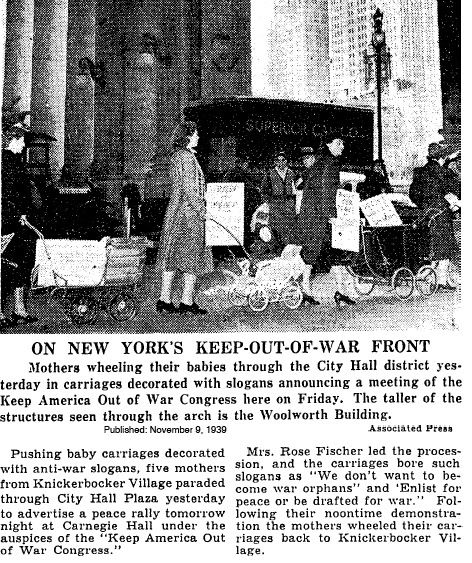
Meanwhile in November of 1939, Rose Fischer and other Knickerbocker Village mothers were campaigning, along with baby carriages, at City Hall against possible US involvement in a future war.
Sunday, December 02, 2007
Victory At Sea 2 and Victory on the Home Front for KV Hero Anna Wolkoff
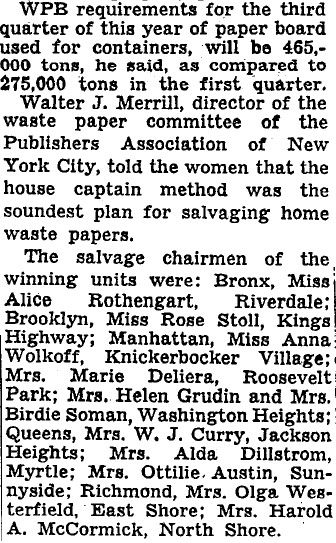
The attack on Pearl Harbor begins. While later on during the war years Miss Anna Wolkoff of Knickerbocker Village leads her team of salvagists to another kind of victory, Fron the nytimes June 27, 1945
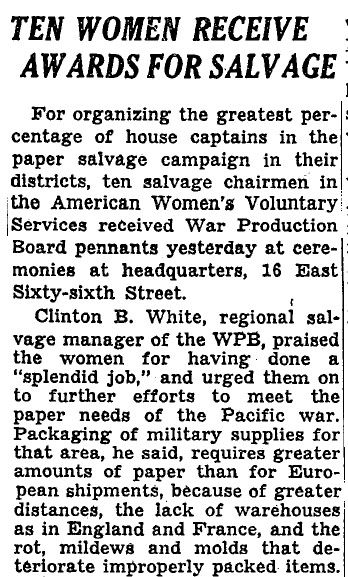 From tin can colonels and uncle sam scrappers:
During World War II, the folks back home in the United States undertook a series of conservation measures which included rationing, production of food in home "Victory" gardens for one's own use, and collections of scrap materials to be remanufactured into war materiel. The first scrap drive was for aluminum in the summer of 1941. Many different kinds of items were eventually collected, including iron, steel, rubber, copper, brass, aluminum, zinc, lead, paper, tin cans, nylon, silk, cooking fats, and rags .
There were a number of drives in 1941 and 1942, many of which involved children, but one of the more significant events occurred in June, 1942 when the popular Little Orphan Annie newspaper comic strip introduced a story line in which his plucky orphan girl decided to help the war effort by organizing children to collect scrap. For a name for her organization she adopted the name "Junior Commandos." Having had some previous military experience in single-handedly blowing up Nazi submarines(!), Annie assumed the top rank of colonel - Colonel Annie - and organized the children along military lines. Though Annie's efforts were , of course, only in the funny pages real groups, organized in the same way, were launched within a month .
Graphic Novels: Pearl Harbor
I came across a few of these titles at the Strand and bought them at a good discount.
The publisher provided free downloads of selected passages. I used the selection from Day of Infamy: Attack on Pearl Harbor to make the video above. Music: Victory At Sea If the experts would spend less money on wasteful and boring staff development and put these kinds of materials in teachers' hands kids might be interested.
From The Osprey Graphic Novels Web Site:
Osprey Graphic History present compelling true stories of war in a gripping comic strip narrative, written and developed by renowned comic book writers and illustrators, which will appeal to children and adults alike.
The stories are supported by a wealth of historical detail, including further reading on the causes and consequences of the events, the key players, a glossary of important terms and where to find out more.
Fast-paced action, historical accuracy, exciting art and comprehensive supporting materials complete these stories of momentous events in history.
The Osprey Graphic History series is a responsible, graphic treatment of great battles and campaigns in history that provides an accurate reflection of the dramatic events our ancestors lived through, in an exciting comic-strip format.
There is widespread concern about the decline in childhood reading, particularly amongst boys. By presenting historical events in a comic-book we hope that this will stimulate interest both in history and reading more about the great events that have shaped our world.
Additional material includes an Overview and Aftermath, a Who's Who, Glossary and Further Reading, all to provide further opportunities to study the battles represented in more detail.
The series is suitable for all ages, from eight upwards. Wars are terrible and devastating events that cause suffering for soldiers and civilians alike. These books present this responsibly, without glorification, but seek to explain the consequences and causes of violence in an educational way whilst honouring the courage and bravery of those who were often reluctant warriors.
The Bloodiest: Day Battle of Antietam
The Empire Falls: Battle of Midway
Surprise Attack! : Battle of Shiloh
Gamble for Victory: Battle of Gettysburg
Island of Terror: Battle of Iwo Jima
Day of Infamy: Attack on Pearl Harbor
Ironclads at War: The Monitor vs the Merrimac
Fight to the Death: Battle of Guadalcanal
The War is On!: Battle of First Bull Run
Deadly Inferno: Battle of the Wilderness
The Tide Turns: D-Day Invasion
Hitler's Last Gamble: Battle of the Bulge
Victory At Sea
KVer Howie will be celebrating his 56th birthday on December 8th and being a fellow history buff he reminded me about the "Day of Infamy" speech that occurred on December 8, 1941. In this slide show (it's hard for me to forget that I'm not teaching anymore)
I took a cartoon from the excellent site that had been created for a Virginia newspaper school supplement . It's one in a series on WW2. In order to make it visible in the 320x240 video viewer I increased the resolution using a neat photoshop add on program called Genuine Fractals PrintPro. I also made the cartoon into smaller frames. To make the KV connection more valid I added a Victory at Sea soundtrack (a great resource for Victory At Sea music) I remember watching Victory at Sea with my father on our DuMont. I'm sure it was a similar experience for my fellow KV baby-boomers.
Thursday, November 01, 2007
Flying The Hump With Max Weintraub In WW2
A clip from the talk that Max, Miguel and I had on 10/30/07 at Noah's Ark Deli on Grand St. Hard to hear at times amidst the clattering of dishes and I didn't do the best of edits. Max served as a radio operator on an air transport plane in the China Burma India Theater in World War II.
He talks about the recklessness that Generals played with the lives of their troops. In this case General Hardin insists that "The Hump Is Never Closed" so that Chiang Kai-Shek can never want for money and goods that were considered luxuries at that time.
Many images are from a Burma pilot, Bob Thompson, from a comprehensive site devoted to that theater of operations
I found General Hardin's bio. Sounds like if he were alive today he would work for Blackwater. He got medals and was buried in Arlington, but Lieutenant N.V. Meeks who
probably saved the life of Max and his crew by disobeying orders got no recognition.
I also looked up Meeks...he didn't survive the war.
MAJOR GENERAL THOMAS O. HARDIN
Retired Feb. 1, 1955. Died Nov. 1, 1968.
Thomas O. Hardin was born in Mexia, Texas, in 1894. He graduated from high school in Rockport, Texas, and later learned to fly. He was a civilian contract transport specialist with the Quartermaster Corps on the Mexican Punitive Expedition from March 1916, to January 1917. The next summer he enlisted in the Aviation Section of the Signal Corps and the following December went overseas. He returned from France in April 1919, and was discharged the following month.
In 1922, General Hardin was commissioned a second 1ieutenant in the Air Reserve and rated a pilot.
Until 1927, he was engaged in barnstorming and fixed base operations work in the Southwest. He then organized the Texas Air Transport, at Fort Worth, the first contract air mail company in Southwest, and served as vice president and general manager. Two years later, he set up the Southern Air Transport at Fort Worth, of which he was vice president and general manager. Later in 1929, these companies were merged with the Aviation Corporation, of New York City, and he was made director of operations of the corporation. In January 1930, he became general manager of the newly-organized American Airways (now American Airlines), with which he served until July, 1938, when President Roosevelt appointed him chairman of the Independent Air Safety Board.
Two years later he became vice president of Trans-World Airlines, in which capacity he served until 1941. During that time he was loaned to the Defense Supplies Corporation and made surveys of air transportation in Latin American Countries for the Civil Aeronautics Board. Later in 1941, along with others, he took over the German airlines in Ecuador, Bolivia and Peru, on behalf of the War, Navy and State departments, and early the following year took over the German and Italian airlines in Brazil and Argentina for the same departments. In April 1942, he went to Africa and India to survey air transport requirements in the Middle and Far East.
On May 9, 1942 he went on active duty as a lieutenant colonel and 11 days later was promoted to colonel. He then joined the Middle East Wing of Air Transport Command in Africa, with which he served as assistant chief of staff for operations and deputy commander until June 1943. At that time the wing split up and he assumed command of the Central African Sector headquarters at Khartoum. Two months later he was sent to India to take over operations on the "Hump" as commander of the India-China sector of Air Transport Command. On Jan. 21, 1944, he was promoted to brigadier general and assigned to the China-India-Burma Division of Air Transport Command. chabua
General Hardin, in September 1944, was assigned to command of the First Coast Wing of ATC, with headquarters at San Francisco, Calif. In April 1945, he was named commanding general of the Central Pacific Wing of Air Transport Command on Guam, where he remained until the end of World War II. On Sept. 20, 1945, he was relieved from active duty.
The following months General Hardin was executive vice president of Taca Airlines in Central and South America and in July, 1946, he was aviation consultant for several airline and manufacturing concerns in the United States and abroad.
On Oct. 10, 1947, he was recalled to duty with Air Transport Command and was separated from the service on June 15, 1948. Six days later he returned to active duty at Air Force headquarters as chief of the Air Reserve Division of the Civilian Components Group in the Office of the Deputy Chief of Staff for Operations. He retained that position when the Air Reserve Division was transferred to the Office of the Special Assistant to the Chief of Staff for Reserve Forces in November 1948.
General Hardin, in October 1950, was appointed Director of Technical Inspection, Office of the Inspector General, at Norton Air Force Base, San Bernardino, Calif.
General Hardin has been awarded the Distinguished Service Medal, Distinguished Flying Cross, Air Medal, Distinguished Unit Citation, Army Commendation Ribbon, and Chinese Certificate of Merit. He is rated a senior pilot.
Wednesday, October 31, 2007
Objective Burma, The Movie
One of the great WW 2 movies. One of my favorites Errol Flynn, along with the lower east side's George Tobias and James Brown, aka Lt. Ripley 'Rip' Masters of Rin Tin Tin fame. This is towards the end. "Oh by the way, my name ain't Joe."
Objective Burma
Released in 1945, it starred Errol Flynn. It was nominated for 3 Oscars - Best Film Editing, Best Music and Best writing. The film was not shown in Britain because of protest that the Burma Campaign was mostly British and Australian(which was true)and the movie depicts the Americans as the heroes.
This is a pretty good movie. Veterans of Burma say it looks like they went to Burma to film it when it was really filmed in California. It is about a commando raid to blow up a Japanese radar station. They miss their pickup to get out and have to walk for miles through Japanese held territory for rescue. The movie has always given me the feeling of what it must have been like fighting in that hot jungle environment.
Objective Burma 2
Someone filmed a WW2 vet talking about his experiences of "Flying The Hump" in Burma
and posted it on youtube (God Bless youtube). Max Weintraub was a radio man on one of the planes that flew over the hump
Objective Burma

Yesterday I had the pleasure of having lunch with the dynamic duo of Max Weintraub and Miguel Figueroa. I used the occasion to do a little interview with Max about his World War II experiences. Max is an incredible guy, one of the most vibrant and giving people I know and by coincidence he went to school with my father at Seward Park High. Here's a post from December 2005 with some background on Max. Max's WW2 experiences were quite interesting. He served In the Burma "Theater."
While I take time to edit the interview here's a transcript of an oral history I found of Louis Jimenez on the hbo site constructed for Band Of Brothers:
Louis Jimenez
San Antonio, TX United States
124th Cavalry/Medical Unit/T4
United States Army
I volunteered for the draft on November 21st, 1940, a few months after President Roosevelt ordered registration for military service of all male citizens eighteen years old or older. We were the first volunteers to leave San Antonio, Texas pursuant to the President's order. I was assigned to the medical detachment, veterinary section at Fort Brown, an old cavalry post on the Mexican border in Brownsville, Texas. I had volunteered for one year, but due to an error on my discharge certificate I was not discharged on November 21st, 1941. Along came December 7th and the attack on Pearl Harbor and I didn't see that beautiful discharge certificate until FOUR years later. And here I was engaged to be married after my year of service.
For the next 2 years, other than Fort Brown, Brown, I was stationed in Fort Ringold, Rio Grande City and Fort D.A. Russell in Marfa, Texas where we made sixty mile one day horse rides to Presidio, Texas on the Rio Grande. All this time the 124th Cavalry was in manuevers, practicing and studying Cavalry tactics.
In May 1944 we and the horses were sent to Fort Riley Kansas where the horses were to remain, while we were sent to Camp Anza, California.
On July 25th we left the USA from San Pedro, California aboard the USS General Butner. Crossed the International Date Line on August 3rd, 1944. Arrived in Bombay, India on August 26th via Melbourne, Australia after crossing the equator twice. Looking at the Indian coast before arriving, there is something silent and mysterious about the Far East. Left Bombay the same day by train going east across India. The very small boxcars could barely handle twelve GIs and their equipment despite the fact there was a sign above the door of each car that read "Capacity 42".
On September 1st we arrived at Ramgartown, Province of Bihar, India, 281 miles north of Calcutta. This is the place where the Merrill Marauders jungle-trained before their encounter with the Japanese. And this is the place where the 124th Cavalry became the 124th Cavalry Special. "Special" because there were no horses, and all those years of cavalry training and mounted tactics are to be erased from your mind. "You are now jungle fighters. In a month from now you will be experts in the jungle. You will challenge the craftiest jungle fighters in the world, the Japanese. But you will be ready. Remember this is not practice, this is the real McCoy."
On September 26th left Ramgartown by train headed northeast, crossed the Brahamaputra River on a ferry. There had been a flood up river, there were human bodies floating down stream. Boarded a train going east and arrived the following day at an airport near Ledo, India. On November 1st we boarded C-47 (Rice Plane) flew over the battleground of the Burma retreat of General Stillwell and landed in Myitkina, Burma. The town had been bombed considerably, few buildings are standing. We were warned that the enemy was close.
On December 18th, 1944 after more jungle training, we left on what was going to be a 350-mile foot hike south, through the Burma hills. Other than a full pack on our backs, each of us was pulling a loaded pack mule with medical supplies, temporary ammunition and chests of other emergency supplies needed on such an unforeseeable journey. Food and ammunition were air dropped about every three days. There were times, at least once, that the supply plane, due to wind and rain, missed the target and we had to go without food for three days. Also prior to that, to be more accurate, the supply planes had flown at lower altitude, but some of the kickers on the plane had been wounded by ground fire by Japanese soldiers, so they had to fly at a higher altitude. Later we found dead Japanese soldiers with new GI combat boots and other American items. Enemy contact was constant.
On December 25th - Merry Christmas - we washed our clothes. of the 124th Cavalry, the 275th Infantry known as the "Mars Task Force" with the help of the 30th and 38th Chinese Divisions was to take control of the Burma Road. The road was thick with Japanese vehicles and the Japanese artillery was heavy, firing constantly. Casualties were light but constant. By then I was converted from a veterinary technician to a human first aid medic.
On February 2nd, a Japanese observation post on a hill had to be taken. Lt. Jack Knight, from Weatherford, Texas, Commander of F Troop of the second squadron of which I was attached, was leading the attack. while going up the steep hill, with fire coming out of several
On January 31st, 1945 arrived at Nam Packa, Burma confronted the enemy and saw the Burma Road for the first time.
The Burma Road was important because it was the only land link between China and Burma-India. The other link was by air by flying over the "Hump". The Japanese were in control of the "Road". The mission pill boxes on top of the hill, Lt. Knight was wounded several times but kept on going, throwing hand grenades into pill boxes. After disabling several boxes he was fatally shot. His First Sergeant, his brother, Curtis, was seriously wounded. Casualties were heavy. I noticed that among the most seriously wounded or dying soldiers, the word "Mother", "Mama" or among Hispanics "Ama" was murmured more than any other names.
Due to the actions of Lt. Knight, his brothers and the troopers, the hill was taken, but what a heavy price. Vice Admiral Louis Mountbatten, being at the time Viceroy of India, promised to name the hill "Knights Hill" in honor of our Commander. Lt. Knight was later awarded, posthumously, the Congressional Medal of Honor, the only one awarded in the China-Burma-India Theater of Operations. Other battles by the Marsmen that helped end the Central Burma campaign were in Tomkwa and at Hosi Valley. The British coming from the south had taken care of southern Burma - Rangoon and Mandalay. The Burma Road was opened to the Allies.
On March 11th, 1945 we resumed our long walk south to Lashio and arrived on the 15th. On the 7th of April left Lashio, headed north on trucks, arrived in Myitkyina of the 17th. Rumor had it that I and some other troppers from the 124th Cavalry and mule skinners from a Quartermaster pack outfit are to drive or herd all the mules used in the campaign, to Kunming China, a distance of over 800 miles of steep climbs at the foothills of the Himalayas.
On May 28th, 1945 converted back to a veterinary technician. I mounted a scrawny mule, with nine other mounted muleskinners, and our leader, Lt. Johnson. The Lieutenant would ride a beautiful mare with a bell on its neck, leading the pack, and the mules would follow. The rest of us would ride on the sides and rear. It wasn't that easy, mules are stubborn, especially your riding mule. We were trailblazers, the first bunch to take off from Myitkyina. Thereafter, to avoid congestion on the road, fifty mules The rest of us would ride on the sides and rear. It wasn't that easy, mules are stubborn, especially your riding mule. We were trailblazers, the first bunch to take off from Myitkyina. Thereafter, to avoid congestion on the road, fifty mules and ten men would leave Myitkyina every two or three days until the approximate 700 mules are on the road.
We were to ride southeast on the Ledo road, also known as the "Stillwell Road" named after General "Vinegar Joe" Stillwell, which connects with the Burma Road beyond the Burma-China border.
On June 12th arrived at Lung Ling, China on the Burma Road. This is the trail Marco Polo traveled some 700 years before. The trail was steep and the rock paving was as slick as ice and the monsoon rains did not help.
On June 17th we arrived at the Salween River. The Salween Valley was so hot and humid that it made breathing difficult. With all of that, it helped understand the description Marco Polo gave of the valley in 1272 when he said "During the summer season the atmosphere is so gloomy and unwholesome that merchants and other strangers are obliged to leave the district in order to escape death".
On July 6th we arrived at Hsia Kwan and this is what Marco Polo had to say about this place. "Before the time of becoming subject to the dominion of the great Kahn, Kublai Khan, these people were addicted to the following custom: When a stranger of superior quality, who united personal beauty with distinguished valor, happened to take up his abode at the house of one of them, he was surrendered during the night, not for the sake of his money, but in order that the spirit of the deceased endowed with his talents and intelligence, might remain with the family and all their concerns might prosper. Accordingly that native was accounted fortunate, who possessed in this manner the soul fo any noble personage, and many strangers lost their lives in consequence."
Arrived at Tshou Hsiung on July 13th and left the same day. Marco Polo said about this place "In this country there are salt springs, from which all the salt used by the inhabitants is procured."
On July 15th we arrived at Tsu Yung. For some unknown reason, they held us there longer than any other place. We thought perhaps the Chinese were not ready for the mules.
On August 6th, the atomic bomb was dropped on Hiroshima and three days later another one was dropped on Nagasaki. It seemed like the War was coming to an end. All of a sudden we were brought back to life from an unending hopelessness. I thought about my parents heir prayers and mine are about to be answered. I had not received a letter from them or from anybody in nine months. I heard that I had a duffel bag full of mail following me but it never caught up with me.
On September 2nd, when General MacArthur and other allied leaders were accepting the Japanese surrender we were ordered to destroy the mules. At times we were impatient with them and cussed them for being stubborn or slow but when we heard that we had to kill them, there was a wave of pity and genuine love for them. During the Burma campaigns they used to shake and tremble with gunfire and artillery fire as we did. They carried hundreds of pounds on their backs for hundreds of miles, climbing and descending steep hills during the rainy season and this will be their reward? To top it off, I was chosen to be one of the executioners. I am and have been against the death penalty for all creatures. This is cruel. After a talk of how they would starve in China if left alive, it made the choice a little easier.
In that part of China there are deep gullies on the ground. We took the mules to the edge of the gully one by one, shot them and rolled them over the edge. When there were enough down there, we moved further down. When through, the banks were blown in.
Left this dreadful place on September 13th on trucks and arrived at Yu Nan Fu, better known as Kunming, China.
Left Kunming, China on September 18th, headed for Calcutta, India. While over Burma one of the engines caught fire and an emergency landing was made in Bhamo. Took a C-54 and landed in Calcutta on September 19th. Left Kamchapara (Calcutta) on October 4th and started to board the USS General Hodges. On the 5th at 15:00 still loading troops including general prisoners. On the 7th we finally left the dock and were in deep water at 21:00. The Bay of Bengal is very calm. Sighted the Island of Ceylon (Sri Lanka). Passing within sight of Minikoi Island 16:30 October 11th, a leper colony, and on the 14th entered the Gulf of Eden and saw Cape Guardafui on the north-eastern corner of Africa. On the 15th entered the Red Sea and on the 18th entered the Suez Canal which was opened in 1869. On the 19th arrived at Port Said and entered the Mediterranean Sea at 7:00. On October 22nd at 2:00 passed through the Malta Channel between Malta and Sicily. Saw Pantellaria (10:00), Cape Bon (14:00) and Bizerte (17:00). On October 23rd sighted Algiers and passed through the Strait of Gibralter on the 24th at 11:00. Saw the lights of Cape San Vicente Portugal, the last sight of Europe at 21:00.
On October 30th we are in a storm in the Atlantic. The Hodges is thrown 12 miles off course, speed 12.7 knots.
On November 1st, 1945 at 17:29 I saw the blurred outline of the Statue of Liberty. It was blurred by the tears in my eyes.
During my darkest days in the Burma jungle, and there were many, I had some serious doubts that I would see this beautiful scene. I must confess that at times my Catholic faith faltered, when expecting the worse, but when those moments passed, it came back stronger. I felt better with a medical kit to save lives than with a powerful weapon to destroy them.
After leaving California, spending 31 days in the ocean to reach Bombay, and again 26 days from Calcutta to New York completing the trip around the world and be met by the symbol of liberty, the emotion was overwhelming.
I was discharged November 10th, 1945 at Fort Sam Houston in San Antonio Texas. I emotionally kissed and embraced my loved ones who had been praying for me.
I had served five years less eleven days.
Awards: 1 Bronze Star Medal, Combat Medal Badge, Asiatic-Pacific Campaign with 2 Bronze Stars, 2 Overseas Service Bars, 1 Service Stripe, American Defense Service Medal, Americn Theater Campaign Medal and a Good Conduct Medal
Tuesday, October 16, 2007
Air Force
Resurrected from my lost youtube collection. In my opinion, one of the best WW2 movies ever, with two sons of the Lower East Side; John Garfield (Julius Garfinkle)who was born on the LES and later moved to Brownsville and then the Bronx. Also George Tobias, born Abner Kravitz in 1901. from wikipedia:
Air Force is a 1943 Academy-Award-winning movie directed by Howard Hawks. It starred John Garfield, John Ridgely, Harry Carey, George Tobias, Gig Young and James Brown (later famous as Lieut Rip Masters on Rin Tin tin
The film details the story the crew of the Mary-Ann, a B-17 bomber, in the early days of World War II. It begins with a flight from California to Hickam Field at Pearl Harbor, Hawaii, beginning on December 6, 1941. The unarmed B-17 squadron arrived right at the beginning of the Japanese attack (This really happened; radar operators thought the Japanese planes they detected was the incoming flight of B-17s). It portrays John Garfield as a disaffected gunner who was washed out of flight school after a mid-air collision where another pilot was killed. Harry Caray has a very effective role as the Mary-Ann's crew chief and a long time veteran in the Army Air Corps with a son who is a pilot. Made in the early days of World War II, there is quite a bit of anti-Japanese propaganda. The crew is shot at by "local Japanese" on Maui and the Hickam Field. Their commander tells the crew that vegetable trucks knocked the tails off a row of P-40 Warhawk fighters as the attack began. As detailed in Walter Lord's book, Day of Infamy, later investigations proved no Japanese-American was involved in any sabotage during the Pearl Harbor attack.
In this heart wrenching scene, the crew says their goodbye to their mortally injured Captain.
Sunday, October 14, 2007
WW2 In Cartoons: Yankee Doodle Mouse
From wikipedia:
"The Yankee Doodle Mouse is a one-reel animated cartoon short subject in the Tom and Jerry series, produced in Technicolor and released to theatres on June 26, 1943 by Metro-Goldwyn Mayer. It was produced by Fred Quimby and directed by William Hanna and Joseph Barbera, with musical supervision by Scott Bradley and animation by Irven Spence, Pete Burness, Kenneth Muse and George Gordon.
The short features Tom and Jerry chasing each other in a pseudo-warfare style, making numerous references to World War II technology such as Jeeps and dive bombers. The Yankee Doodle Mouse won the 1943 Academy Award for Best Short Subject: Cartoons, making it the first of seven Tom and Jerry cartoons to receive this distinction.
In a cellar, Jerry is pursued by Tom, rushing into his Cat Raid Shelter, or mouse hole. Tom peers into the hole, in frustration. Jerry launches a tomato from a mousetrap, which goes splat into Tom's face. Jerry climbs up the wall and grabs a handful of Hen Grenades, or, to the uninitiated, eggs. As Tom wipes the tomato off his face, he is promptly covered in egg. Jerry reaches a case of champagnes and shoots off the corks, hitting Tom in the face and sending him into a tub of water, floating in a pot. Jerry launches a brick from a spatula, which crashes into the pot, sinking the cat. A communique reads "Sighted cat - sank same. Signed, Lt. Jerry Mouse."
Jerry uses a brassiere as a makeshift parachute in The Yankee Doodle Mouse.
Later on, Jerry observes Tom through a makeshift plumbing pipe acting as a periscope. Tom approaches Jerry's hole, mallet in hand. Jerry opens the ironing board cupboard, and the board wallops Tom. The mouse charges down the board in a jeep/cheese grater, tearing Tom's fur as the grater speeds past him. However, Jerry's jeep crashes into a wall, sending a sack of flour tumbling down. Jerry grabs the sack and runs across the room, with flour billowing out behind him, as a smokescreen. Tom can barely see through the thick smoke, and Jerry, who can see (as the flour begins just above his head), repeatedly smacks Tom in the rear with a board.
Tom, wearing a bowl for a helmet, throws a stick of dynamite towards Jerry, who immediately throws it back to Tom. The lit firecracker exchanges hands repeatedly until Jerry tricks Tom into wanting it. The cat snatches the dynamite back, proudly holding it in his hand, until it explodes. Jerry jumps into a kettle, which Tom approaches and throws another firecracker in. Jerry panics and escapes through the spout. Tom opens the kettle lid and sticks his entire head in. The explosive device goes off, leaving Tom in blackface, with a flower appearance.
Tom launches a paper aeroplane with a firecracker hidden inside, but Jerry blows it back and it lands beneath Tom, exploding once again. Later, Jerry plants an enormous stick of dynamite behind Tom. Tom sees the bomb and screams. However, the firecracker splits into half, to reveal a smaller one, which peels away, and pops open harmlessly to reveal successively smaller sticks of dynamite, leaving behind a minuscule replica of the original firecracker. Tom picks it up, believing it to be harmless, but the dynamite explodes powerfully.
Jerry tricks Tom to tie his own paws to his rocket in The Yankee Doodle Mouse.
Jerry jumps into his plane, which is fashioned from a box. He drops a succession of light bulbs onto an unsuspecting Tom, which explode on his head. He then launches a banana torpedo into the cat's face. Tom grabs a firecracker launcher and skillfully shoots down Jerry's 'plane.' Jerry hurtles towards the floor, but then his parachute, a brassiere, opens up, and he floats down gently. He races into his hole, and Tom pushes the cannon into the same hole, as the mortars chase after Jerry through the cellar, into a hose, which Jerry targets towards Tom, watching confidently from inside a barrel. The barrel explodes, leaving Tom riding the remaining parts of the exploded barrel as a bicycle, crashing into the wall.
Tom then fires a dart gun at Jerry, catching him by the tail as he attempts to dive into his mouse hole. Tom grabs Jerry and ties him to a rocket, which he lights up. However, Jerry ends up helping Tom to tie himself up. Jerry emerges from the ropes and waves to Tom as the rocket shoots up with a helpless Tom, and explodes in the air, provoking a set of fireworks overlooking the American flag. Jerry proudly salutes the flag, and we see another war communique: "Send more cats!"
Saturday, October 13, 2007
WASPs: Women Pilots of WWII
UFT President Randi Weingarten finally came out of the closet. Congratulations to her, but she's not a hero of mine. I'm sure some of these women might have been gay, they were heroes.
The half-hour documentary begins in the early 1940s when the Army Air Force faced a dilemma: It needed thousands of newly assembled airplanes delivered to military bases, but most of America's pilots were overseas fighting the war. To solve the problem, the government launched an experimental program to train new pilots -– the Women Air force Service Pilots, or WASPs. Drawn from more than 25 hours of interviews and archival tape, the documentary The WASPs presents an oral history of the pioneering program and pilots.
My main image source for the video accompaniment
The WASPs is only one of more than 25 radio documentaries Richman has produced –- many of them "radio diaries" where the subjects turn the mikes on themselves and record their own aural journal entries. Critics praise the technique, and Richman's use of it. "Mr. Richman's recorded 'Diaries' are sometimes eerily intimate," says one, "with the audience entering into a closer bond with the person on tape than is possible perhaps in any other medium, including documentary film." And another commends Richman as "a radio Boswell, a biographer who stands aside and lets his subjects do the talking."
Exclusively for npr.org, Richman tells the stories behind the making of the documentary The WASPs.
npr.org: What planted the seed for a project on World War II women aviators?
Richman: It's always strange how stories begin. Usually we go out looking for stories, but sometimes the stories come looking for you. That was the case with the WASPs. Teal Krech, who I work with at Radio Diaries, came to work one day with a page from her high school alumni magazine. She had ripped out a small profile of a woman who had graduated from this high school 60 years earlier. There was a photo from 1943 that showed a tough and beautiful woman in a leather bomber jacket leaning against a huge plane -- it was a B-25 -- and there was a look in her eyes. The photo told all you needed to know about the WASPs.
How many of these WASPs were there at the height of their service, about how many of them are still alive today -- and how did you go about finding them?
The Air Force was looking for pilots to do some of the domestic jobs -- ferrying airplanes, testing airplanes, towing targets for anti-aircraft practice -- and to take the place of men who were going to combat. In 1941 there were about 3,000 women who had a private flying license. So that's where the Air Force started to look. By the end of the two-year WASP experiment, 25,000 women had applied for the program, 1,800 or so had gone through basic training, and 1,074 graduated.
Of the graduates there are, I think, about 600 still alive. And judging from the 50 or so that we met (about half of whom we interviewed), they are all strong-willed, independent, wonderful, kick-ass women.
When we started to research the story, we found out that in about two weeks, many of the women were going to be meeting in Tucson for a reunion. So our timing was very lucky. We met most of the women we interviewed at the reunion, but also did more interviews with WASPs around the country in the months that followed.
We had to do so many interviews because the documentary has no reporter or narrator (the style we usually work in). The story is told entirely in the voices of the women who flew in World War ll. In the end, we had about 30 hours of interviews, plus tons of wonderful archive newsreel recordings. The newsreels are wonderful and cheesy. It seems that each time Fox Movietone or whoever came to do a story about the WASPs in WWll, there had to be a scene where the women pilots relax in their bathing suits.
What sort of experiences did your interview subjects share about being women in a distinctly male domain?
Well, they all have different views on this. Most of them say it was pretty tough, that some of the men didn't like the idea of women pilots -- especially if the women were getting some of the "good" jobs. But all the women talk about their WASP experience as a magical bubble -- a lucky accident of history -- that allowed them to fly planes that women otherwise would not fly until 1976. That was the year the Air Force finally let women in.
I think it's a classic WWll story for many of these women: The war gave them experience and training that they would not have had otherwise. But when the men came back, the women were expected to leave the factories -- and airfields -- and return home. As one of the WASPs, Kaddy Steele, said, they didn't want to return to housekeeping or the Junior League. But after the war there weren't many jobs for women pilots.
What's your favorite close-call story from these interviews?
There are so many amazing stories -- and of course, like any documentary, so many that never get into the final piece.
Dora Strother tells the story of being one of two women to fly the B-29. It was a brand new plane, the bomber that would later drop the bomb on Japan. But at the time, it was getting a bad reputation at the training bases because of engine fires, and the men didn't want to fly it. So combat test pilot Paul Tibbets had the idea to train two women to fly the B-29 to show the men "how easy it was." (Tibbets subsequently led the crew of the Enola Gay that dropped the first atomic bomb on Aug. 6, 1945.)
Many of the women had interesting close call stories. And, of course, there were some who were killed -- engine failure, collisions, etc. Over the two years of the WASPs, 38 women were killed -- flying back then was a pretty dangerous thing to do.
Tell us about the WASP you met who's still flying, and your outing with her.
The documentary starts and ends with Elizabeth Eyre Taylor from Massachusetts, who still flies at the age of 79. When we heard that some of the women still fly, well, we knew it had to go in the story. So we went up with her.
It was amazing. And a bit scary. Those small planes are pretty skittish -- or was that me? Taylor doesn't fly much anymore, but she also says she has no plans to stop, ever. She's been flying an airplane for 60 years -- so I guess we were in good hands.
The documentary The WASPs was produced by Joe Richman, Teal Krech and Shelley Preston. Editors were Ben Shapiro and Deborah George
What Is America To Me?
There's more to say on the saga, but I want to step away for now and hopefully be judicious as a result.
Maybe this will be cleansing. I had this slide show in my WW2 archive from two years ago and now "google videoed" it, after trying to improve the visibility of the text.
The song has an interesting history.
"The song "The House I Live In" was a patriotic favorite of World War II. The melody was written by Earl Robinson, a famous leftist composer who was blacklisted in the 50's. The lyricist was Lewis Allen, whose real name was Abel Meeropol, the same Meeropol who became the adopted father of the Ethel and Julius Rosenberg's boys, Michael and Robert. Abel Meeropol wrote the song. "Strange Fruit," made popular by Billie Holiday. "The House I Live In" was a perennial favorite at both Republican and Communist conventions.
What is america to me
A name, a map, or a flag I see
A certain word, democracy
What is america to me
The house I live in
A plot of earth, a street
The grocer and the butcher
Or the people that I meet
The children in the playground
The faces that I see
All races and religions
Thats america to me
The place I work in
The worker by my side
The little town the city
Where my people lived and died
The howdy and the handshake
The air a feeling free
And the right to speak your mind out
Thats america to me
The things I see about me
The big things and the small
That little corner newsstand
Or the house a mile tall
The wedding and the churchyard
The laughter and the tears
And the dream thats been a growing
For more than two hundred years
The town I live in
The street, the house, the room
The pavement of the city
Or the garden all in bloom
The church the school the clubhouse
The millions lights I see
But especially the people
- yes especially the people
Thats america to me
Wednesday, October 10, 2007
This Isn't The Army Mr. Negrin
Ok, ok, I said no more WW2 songs but then I forgot that I didn't tap the great Glenn Miller Army Air Corps Band library. The context of this posting: The folks at the Kehila Kedosha Janina Museum are planning a Veteran's Day Exhibit:
"We are now collecting memorabilia and photos for a new exhibit scheduled to open on November 9, 2008. In anticipation of Veteran’s Day, we will be honoring our community who served their country during the Second World War. We have already collected photos of patriotic parades and speeches on the Lower East Side, some taken in front of Kehila Kedosha Janina. Please share with me any photos you have of yourself or family members [in uniform] and information about there service during WWII. We would also appreciate the loan of war medals."
I thought I would contribute (my father, a Janinite, was 4F due to rheumatic fever in WW2) images of WW2 draft cards for this exhibit. I searched for typical Greek Romaniote names like Negrin, Eskenazi, Matsil, Coffina, etc with the idea of printing them out, high resolution for a display. The images available online (at ancestry.com) are only the supplemental "old men" draft cards:
"The U.S. officially entered World War II on 8 December 1941 following an attack on Pearl Harbor, Hawaii. Just about a year before that, in October 1940, President Roosevelt had signed into law the first peacetime selective service draft in U.S. history, due to rising world conflicts. After the U.S. entered WWII a new selective service act required that all men between ages 18 and 65 register for the draft. Between November 1940 and October 1946, over 10 million American men were registered.
This database is an indexed collection of the draft cards from the Fourth Registration, the only registration currently available to the public (the other registrations are not available due to privacy laws). The Fourth Registration, often referred to as the "old man's registration", was conducted on 27 April 1942 and registered men who born on or between 28 April 1877 and 16 February 1897 - men who were between 45 and 64 years old - and who were not already in the military."
Information available on the draft cards includes:
• Name of registrant
• Age
• Birth date
• Birthplace
• Residence
• Employer information
• Name and address of person who would always know the registrants whereabouts
• Physical description of registrant (race, height, weight, eye and hair colors, complexion)
Anyway, I tried my best to get the resolution good enough to view in the 320 X 240 google video screen. What's interesting to me is to see where this group of Sephardic elders, who never were called upon thankfully in WW2 (I stuck in a few yids and others) moved to from their original Lower East Side immigrant locations. Mostly to the Bronx it appears and to Bensonhurst, Brooklyn. Looks like a Google Map project for me. Oh yes, the song lyrics:
We all have been selected from city and from farm
They asked us lots of questions, they jabbed us in the arm
We stood there at attention, our faces turning red
The sergeant looked us over and this is what he said:
This is the Army, Mister Jones
No private rooms or telephones
You had your breakfast in bed before
But you won't have it there any more
This is the Army, Mister Green
We like the barracks nice and clean
You had a housemaid to clean your floor
But she won't help you out any more
Do what the buglers command
They're in the Army and not in a band
This is the Army, Mister Brown
You and your baby went to town
She had you worried but this is war
And she won't worry you anymore
Sunday, October 07, 2007
Off We Go Into The Wild Blue Yonder
I think I'm about finished with my obsession with WW2 songs. I felt compelled to use thus as a backdrop for a great source for paper model builders of war related stuff I think kids would enjoy this as a
connection to any WW2 study. Some artist contributed work is better than others and the airplane models are pretty good. I use Crobsy's version of the Air Force song. I wasn't aware it had so many variations
Off we go into the wild blue yonder,
Climbing high into the sun;
Here they come zooming to meet our thunder,
At 'em boys, Give 'er the gun! (Give 'er the gun now!)
Down we dive, spouting our flame from under,
Off with one helluva roar!
We live in fame or go down in flame. Hey!
Nothing'll stop the U.S. Air Force!
Additional verses:
Minds of men fashioned a crate of thunder,
Sent it high into the blue;
Hands of men blasted the world asunder;
How they lived God only knew! (God only knew then!)
Souls of men dreaming of skies to conquer
Gave us wings, ever to soar!
With scouts before And bombers galore. Hey!
Nothing'll stop the U.S. Air Force!
Bridge: "A Toast to the Host"
Here's a toast to the host
Of those who love the vastness of the sky,
To a friend we send a message of his brother men who fly.
We drink to those who gave their all of old,
Then down we roar to score the rainbow's pot of gold.
A toast to the host of men we boast, the U.S. Air Force!
Zoom!
Off we go into the wild sky yonder,
Keep the wings level and true;
If you'd live to be a grey-haired wonder
Keep the nose out of the blue! (Out of the blue, boy!)
Flying men, guarding the nation's border,
We'll be there, followed by more!
In echelon we carry on. Hey!
Nothing'll stop the U.S. Air Force!
Notes: Crawford didn't write "Hey!"; he actually wrote "SHOUT!" without specifying the word to be shouted. Wherever they appear, the words "U.S. Air Force" have been changed from the original "Army Air Corps." Words in parentheses are spoken, not sung.
Saturday, October 06, 2007
Gone With the Draft
Back to WW2. This song was featured in the Burns' documentary. I tried the best that I could to match it with images pertaining to the draft and recruitment. American Memory at the Library of Congress was a source, but I always find that a difficult one to search.
Not many folks know how great a jazz instrumentalist Nat King Cole was before his fame as a vocalist. This goes back to the early 40's. The lyrics:
Gone, gone, gone with the draft,
Gone, gone, gone with the draft...
When skinny me went out with my honey, the boys all started to laugh;
But now it's not so funny - they're all gone with the draft.
As a shiek, I can't be beat - the boys all hand me a laugh.
But since I have got flat feet, I'm not gone in the draft.
(Bridge 1:)
I used to envy the fellows who had such fine physiques;
But all they can say is "Hello" on seven-fifty a week.
When the boys get back and see how I'm doin',
they'll be sorry they laughed;
'Cause one can't keep on wooing and still be gone with the draft.
(Instrumental Interlude: 1 Verse, 1 Bridge and 1 Verse)
When Franklyn D did sign the draft, the cats all had a chill;
The boys turned pale and ceased to laugh, 'cause this is a serious bill.
They now realize that skinny me was the luckiest one of all,
Who can stay at home with Minnie, while they face the cannon balls.
(Bridge 2:)
So boys, take it on the chin, and always wear a smile;
You'll find it hard to win carryin' fifty pounds for miles.
When your year of drill is up, you get your calves discharged,
You can come back home and freshen up, and run around at large.
(Coda:)
Gone, gone, gone, gone with the
Draft, draft, draft, draft.
Thursday, October 04, 2007
An Alternative View To "The War"
I must be coming across as a Ken Burns' groupie with all these posts on the war.
I am well aware of the criticisms and they have been mentioned previously. I came across the Unrepentent Marxist and here is some of what he had to say
"Just around the time I watched Clint Eastwood’s “Letters from Iwo Jima,” I decided to take in as much of Ken Burns’s PBS series on WWII titled “The War” as I could bear. As should be obvious from my review of Stephen Spielberg’s “Saving Private Ryan,” I am no fan of WWII nostalgia.
..... All in all, I find that his documentaries tend to wrap their subjects in a kind of hagiographic gauze. Whether he is dealing with Duke Ellington or some marine who killed a bunch of Japs (as the interviewees are wont to say), you feel as if you are being introduced to a demigod. ....
I managed to watch most of three episodes of “The War”. It is a mixed bag, with the kind of hero worship found in “Band of Brothers” but focused on ordinary soldiers rather than the top generals. It also describes WWII as a cataclysm rather than a glorious adventure. Finally, it zeros in on the racism directed at Black and Japanese-American soldiers......
Episode one is titled “A Necessary War” and is probably the most repugnant in the entire series. It is focused on the aftermath of Pearl Harbor and is filled with all sorts of really ugly characterizations about the Japanese. In keeping with the almost total refusal to engage with the historical causes of WWII, the program guide states:
For most Americans finally beginning to recover from the Great Depression, the events overseas seem impossibly far away. But on December 7, 1941, their tranquil lives are shattered by the shock of the Japanese attack on Pearl Harbor, and America is thrust into the greatest cataclysm in history.
Well, the attack on Pearl Harbor might have been a shock to the average American but not to the corporate elite and military brass who understood that the Japanese had almost no alternative except to go to war after the US decided to put a stranglehold on oil. Then, as now, oil had a way of making nations go to war.
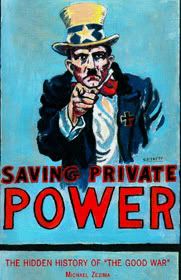
If Burns was following convention in describing Pearl Harbor as a bolt from the blue, there are alternative interpretations. Chapter four of Michael Zezima’s “Saving Private Power: the hidden history of ‘The Good War’” targets the myth that “The attack on Pearl Harbor was a surprise”:
The build-up to Pearl Harbor began two decades prior to the attack when, in 1922, the U.S., Britain, and Japan agreed that the Japanese navy would not be allowed more than 60 percent of the capital ship tonnage of the other two powers. As resentment grew within Japan over this decidedly inequitable agreement, that same year the United States Supreme Court declared Japanese immigrants ineligible for American citizenship. This decision was followed a year later by the Supreme Court upholding a California and Washington ruling denying Japanese the right to own property. A third judicial strike was dealt in 1924 with the Exclusion Act which virtually banned all Asian immigration. Finally, in 1930, when the London Naval Treaty denied Japan naval hegemony in its own waters, the groundwork for war (and “surprise attacks”) had been laid. Upon realizing that Japan textiles were outproducing Lancashire mills, the British Empire (including India, Australia, Burma, etc.) raised the tariff on Japanese exports by 25 percent. Within a few years, the Dutch followed suit in Indonesia and the West Indies, with the U.S. (in Cuba and the Philippines) not far behind. This led to the Japanese (correctly) claiming encirclement by the “ABCD” (American, British, Chinese, and Dutch) powers. Such moves, combined with Japan’s expanding colonial designs, says Kenneth C. Davis, made “a clash between Japan and the United States and the other Western nations over control of the economy and resources of the Far East and Pacific…bound to happen.” Burns not only leaves out these dimensions, he treats the Philippines practically as American territory–which, come to think of it, it was. But Ken Burns is not interested in trying to figure out what caused the war. His goal is to mine the stories of hitherto obscure fighting men and their wives and lovers for personal drama. The war becomes a kind of rite of passage in which young men become adults. You are initiated by killing Nazis or “Japs” rather than enduring tribal scars or some other test of your manhood. This seems like an awful waste considering the cost in life and treasure. When Burns was interviewed by Fox News, he tried to draw comparisons between WWII and the current war in Iraq. He said that he was not interested in making a political statement about the first war, but did note that there was a sense of national unity then that cannot be found today. As he put it, we were all in the same boat and all the oars were moving in the same direction in WWII. Whatever Ken Burns’s attitude toward the war in Iraq, there is no doubt that “The War” will reinforce all the worst prejudices in American society. If the US had a right to control resources in Asia in the name of democracy against “evil dictators”, why should it not have the same right today?"
Red Hook VFW Post
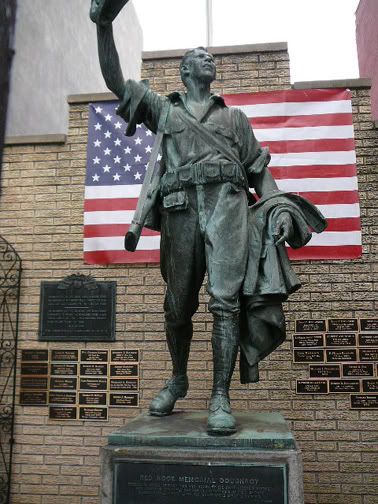 The World War I Doughboy statue had been formerly located in a Park, but it had been vandalized. It was moved to this location at 325 Van Brunt Street. This is where I was getting information from the plaques as clues to addresses of veterans. I found this on a south brooklyn bulletin board posted by Joan Diamond:
"I had wanted to add that Patrick and Anna had 9 children. William also nicknamed Red worked in his father's bar and grill. After the Brooklyn Dodgers had lost a game to the Giants my Uncle William was teasing one of the customers, Robert Joyce a Post Office worker and one thing led to another and Joyce ended up fatally shooting Robert Krug in the head and my uncle in the stomach (july 1938). This information was included in a book titled BUMS (the #1 Baseball memory book) by Peter Golenbock in 1984. My other uncle joseph was killed in WW11 and the Joseph Diamond Post 1427 of the American Legion was named in his memory. My grandfather dies in 1941 and his wife Anna in 1961. Patrick, George and Neil have all passed away as well as Ann and Katherine , my two aunts. Elizabeth survives and still resides in Brooklyn. If anyone remembers any of the Diamonds I would love to hear your memories."
1318 W. Columbia Street, Milwaukee

The Baldridge family home mentioned in the WW2 Valentines post that precedes this. I looked it up in Google Maps. Could be the same one as 1945?
BTW, a Dave wrote in supplying the full set of lyrics to American Anthem:
American Anthem
Lyrics by Gene Scheer
All we've been given by those who came before
The dream of a nation where freedom would endure
The work and prayers of centuries have brought us to this day.
What shall be our legacy?
What will our children say?
(Chorus)
Let them say of me
I was one who believed
In sharing the blessings I received.
Let me know in my heart when my days are through
America, America I gave my best to you.
Each generation from the plains to distant shore
With gifts that they have given were determined to leave more.
Valiant battles fought together,
Acts of conscience fought alone.
These are the seeds from which America has grown.
(Chorus)
Let them say of me
I was one who believed
In sharing the blessings I received.
Let me know in my heart when my days are through
America, America I gave my best of you.
For those who think they have nothing to share,
Who fear in their hearts there is no hero there,
Know that quiet acts of dignity are that which fortifies
The soul of a nation that never, never dies.
(Chorus)
Let them say of me
I was one the one who believed
In sharing the blessings I received.
Let me know in my heart when my days are through
America, America I gave my best to you.
Subscribe to:
Posts (Atom)

 Posts


