Finally, someone from one of my google map sites who lives nearby and who is a big favorite of mine. He lived at 382 8th Street.
Showing posts with label google maps. Show all posts
Monday, July 07, 2008
Eddie Sauter: Brooklyn Born
Finally, someone from one of my google map sites who lives nearby and who is a big favorite of mine. He lived at 382 8th Street.
Tuesday, June 10, 2008
C. Everett Koop: Part 3
So I discover the 1920 and 1930 addresses of C. Everett Koop and go off to photograph them so I can add the sites to my google map of famous Brooklynites. I decided to capture the reactions of the current residents as I inform and give them copies of the records I discovered. The 1930 folks weren't home, but I left the information with their neighbors. I added more Koop images (along with the house images) to the soundtrack
Saturday, May 24, 2008
Peter Nero: My Goggle Maps
I've added Peter Nero to my famous people in Brooklyn google map He lived on the same block as famous boxer Al "Bummy" Davis and two blocks from famous author Jack Ezra Keats and within three blocks of Danny Kaye!
Saturday, May 17, 2008
Emma Lazarus: 18 West 10th Street
from wikipedia:
Emma Lazarus (July 22, 1849 – November 19, 1887) was an American poet born in New York City.
She is best known for writing "The New Colossus", a sonnet written in 1883, that is now engraved on a bronze plaque on a wall in the base of the Statue of Liberty. The sonnet was solicited by William Maxwell Evarts as a donation to an auction, conducted by the "Art Loan Fund Exhibition in Aid of the Bartholdi Pedestal Fund for the Statue of Liberty" to raise funds to build the pedestal. Lazarus was the fourth of seven children of Moses Lazarus and Esther Nathan, Portuguese Sephardic Jews whose families were long settled in New York, and was related through her mother to Benjamin N. Cardozo. From an early age, she studied American and European literature, as well as several languages, including German, French, and Italian. Her writings attracted the attention of Ralph Waldo Emerson, who corresponded with her up until his death.
Lazarus is buried in Beth-Olom Cemetery in Brooklyn. She wrote her own original poems and edited many adaptations of German and Italian poems, notably those of Johann Wolfgang von Goethe and Heinrich Heine. She also wrote a novel and two plays.
The New Colossus
Not like the brazen giant of Greek fame,
With conquering limbs astride from land to land;
Here at our sea-washed, sunset gates shall stand
A mighty woman with a torch, whose flame
Is the imprisoned lightning, and her name
Mother of Exiles. From her beacon-hand
Glows world-wide welcome; her mild eyes command
The air-bridged harbor that twin cities frame.
"Keep, ancient lands, your storied pomp!" cries she
With silent lips. "Give me your tired, your poor,
Your huddled masses yearning to breathe free,
The wretched refuse of your teeming shore.
Send these, the homeless, tempest-tost to me,
I lift my lamp beside the golden door!"
Emma Lazarus, 1883
Lazarus' latent Judaism was awakened after reading the George Eliot novel, Daniel Deronda, and this was further strengthened by the Russian pogroms in the early 1880s. This led Lazarus to write articles on the subject and to begin translating the works of Jewish poets into English. When Eastern European Ashkenazi Jews, expelled in great numbers from the Russian Pale of Settlement began to appear in destitute multitudes in New York in the winter of 1882, Lazarus interested herself actively in providing technical education to make them self-supporting. She traveled twice to Europe, first in May 1885 after the death of her father in March and again in September 1887. She returned to New York City seriously ill after her second trip and died two months later on 19 November 1887, most likely from Hodgkin's disease.
She is known as an important forerunner of the Zionist movement. In fact, she argued for the creation of a Jewish homeland thirteen years before Herzl began to use the term Zionism.
Tuesday, March 04, 2008
Saturday, March 01, 2008
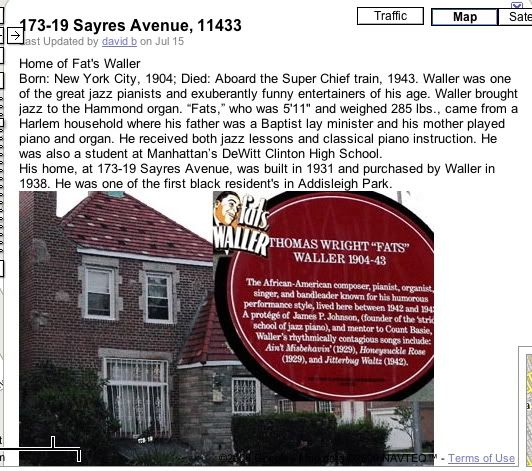
Google Maps: Fats Waller
from My Queen's Jazz Trail
A description: Homes of Jazz Greats and other notables in Queens,NY. With an assist from
Ephemera Press' great maps, the Central Queens Historical Association and Forgotten-NY.com. Bonus treat (those with red pins): hear a few bars of the music of these jazz greats or some video (yellow pins) Bonus also some panoramic movies (yellow movie icon)
my last unofficial post before the end of Black History Month on Every Month Is Black History Month
I made almost 350 posts alone in February, an exceptional "Obsessive Compulsive"
accomplishment and I can tell via the site meter that schools nation wide made great use of it. There's still a backlog of about 50 entries I didn't get in under the wire, but I'll add more a little less compulsively.
Wednesday, October 10, 2007
Thursday, October 04, 2007
My Google Maps: Red Hook
The latest one I'm working on and it is located here. What is unique about this one is that I am including addresses of WW2 veterans. (The red crosses denote casualties, the red hazard symbols denotes wounded or prisoner of war) I first was going to use information garnered from memorial plaques located at a VFW Post and then work backwards through census data. A much more accurate source of info was obtained by old Times' listings of New York City casualties from the war.
1318 W. Columbia Street, Milwaukee
The Baldridge family home mentioned in the WW2 Valentines post that precedes this. I looked it up in Google Maps. Could be the same one as 1945?
BTW, a Dave wrote in supplying the full set of lyrics to American Anthem:
American Anthem
Lyrics by Gene Scheer
All we've been given by those who came before
The dream of a nation where freedom would endure
The work and prayers of centuries have brought us to this day.
What shall be our legacy?
What will our children say?
(Chorus)
Let them say of me
I was one who believed
In sharing the blessings I received.
Let me know in my heart when my days are through
America, America I gave my best to you.
Each generation from the plains to distant shore
With gifts that they have given were determined to leave more.
Valiant battles fought together,
Acts of conscience fought alone.
These are the seeds from which America has grown.
(Chorus)
Let them say of me
I was one who believed
In sharing the blessings I received.
Let me know in my heart when my days are through
America, America I gave my best of you.
For those who think they have nothing to share,
Who fear in their hearts there is no hero there,
Know that quiet acts of dignity are that which fortifies
The soul of a nation that never, never dies.
(Chorus)
Let them say of me
I was one the one who believed
In sharing the blessings I received.
Let me know in my heart when my days are through
America, America I gave my best to you.
Sunday, September 30, 2007
My Google Maps: Sacramento
This is the latest map I'm working on (it's my 12th) and I'm just about through. Above is an image of it, it's location on the web is here. It coincides with much of the historical information I gathered from the Burns' War documentary. Sacramento was one of the the series' four anchor cities and it was the most diverse. I believe it is considered now the most diverse city in the country. It's uniqueness of the anchor cities was its considerable Japanese-American population and their subsequent isolation in internment camps.
From the PBS War site:
"Sacramento, California, the state capital, had been the gateway to the California Gold Rush and the western anchor of the transcontinental railroad. Europeans had first arrived in the 1830s, followed by thousands of Chinese laborers who had helped build the railroad and then settled in Sacramento. A small African-American communityemerged in Sacramento as well, and by 1860, the only two black doctors in the far west had practices in the city.
Surrounded by some of the most fertile land in the west, Sacramento was a diverse farming town of 106,000, including Italian, Filipino, Portugese, and Mexican Americans. The city’s biggest employers were the local cannery, the state government and the Southern Pacific Railroad. On the eve of WWII Hundreds of “Okies” — refugees from the dust bowl — still camped on the edge of town and worked the fields, orchards and vineyards of the surrounding Sacramento Valley. Jobs were scarce during the Great Depression, and many in the city were dependent on charity, relief and federal work programs."
What I tried to do is map sites mentioned in the show as well as other historical sites I researched. I also tried to make the map more engaging by linking images to each marker. This can be a tedious process because care most be taken to limit the size of the picture, otherwise the "bubble" for the marker becomes "overwhelmed." This map has about 50. Google limits you to 100 per map, which is just as well because the markers become too crowded and indistinguishable especially if the geographic area is not too spread out. I also try to pick up clues from the show and supporting site as to where some of the "witnesses" lived. I also use census records
(the closest being 1930) to help spot the location. Some of those mentioned are Earl Burke, Barbara Covington, Burnett Miller, Harry Schmid, Burt Wilson, Susumu Satow, Sascha Weinzheimer, Dolores Silva, Asako Tokuno and Robert Kashiwagi
Sunday, September 23, 2007
My Google Maps: New York Goes to War
Based on the wliw/wnet documentary to accompany Ken Burns' "The War" A map highlighting the New York experiences of the veterans whose lives were portrayed. They are Paul Canin, Theresa Rachieli, William McBurney, Paul and Gloria Medina, Greta Zimmer and Philip Wood. Included are their home locations, job sites, regiment armories, favorite eateries, etc.here's a link to my google map on ny war stories
Saturday, September 22, 2007
My Google Maps: My Lower East Side
A personal history of the lower east side, including some neighborhood history as well.
In addition to facts and images (both new and archival) there are slide show movies, panoramic movies, podcasts, primary documents, area walks and links to relevant YouTube movies. here's a link to my google map on my lower east side
Saturday, September 15, 2007
My Google Maps: Harlem History
This was one of my first maps: Addresses of famous people who lived in Harlem (red markers). A valuable source: Ephemera Press Harlem Map. Also sites of historic note are listed as well as some music clips (green markers), youtube movies, panoramic movies and panoramic scenes (links one panorama to another through a hot spot).
here's a link to my google map on harlem
Friday, September 14, 2007
My Google Maps: Place Matters
Well this is what I have been working on and where I have been. This is my latest (I currently have 14 of them) and a lot of tedious work is involved in creating them. The description of this map
"Your Guide to the Lower East Side" (red markers on this map) presents the experienc-es of past and present Lower East Siders on 28 signs at 6 separate sidewalk locations. With photographs and text in 5 languages, these “place markers” weave personal stories and cher-ished memories directly into the landscape, often right where the stories took place. The signs reveal the rich and diverse layers of human experience that make the neighborhood so distinctive. They transform the participants’ stories of struggle and achievement into a legacy for all who pass by. Place Matters is an initiative of City Lore and the Municipal Art Society to promote and protect places that con-nect us to the past and sustain community. Go to www.placematters.net to learn more about places on the Lower East Side and all around the city. here's a link to my google map on place matters
Subscribe to:
Posts (Atom)