Showing posts with label lincoln brigade. Show all posts

Thursday, January 24, 2008

70th Reunion Of The International Brigades


Here's a clip I found on youtube of the 70th reunion of the International Brigade. I get goosebumps.
Here's a portion the text of the times article of 1/13/08, entitled, "In Spain, a Monumental Silence,"
By MICHAEL KIMMELMAN
that provides the background for the previous post
LAST month Spain passed a law that doesn’t make much sense, on its face, but says quite a lot about Europe in the new century. The Parliament, fulfilling a campaign promise from 2004 by Prime Minister José Luis Rodríguez Zapatero, ordered that families wanting to unearth bodies of relatives killed during the Spanish Civil War of the late 1930s or who suffered as a political consequence of General Francisco Franco’s four-decade-long regime should get full cooperation from the state, and at the same time that every province in the country must remove remaining monuments to Franco. Unearth the past — and erase it. Never mind that over the years most of these monuments have already been carted off, making the law largely toothless and symbolic. Even so, in the debates over it, nobody here has talked much about the inherent contradiction. Or is it a contradiction? “A new generation has begun to look at the past,” Santos Juliá, a senior historian of the post-Franco years, explained to me one recent morning. “They’re the grandchildren of the civil war. My generation wanted to discuss what happened without a sense of culpability. The grandchildren look on the same years of reconciliation as an unending concession, and it is time to fix blame.” Survivors build monuments to remember the dead, and tear down the statues of the tyrants who killed them, but mostly in vain. Statues and memorials inscribe history, which each generation rewrites to suit itself. In Budapest statues of Communist idols have been relocated to a park on the city outskirts to become virtual headstones at a kind of kitsch graveyard. Russia, in its dash to prosperity, remains conspicuously reluctant to rehash the past, but it also removed many signs of Soviet rule.
And of course nobody has scrutinized public symbols and spaces more than the Germans, for whom nearly every stone and street sign has provoked a fresh monument. The meeting room for the German foreign minister in Berlin is an example of the extent to which the Germans have gone even in private. Originally the office for the head of the Nazi state bank, then taken over by Erich Honecker, the East German leader, who met in it with his Politburo, the room was left nearly intact after the Wall fell when the Foreign Ministry moved in, so that on where paintings of Marx and Engels once hung behind Honecker’s chair, faded rectangles were left as cautionary reminders.
Spain is different, though, having endured a civil war. With their traditional fear of deep, dark demons in their soul, Spaniards after Franco’s death and during the transition to democracy entered into what has long been called here a pact of silence, which the new law clearly aims to undo. As the historian Hugh Trevor-Roper put it 40 years ago, about a different regime, “A single personal despot can prolong obsolete ideas beyond their natural term, but the change of generations must ultimately carry them away.” You might say that in Spain’s case the change now comes a generation late.

Sunday, January 20, 2008

VIVA LA QUINTE BRIGADA


A special version for the Irish vets by Christy Moore
Ten years before I saw the light of morning
A comradeship of heroes was laid
From every corner of the world came sailing
The Fifteenth International Brigade
They came to stand beside the Spanish people
To try and stem the rising fascist tide
Franco's allies were the powerful and wealthy
Frank Ryan's men came from the other side
Even the olives were bleeding
As the battle for Madrid it thundered on
Truth and love against the force of evil
Brotherhood against the fascist clan
Chorus:
Viva la Quinte Brigada
"No Pasaran", the pledge that made them fight
"Adelante" is the cry around the hillside
Let us all remember them tonight
Bob Hilliard was a Church of Ireland pastor
Form Killarney across the Pyrenees he came
From Derry came a brave young Christian Brother
Side by side they fought and died in Spain
Tommy Woods age seventeen died in Cordoba
With Na Fianna he learned to hold his gun
From Dublin to the Villa del Rio
Where he fought and died beneath the blazing sun
Viva la Quinte Brigada
"No Pasaran", the pledge that made them fight
"Adelante" is the cry around the hillside
Let us all remember them tonight
Many Irishmen heard the call of Franco
Joined Hitler and Mussolini too
Propaganda from the pulpit and newspapers
Helped O'Duffy to enlist his crew
The word came from Maynooth, "support the Nazis"
The men of cloth failed again
When the Bishops blessed the Blueshirts in Dun Laoghaire
As they sailed beneath the swastika to Spain
Viva la Quinte Brigada
"No Pasaran", the pledge that made them fight
"Adelante" is the cry around the hillside
Let us all remember them tonight
This song is a tribute to Frank Ryan
Kit Conway and Dinny Coady too
Peter Daly, Charlie Regan and Hugh Bonar
Though many died I can but name a few
Danny Boyle, Blaser-Brown and Charlie Donnelly
Liam Tumilson and Jim Straney from the Falls
Jack Nalty, Tommy Patton and Frank Conroy
Jim Foley, Tony Fox and Dick O'Neill

Milt Wolffe Slide Show


I combined some stills I found of Milt with Viva la Quince Brigada

Viva la quince brigada,
Rumba la, rumba la, rumba la,
Viva la quince brigada,
Rumba la, rumba la, rumba la,
Que se ha cubierto de gloria.
¡Ay, Manuela! ¡Ay, Manuela!
Que se ha cubierto de gloria.
¡Ay, Manuela! ¡Ay, Manuela!

Luchamos contra los moros,
Rumba la, rumba la, rumba la,
Luchamos contra los moros,
Rumba la, rumba la, rumba la,
Mercenarios y fascistas.
¡Ay, Manuela! ¡Ay, Manuela!
Mercenarios y fascistas.
¡Ay, Manuela! ¡Ay, Manuela!

Solo es nuestro deseo,
Rumba la, rumba la, rumba la,
Solo es nuestro deseo,
Rumba la, rumba la, rumba la,
Acabar con el fascismo.
¡Ay, Manuela! ¡Ay, Manuela!
Acabar con el fascismo.
¡Ay, Manuela! ¡Ay, Manuela!

En los frentes de Jarama,
Rumba la, rumba la, rumba la,
En los frentes de Jarama,
Rumba la, rumba la, rumba la,
No tenemos ni aviones,
Ni tanques, ti cañones.
No tenemos ni aviones,
Ni tanques, ti cañones.

Ya salimos de España,
Rumba la, rumba la, rumba la,
Ya salimos de España,
Rumba la, rumba la, rumba la,
A luchar en otros frentes,
¡Ay, Manuela! ¡Ay, Manuela!
A luchar en otros frentes,
¡Ay, Manuela! ¡Ay, Manuela!

Milton Wolffe 5


the last installment I'll post from the original 121 minute interview (all told in the 5 parts there were about 75 minutes posted)
video from world war II oral history archives
Part 5 of obituary by Peter Carroll
But Wolff saw himself first as a soldier and wanted to participate in the military defeat of fascism. In 1942, he enlisted in the U.S. Army, expecting to serve as an infantryman in battle and to bring his military experience to speed the victory. Those illusions soon confronted a military establishment that saw Spanish Civil War veterans as "premature anti-fascists" and so considered them unacceptable for combat assignments. To his growing frustration, the Army dropped Wolff from Officer Candidate School and gave him non- combatant assignments. While pulling strings to get a transfer, Wolff picked an assignment that took him to Burma where he saw action under the General Joseph Stillwell. Soon afterward, the OSS summoned Wolff to Italy, where in joined other Lincoln veterans he had earlier recruited such as Irving Goff, Vincent Lossowski, and Irving Fajans in establishing intelligence networks among the Communist partisans. One of Wolff's proudest achievements was graduating from parachute school, but he was on the ground when he was sent into southern France on a secret mission that was never consummated. However, while there he met members of the Spanish resistance planning to invade Spain. Wolff's efforts to bring them OSS assistance resulted in his hasty recall and a transfer back to the United States. In the post-World War II climate, Wolff and other Lincoln vets continued to work for Spanish democracy, tirelessly lobbying the State Department to break relations with Franco Spain, and to gain assistance for Spanish refugees and prisoners of the Franco regime. At a time when the U.S. government was creating an anti-Communist alliance that included Franco Spain, however, Wolff's leadership position alarmed the FBI, which kept him under constant surveillance. When the Department of Justice classified the Veterans of the Lincoln Brigade as a subversive organization in 1947 and the McCarran Act of 1950 obliged the veterans to register with the government, Wolff emerged as the public face of the VALB. He and Moe Fishman presided over the defense of the veterans before the Subversive Activities Control Board in hearings during 1954 and carried the subsequent appeals through the federal courts. During this period, Wolff also worked for the embattled Civil Rights Congress, a left-wing organization that defended African Americans accused on dubious grounds of capital crimes. As the anti-Communist crusade abated in the 1960s, Wolff remained active in the U.S. Committee for a Democratic Spain, an organization that lobbied against U.S. treaties with the Franco regime, assisted the families of Franco's political prisoners, and advocated for political reform. Wolff also led the revitalized VALB in demonstrations against the Vietnam War. At one point, he wrote a personal letter to Ho Chi Minh offering the services of the Abraham Lincoln Brigade. He also advocated ending the trade embargo with Cuba and helped provide medical aid to a children's hospital in Havana. During the 1980s, Wolff and other veterans instituted a campaign to send ambulances to Nicaragua, an echo of U.S. domestic support for the Spanish Republic fifty years earlier. Invited frequently to return to Spain, Wolff was a beloved figure among Spaniards. In a recent visit, he won cheers when he reminded them that if they got into trouble in the future, "give me a call." As he reached his later years, Wolff devoted more time to painting and writing his memoirs in fictional form. He had recently finished a draft of a third volume, dealing with his experiences in World War II. Through it all, Milton Wolff saw himself as a man of action. For all of his thought and intellect, he knew how to make decisions and get things done. Sometimes, his impulses led to frustrating mistakes, as when he joined the Army in expectations of organizing an invasion of Spain and found himself exiled as a potential subversive. But he never doubted the choice he made to fight in Spain. In 2005, nearly seventy years after he'd swum the river waters, he stood at the rail of a boat on the Ebro and paused for a long moment of silence. Then he evoked the men who had died there beside him-"I call them my dead," he said-and dropped a bundle of red carnations into the water. Mr. Wolff is survived by his daughter, Susan Wallis of Vermont; his son, Peter, of Connecticut; four grandchildren; and nine great-grandchildren. Mr. Wolff said he was turned down for combat duty in World War II because of concerns about his leftist politics. He later fought successfully against the “subversive” label pinned on the Lincoln veterans for decades. He personally delivered 20 ambulances to the Nicaraguan government when the Reagan administration was supporting rebels against it. One of his battles after the civil war was leading his veterans to urge the Brooklyn Dodgers to integrate. “The guys were all Dodgers fans,” he said. “It was a way to carry on the struggle.

Milton Wolffe 4


video from world war II oral history archives
Part 4 of obituary by Peter Carroll
While in court, Wolff was abruptly subpoenaed to appear before the House Un-American Activities Committee in the spring of 1940, the first of many tangles with the government's anti-Communist crusade. Although Wolff had joined the Young Communist League before going to Spain and had nominally joined the Communist Party of Spain during the war, he always insisted he had not joined the U.S. Communist Party even though he sympathized with its policies. To the government, it was a distinction without a difference, and Wolff's movements would be monitored closely by the FBI and other government agencies for decades. Meanwhile, when faced with government inquiries, he answered questions selectively. From his wartime friendship with journalist Vincent Sheean, Wolff had fortuitously met William Donovan, chosen by President Franklin D. Roosevelt to head the newly formed Office of Strategic Services, forerunner of the Central Intelligence Agency. During the spring of 1941, Donovan summoned Wolff to his offices in Wall Street and requested Wolff's assistance in recruiting Lincoln veterans to work for British intelligence. According to Wolff and backed by sparse documentary evidence, this conversation occurred before the German invasion of the Soviet Union and so violated the official Communist position of non-participation in World War II. Wolff's willingness to cooperate with OSS reflected his flexibility about ideology: though a man of great principles and ideals, he avoided dogma and rhetoric, and appreciated the imperfections of given situations. Wolff spent the next year working quietly with British intelligence officials. When the bombing of Pearl Harbor brought the United States into the war, Wolff sent a telegram to President Roosevelt offering the services of the Lincoln Brigade in the war effort. He also assisted Donovan's OSS in recruiting Lincoln veterans for special projects that would later bear fruit in U.S. victories in North Africa, Italy, and the Normandy invasion.

Milton Wolffe 3


video from world war II oral history archives
Part 3 of obituary by Peter Carroll
Wolff led the Lincolns back across the Ebro during the summer of 1938, held them in the lines of the violent Hill 666 in the Sierra Pandols, until ordered to turn over the battalion to Spanish officers as the government arranged for the withdrawal of foreign troops in 1938. In a ceremonial transfer of authority, Wolff was promoted to the rank of Major. It was then that the prominent American sculptor Jo Davidson was making clay busts of the Spanish leaders and proposed including an American face. When he saw Wolff's shaggy hair and gaunt features, Davidson asked him to model. Misunderstanding the image he projected, Wolff first had a haircut and shave, nearly causing the furious sculptor to cancel the session. The resulting clay composition inspired Hemingway's eulogy to Wolff, in which he compared him to Lincoln. "He is a retired major now at twenty-three and still alive," wrote Hemingway, "and pretty soon he will be coming home as other men in age and rank came home after the peace at Appomattox courthouse long ago. Except the peace was made at Munich now and no good men will be home for long." Wolff, of course, admired the elegant prose. But his heart and soul was always with the rank and file. Back in New York, some of the returned veterans of the Lincoln Brigade read the reports from Spain with amusement: "Hemingway and [Herbert] Matthews say he looks just like Lincoln. Wonder when they saw Lincoln."

After Spain

Wolff's iconic stature kept him at the forefront of the struggle to save the Spanish Republic, even after General Francisco Franco claimed military victory in 1939. He participated in street protests in New York, urging Washington officials to lift the embargo on shipments to Spain and to provide assistance for the Spanish refugees trapped in French concentration camps. When the French government threatened to deport these victims of war back to Franco's Spain, where many would face summary execution, Wolff joined other Lincoln veterans in demonstrations outside the French consulate in New York. He was arrested in 1940 for this activity and served fifteen days in jail.

Milton Wolffe 2


video from world war II oral history archives
Part 2 of obituary by Peter Carroll
He sailed for Spain in March 1937. Wolff recounted his experiences as a soldier in the autobiographical novel, Another Hill (1994). Moved by the enthusiasm of the other volunteers, he switched from a medical assignment to serve in a machine gun company in the newly formed Washington Battalion and went into action at Brunete in July 1937. Men inches away from him were wounded and killed, but he emerged without a nick.
A few weeks later, while on leave in Madrid, his captain, Philip Detro from Texas steered him to the Café Chicote on the Gran Via. There he met Ernest Hemingway. The 21-year old Wolff was not impressed. "Ernest is quite childish in many respects," he wrote to a friend in Brooklyn. "He wants very much to be a martyr...So much for writers," he concluded. "I'd much rather read their works than be with them." Within a month, Wolff was fighting on the Aragon front, leading a section of the machine gun company at Belchite and Quinto. By October, he commanded the machine gunners at Fuentes de Ebro. At Teruel, in January 1938, Wolff was a captain and an adjutant. Two months later, when a direct hit destroyed the battalion headquarters and killed the leadership, Wolff became the commander. He led the soldiers through the treacherous retreats, avoided capture, and wandered alone behind enemy lines until managing to swim across the Ebro.
Wolff assumed responsibility for rebuilding the broken battalion. During the training period, Robert Capa, the legendary photographer, captured Wolff standing next to Hemingway, a visual contradiction: Hemingway, stocky, an adventurer in his half-opened zippered jacket; Wolff, lanky in uniform, a beret covering his thick, dark hair, but shy, hands in his pockets, face turned downward, impatient to get on with the war.
A few weeks later, the photograph appeared in a New York Yiddish newspaper. To her surprise, Wolff's mother finally discovered what her absent son was doing in Spain. Not, as he had reported in his letters, working in a factory so that a Spanish worker could fight for the Republic, but leapfrogging through the military ranks. A "nobody at home," the soldier- poet Edwin Rolfe wrote about Wolff in his diary; "leader of men here."

Milton Wolffe 1


In Memory of Milton Wolff, 1915 - 2008
video from world war II oral history archives
By PETER N. CARROLL, from the veterans of abraham lincoln brigade web site
Milton Wolff, the last commander of the Lincoln-Washington Battalion consisting of the North American volunteers in the Spanish Civil War and an iconic leader of the Veterans of the Abraham Lincoln Brigade since the war ended in 1939, died of heart failure in Berkeley, California on January 14. He was 92.
"Nine men commanded the Lincoln and Lincoln-Washington Battalions," wrote Ernest Hemingway at the end of the war; four were dead and four were wounded. The ninth, Milton Wolff, was 23 years old, "tall as Lincoln, gaunt as Lincoln, and as brave andas good a soldier as any that commanded battalions at Gettysburg. He is alive and unhit by the same hazard that leaves one tall palm tree standing where a hurricane has passed."
Born in Brooklyn on October 7, 1915, Wolff stood six feet two in bare feet and a few inches higher in the muddied brown boots he had picked up after swimming across the swollen Ebro River during the great retreats of 1938, just a few months before Hemingway wrote his profile. He had a loud, gravelly voice that was pure Brooklyn. Later, he claimed that was the reason he was picked to lead the Lincoln volunteers at the age of 22, but Wolff knew-he always knew but it embarrassed him-that he possessed a tremendous charisma that won the love of men and women throughout his life. And what all of them also knew was that Milton Wolff was a very intelligent man.
The author Vincent Sheean, who like Hemingway, wrote about the Spanish Civil War for various U.S. newspapers, had witnessed Wolff's unexpected return after being lost six days behind enemy lines and had seen him enter the small hastily- built shelter that served as battalion headquarters after the recent defeat. "You built this thing pretty low," Wolff had deadpanned. "I guess you guys didn't think I was coming back." Then he had taken a plate of garbanzo beans cooked in olive oil, grabbed some long-delayed letters from his girlfriend in New York, and disappeared into a deep silence. "Now he sat doubled up over his beans and his letters," observed Sheean, "his gaunt young face frowning in concentration. I think he knew how glad they all were to see him, and he wanted to ignore it as much as possible."
Wolff described his childhood in an autobiographical work, slightly fictionalized, titled Member of the Working Class (2005). His was an ordinary story, tempered by a curious mind confronting hard times. Coming of age in the Depression, a high school drop-out, Wolff took the opportunity to enroll in the New Deal's experimental Civilian Conservation Corps, a military type operation that brought unemployed city boys to work on forestry projects. He loved the physical activity and camaraderie and developed some skill as a first aid assistant. But he also witnessed a bureaucratic indifference that led to the death of one of his friends. For protesting conditions there-his first political act-Wolff was not permitted to reenlist.
He returned to Brooklyn, hung around with neighborhood kids, and found a job in a millinery factory in Manhattan. As part of their social activity, some had joined the Young Communist League and Wolff followed them into the ranks. As he later explained, his political development was rudimentary, but when the Spanish Civil War began in 1936 and one of the YCL organizers asked if there were any volunteers to join the fight, Wolff raised his hand. He planned to serve as a first- aid man.

Monday, January 07, 2008

Spanish Civil War: The Last Great Cause 2

Spanish Civil War: The Last Great Cause 1


from BBC

Spanish Civil War History 2


Part 2 about American women volunteers in the Spanish Civil War

Spanish Civil War History 1


A history of American women in the war effort

Moe Fishman


Here's Moe Fishman speaking at a convention in 2006. He passed away last year
August 12, 2007, Moe Fishman Dies at 92; Fought in Lincoln Brigade
By DOUGLAS MARTIN
Moe Fishman, who as a 21-year-old from Astoria, Queens, fought Fascists in Spain with the Abraham Lincoln Brigade and was severely wounded, then led veterans of that unit in fighting efforts to brand them as Communist subversives, died on Aug. 6 in Manhattan. He was 92.
The cause was pancreatic cancer, said Peter Carroll, chief of the board of governors of the Abraham Lincoln Brigade Archives.
Mr. Carroll said that about 40 of about 3,000 American veterans of the Spanish Civil War volunteers are living. It had been the job of Mr. Fishman, as executive form the XV International Brigade.
In 1937, Mr. Fishman was a college dropout working in a laundry and driving a truck. He was also a member of the Young Communist League, having joined partly to meet like-minded young women at dances the organization sponsored, he said in an interview with The New York Times in 2004.
He also liked how the Communists responded when a family behind on the rent was evicted and thrown on the streets with its furniture. He told The Times that party members would use an ax or hammer to break the lock on the door and put the family back in.
Many believe that at least half of the volunteers for the Lincoln Brigade were Communists, but Mr. Fishman’s reasons for joining were more complex, he told The Times in 1969.
“Why did I go?” he said. “That’s hard to say. That’s a key question. I was active in trade union work. I wanted to travel. I belonged to the 92nd Street Y.M.H.A., and we were very anti-Fascist, much opposed to Hitler, Franco.”
He was born Moses Fishman on Sept. 28, 1915, and grew up in Astoria. On the day he was to depart for Spain, he left for work at the usual time to deceive his parents. Halfway down the stairs, he realized he had forgotten his toothbrush, returned for it and broke it in half so it would fit in his pocket. (It was the only thing he brought back from Spain, he told The Hartford Courant in 2000.)Mr. Fishman called his parents when he got off the subway near the dock, and they cried when he told them his plans. His mother had never seen his father cry. He himself was unafraid. “When you’re 21, there’s no bullet meant for you,” he told The Times in 2000.
On July 5, 1937, during the Brunete offensive west of Madrid, a sniper hit Mr. Fishman’s thigh, leaving 32 pieces of bone and metal. He spent a year in Spanish hospitals, and a pin was put into his leg. At one point the leg became infected, he told The Courant. He was then in and out of hospitals in the United States for two years.
During World War II, Mr. Fishman was in the merchant marine. Afterward, he and other Lincoln veterans became involved in aiding refugees from Franco’s Spain. President Harry S. Truman’s attorney general labeled the veterans group subversive. In 1950, when such organizations had to register with the government, the entire executive committee of the Lincoln Brigade veterans resigned. Mr. Fishman stepped in to become secretary-treasurer.
After a federal court removed the subversive label in the 1970s, Mr. Fishman wrote a colleague that the change might not be good. He wryly suggested doing something subversive so as not to appear irrelevant to rebellious youth. (Mr. Fishman later dropped his party membership, Mr. Carroll said.)
Mr. Fishman is survived by his partner, Georgia Wever, of Manhattan, and his sisters Lilly Litsky, of Santa Cruz, Calif., and Pearl Fishman, of Yonkers.
He never tired of a lively demonstration. But he came to prefer sitting in a folding chair, as he did in 2004, when he hailed protesters at the Republican National Convention in Manhattan. When they saw his Lincoln Brigade banner, they applauded back. In an interview with The Villager, a neighborhood newspaper, he said, “They come up — these young girls — they want you to take a picture with them and they kiss you.”
Other late-life adjustments were harder. In 2001, an article in The Economist recounted how he stumbled over the word “globalization” at a protest against globalization. “It was so much easier to say when we called it imperialism,” he was reported to have said.
Correction: August 30, 2007
An obituary on Aug. 12 about Moe Fishman, a veteran of the Abraham Lincoln Brigade, Americans who fought in the Spanish Civil War, referred incorrectly to his high school education. He was a graduate of Stuyvesant High School in Manhattan; he did not drop out. (He later dropped out of City College, primarily for financial reasons.)

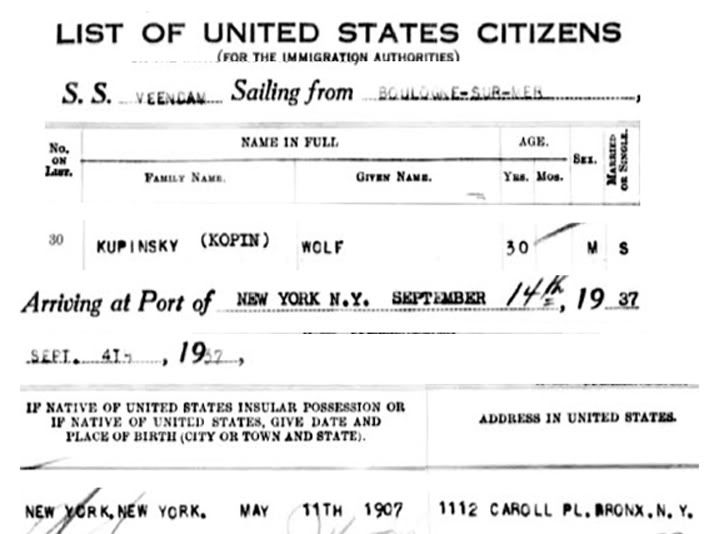
Harry (Wolf) Arrives Home

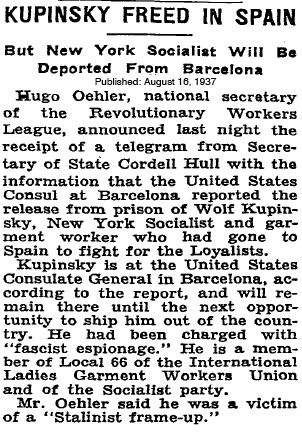
Harry Milton aka Wolf Kupinsky Prisoner Release


Harry had actually been imprisoned by the Stalinists who were trying to gain control of the Republican forces.

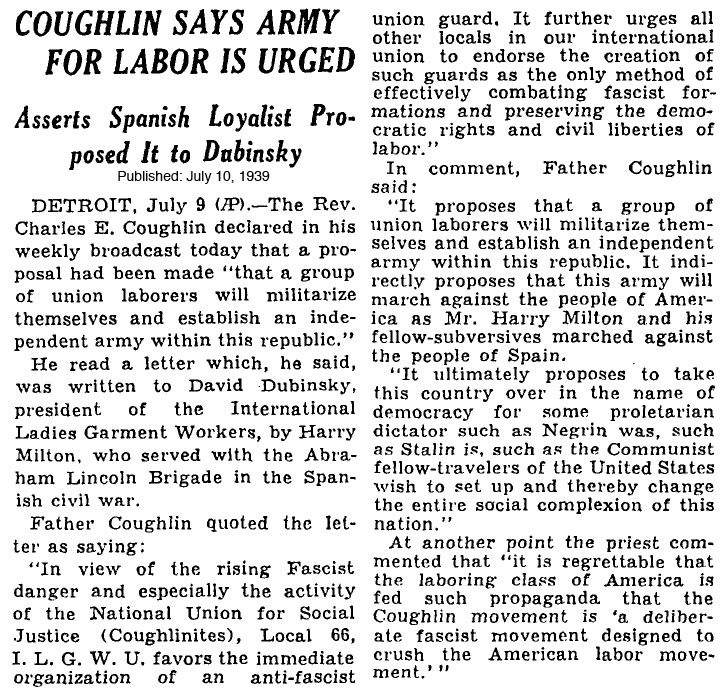
Harry Milton vs. Father Coughlin, 1939

Sunday, January 06, 2008

Who's Who In Knickerbocker Village History: Wolf Kupinsky, aka Harry Milton


I think I was doing a search on the Rosenbergs and I stumbled on an incredible document, a list of the members of the Abraham Lincoln Brigade and their home addresses. Originally there were 2800, now they number in the tens. Those that are still alive are in their 90's. It set me off on the making another one of my google maps. What I do is plot their addresses and then go off to photograph the site, hoping that the original structure (in this case 70 years later) is still there. It's fascinating (at least to me) to look at two houses, maybe a block apart and then look at the names of two guys in their late teens and with no military experience, probably childhood friends, who came up with the idea in 1936 to go to Spain and fight Fascists. I think about a third of those 2800 never made it home. Survivors came home heroes, got no official recognition for their efforts, were lucky to escape recrimination (many went under alias' because of this) for breaking the law, but were later harassed and hounded because they fought on the side of the Communists. Anyway, when I checked the list there were two guys that came from Knickerbocker Village. One of them was Wolf Kupinsky, aka Harry Milton. He was lucky to survive the war and he is credited with saving George Orwell's life.
an excerpt THE MAN WHO SAVED ORWELL, David Jacobs
The American sentry I had been talking to had started forward. ‘Gosh! Are you hit?’ People gathered round. There was the usual fuss — ‘Lift him up! Where’s he hit? Get his shirt open!’ etc., etc. The American called for a knife to cut my shirt open. I knew that there was one in my pocket and tried to get it out, but discovered that my right arm was paralyzed. In the hazy photo (Orwell and Milton), a group of men and one woman pose for the camera behind a wall of sandbags, with their weapons at hand. They do not have the look of regular soldiers, and there are no uniforms. One individual stands literally head and shoulders above the rest. It is none other than George Orwell, or as he was known then, Eric Blair, his real name. The scene is the Spanish Civil War, and the photograph includes ‘the American’ who came to Orwell’s aid when he was shot: Harry David Milton. A small but interesting collection in the Hoover Institution Archives records Milton’s time in Spain, including his encounter with the future author of Nineteen Eighty-Four. The Milton collection sheds light on Orwell’s political development in the crucible of Spain and underlines the role played by American volunteers in Spain who were not members of pro-Moscow Communist Parties and who chose to serve in formations other than the largely Comintern-recruited International Brigades, which received much more attention. Orwell’s vivid description of being wounded on the front lines near Huesca occurs near the end of his memoir of the Spanish Civil War, Homage to Catalonia. Many years later, Harry Milton, describing the incident to a reporter in California, attributed Orwell’s misfortune both to his height and to his somewhat reckless habit of looking over the top of their unit’s fortified position: ‘I heard the crisp sound of a high velocity shot and Orwell [toppled] over. He landed on his back.’ Milton recounts giving first aid, as Orwell waited to be taken to the hospital. In another article about the shooting, Milton claims only a modest role for himself: ‘I simply stopped the bleeding.’ Milton does, however, claim some credit for influencing Orwell’s political consciousness as it developed during his time in Spain.