Showing posts with label harlem. Show all posts

Sunday, February 03, 2008

Lift Every Voice And Sing


originally from 2/4/07, but now with video
One of the paraprofessionals has a great collection of small posters from the Schomburg collection. I offered to scan them at a high resolution so as to preserve them and possibly posterize them at a larger size for display. I also enlarged the text. Here's the result in a slide show set to James Weldon Johnson's famous anthem. (Note even with enlarged text, the screen size limits of youtube make it hard to read any image with more than one line of text)
Lift every voice and sing, till earth and Heaven ring,
Ring with the harmonies of liberty;
Let our rejoicing rise, high as the listening skies,
Let it resound loud as the rolling sea.
Sing a song full of the faith that the dark past has taught us,
Sing a song full of the hope that the present has brought us;
Facing the rising sun of our new day begun,
Let us march on till victory is won.
Stony the road we trod, bitter the chastening rod,
Felt in the days when hope unborn had died;
Yet with a steady beat, have not our weary feet,
Come to the place for which our fathers sighed?
We have come over a way that with tears has been watered,
We have come, treading our path through the blood of the slaughtered;
Out from the gloomy past, till now we stand at last
Where the white gleam of our bright star is cast.
God of our weary years, God of our silent tears,
Thou Who hast brought us thus far on the way;
Thou Who hast by Thy might, led us into the light,
Keep us forever in the path, we pray.
Lest our feet stray from the places, our God, where we met Thee.
Lest our hearts, drunk with the wine of the world, we forget Thee.
Shadowed beneath Thy hand, may we forever stand,
True to our God, true to our native land.

Saturday, February 02, 2008

St. Nicholas Terrace


from 5/21/06, this time supplemented above with goggle video versions of the slide shows (Note, the downloadable versions, being of larger screen size, permit the visibility of the text:
Here's another two slide show entry. The first slide show consists of images taken in my quest to find where Dave Caros might have stumbled upon some rent parties. I had thought they might have been on Edgecombe where the established jazz musicians of Sugar Hill resided.
The high overlook eastward view from Edgecombe was incredible.I chose a Lunceford track, "Lunceford Special," as the music. Jimmy Lunceford resided in Sugar Hill in the 30's and 40's. His band was one of the best of the swing era and is relatively unheralded. The second slide show consists mostly scans from the Harlem Lost and Found book. I put the 1920 composition, "Look For The Silver Lining" by Jerome Kern as the soundtrack. I thought it might fit era wise, but if it didn't, at least it gave me a chance to use Chet Baker. The second version of the song was used for filler so the timing of the slides would be sufficient to allow reading.

Tuesday, December 25, 2007

LES Meets Harlem 1956


I found this amazing clip on youtube. A rehearsal recording of Billie Holiday from 1956 singing My Yiddishe Momme. The images are those of Barbra Streisand and her mother. Billie has a rough beginning but ends up strong
lyric source
My Yiddishe momme
I need her more than ever now
My Yiddishe momme
Id like to kiss her wrinkled brow
I long to hold her hand once more
As in days gone by
And ask her to forgive me
For things I did that made her cry

How few were her pleasures
She never cared for fashion styles
Her jewels and her treasures
She found them in her baby's smiles
Oh I know that I owe what I am today
To that dear little lady who's gone away
To that wonderful Yiddishe momme
momme, momme of mine

What Was I Thinking? A Great Day In Harlem 1958


This comes by way of Knickerbocker Village. A previous post here about this movie is missing the youtube removed clip
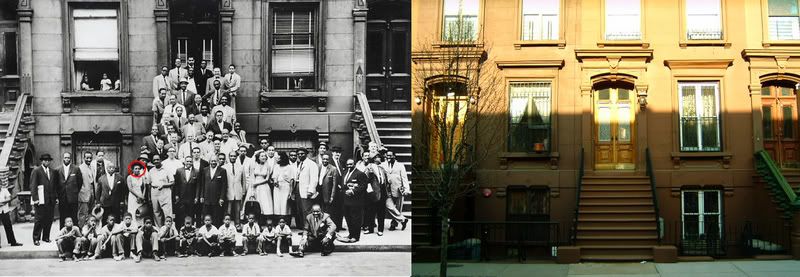
Now what was I doing in the summer of 1958? Probably playing a lot of punch ball in Tanahey Park, when I could have been a kid sitting on a curb in front of this collection of all time great musicians. Harlem was probably thought of as a foreign country to those on the LES
A Great Day in Harlem or Harlem 1958 is a 1958 black and white group portrait of 57 jazz musicians photographed on a Harlem street.

Art Kane, a freelance photographer working for Esquire magazine, took the picture at around 10 a.m. in the summer of 1958. The musicians had gathered on 126th Street, between Fifth and Madison Avenues in Harlem, New York City.

Esquire published the photo in its January 1959 issue. Jean Bach, a radio producer of New York, recounted the story behind it in her 1994 documentary film, A Great Day in Harlem. The film was nominated in 1995 for an Academy Award for Documentary Feature.


The photo was also a key object in Steven Spielberg's film, The Terminal. The film starred Tom Hanks as Viktor Navorski, who came to the United States in search of Benny Golson's autograph to complete his father's collection of autographs by the jazz musicians pictured in the classic 1958 photo.

When I was working in Harlem the last few years I went back to locate the spot to see what it looks like now. It's at 17 East 126th Street.

Saturday, November 17, 2007

Bumpy Johnson: The Real American Gangster


Audio: from the American Gangster trailer. Pics: first section includes Bumpy Johnson and his wife (now 93 years old), Mayme Johnson. The next section are still s from the 1997 film "Hoodlum," which was loosely based on his life. It starred Lawrence Fishbourne.
The real rap on 'Bumpy'
'Harlem Godfather' widow, living here, spills it By JENICE M. ARMSTRONG
Philadelphia Daily News

MAYME JOHNSON, the widow of the infamous Harlem gangster Bumpy Johnson, has no plans to see "American Gangster," a film about one of her husband's former associates. "I don't want to see it because it's not true," she said last week, from a senior facility in Philadelphia. Spry until a recent leg injury left her using a wheelchair, Johnson, 93, can still recall the lavish existence she shared with one of America's most legendary crime bosses, a man whose criminal enterprises ranged from prostitution to numbers running to drugs, beginning in the '20s and '30s. It was a life of spacious New York City apartments, European travel, fur coats, hobnobbing with black celebrities and literary types from the Harlem Renaissance - and it almost never included Frank Lucas.
"American Gangster" is based on Lucas' claims of having been a personal assistant and enforcer for Johnson, as well as his heir-apparent. Lucas, who is portrayed by Denzel Washington in the film, claims to have been Johnson's driver for 15 years - which Johnson's widow angrily disputes.
"I don't agree with anything Frank Lucas has said. To me, he's a sick man. I think he's a total liar," she told me. "I've thought about reaching out to him and punching him in his face, knocking out his teeth. He's a sick man."
Lucas, she said, has inflated his role in Johnson's crime syndicate. To her husband, Lucas was a mere flunky - someone Johnson might have allowed to carry his coat. According to Johnson's widow, Lucas didn't meet Johnson until 1963, after Johnson's parole from prison on a 10-year drug conspiracy charge. Johnson died five years later.
"Bumpy never had nobody to drive him for 15 years," Johnson said.
She insisted that Lucas may have driven Johnson a few times, at most. Karen E. Quinones Miller, a former Philadelphia Inquirer reporter who's written a book about Johnson called "Harlem Godfather: The Rap on my Husband, Ellsworth 'Bumpy' Johnson" pointed out, "Bumpy died in 1968. He got out of prison in '63. Did Frank drive him when he was in Alcatraz? He's never been out on the street for 15 years."
Miller, who met Johnson as a child, pointed out that in the movie, Lucas is shown entering an appliance store with Johnson, who then collapses with a heart attack. In reality, Johnson's heart attack happened while he was dining at Wells Restauraunt, which is known worldwide for its fried chicken and waffles. He died in the arms of his childhood friend, Junie Byrd - not Lucas. "We were watching the Lawrence Welk show that night," his widow remembers. They'd just eaten the dinner he'd requested - lima beans and chicken wings. "And he says, 'Well, I'm going to bed.' He went on in the room and I stayed out in the kitchen. [Later] I went in to bed and he said, 'I think I'll go out.' I said, 'If you feel well enough to go out.'
"He got up and put $500 in his pocket," she added. Since Johnson's driver's license was suspended, Byrd drove him to a card game. After losing all but $30, he walked over to Wells, a popular after-hours watering hole. Johnson ordered a fried chicken leg and hominy grits. Then, he was seen slumping at the table. A nurse who happened to be dining nearby attempted to revive him. Someone ran to get Byrd, who made it back in time to pick Johnson up into his arms and say, "I've got you n-----." Johnson smiled and died. "Frank Lucas was nowhere around. Bumpy did not die with Frank Lucas. All of his talk is lies," Mayme Johnson said vehemently.
A BET episode about "American Gangster" that aired Wednesday night left her especially infuriated. "Did anyone notice that he said we lived on the corner of 121st Street, and then he pointed to a brownstone and said, 'Right there. My boss lived right there?' Well, Bumpy and I lived on 120th Street. Two West 120th Street to be exact. And we lived in an apartment building [apartment 3I], not a brownstone."
Johnson was a largely self-educated man who wrote poetry and studied philosophy when he was incarcerated. Hugely popular, he was known for throwing big Christmas parties for underprivileged youngsters and paying residents' rent when they were on the verge of eviction. "He loved Harlem and Harlem loved him. When he came out of prison, they gave him a parade," Miller said. Johnson pointed out, "Bumpy did good for a lot of people." As for his criminal activities, she said she didn't let that bother her. "I loved him. It didn't make any difference what he was doing. He was good to me. I had everything in life I wanted," she said. "If I had to do it all over again, I'd still marry him." *

Gangster-nationalist: The real and complex story of Bumpy Johnson
By Paul Lee Special to the Michigan Citizen Copyright © 2007 by Paul Lee

The legacy of the real-life black Harlem gangster Ellsworth Raymond (Bumpy) Johnson is a complex one, but audiences won’t get any sense of this in the brief portrayal of him in the opening minutes of the current motion picture “American Gangster,” starring Denzel Washington as heroin kingpin Frank Lucas and Clarence Williams III as Johnson, who, according to Lucas, was his criminal mentor. (See sidebar “‘American Gangster’: It ain’t necessarily so.”)
The criminal resume of Johnson, who was born in Charleston, S. C., and moved to Harlem with his parents when he was a small boy, is neatly summarized by Walter Bell on Court TV’s “Crime Library: Criminal Minds and Methods” Web site:
“He was a dapper gangster who always made it a point to wear the latest and best clothes and to flash a wad of cash wherever he went. Bumpy was a pimp, burglar and stickup man who possessed a recalcitrant attitude. He always carried a knife and gun, neither of which he was hesitant to use. All too often Bumpy ended up in barroom clashes over the slightest of issues. …
“His negative demeanor led to his spending almost half of his life in prisons before he even reached age 30. … Bumpy also proved to be an incorrigible prisoner and spent one-third of a 10-year sentence in solitary confinement.” Upon Johnson’s release from prison in 1932, he built a powerful criminal empire that included narcotics, prostitution, strong-arm enforcement and the “numbers” racket, or illegal lottery. According to Mayme Johnson, Bumpy Johnson’s 93-year-old widow, “He had a hand in almost every illegal enterprise operating in Harlem.” At the time of his death from a heart attack on July 9, 1968, he was free on $50,000 bail following a 1967 indictment by a federal grand jury on charges of importing narcotics from Peru for sale in Harlem. But many Harlemites, police and prison authorities and some of the latter 20th century’s most important black radical and nationalist leaders, including Paul Robeson, Malcolm X, Amiri Baraka, Floyd McKissick and H. Rap Brown, were also aware that Johnson possessed a distinctive racial consciousness, which, contrary to his portrayal in “American Gangster,” expressed itself in more than cheap promotional stunts. It is this that makes Johnson’s legacy an ambivalent one, not reducible to good-or-bad summations, much less to one-dimensional Hollywood portrayals.
Bankers of last resort
Johnson’s underworld role is part of a reality that is little known to white America.
During the era of racial segregation and overt discrimination in the U. S., when black businesspersons found it difficult or impossible to obtain loans from white banks, they were often obliged to turn to black numbers bankers like Johnson, who had the discretionary income to support black business initiatives.
Indeed, many numbers bankers were highly regarded in their communities. They provided the seed money or support for all manner of black businesses, including funeral homes, hotels, insurance companies and newspapers. For example, in Detroit during and following the Depression, John Roxborough — the dignified, college-educated manager of boxing great Joe Louis — Irving Roane and Everett Watson were among the leading bankers of the numbers, known locally as the policy. All were known and respected for their philanthropic acts. Indeed, according to Paradise Valley historian Jiam Desjardins, who had two uncles who were numbers bankers during the same era, the profits generated by these men were the “foundation” of black business activity in Detroit’s famed commercial and entertainment district. However, these relatively victimless activities should be distinguished from Johnson’s more mercenary criminality, particularly drugs and prostitution.
Stirrings
Johnson’s racial consciousness apparently developed early and ran deep, if selectively. During the 1920s, ‘30s and early ‘40s, the teeming black Harlem ghetto, known as uptown, was an after-hours playground for thrill-seeking whites in search of forbidden sex, liquor, drugs and black entertainment, sometimes at clubs that barred black people as patrons. Johnson had nothing but contempt for these transient gawkers, according to Helen Lawrenson, a white lover, in Sondra Kathryn Wilson’s “Meet Me at the Theresa: The Story of Harlem’s Most Famous Hotel” (New York: Atria, 2004). “We ain’t no zoo,” Johnson told Lawrenson. “How would you like it if we was to go downtown to your clubs and restaurants to stare at you people? Not that we’d get in. So why should we let you up here? I can’t no way go downtown and walk into the Ritz [hotel]. … Except maybe I’m walkin’ behind you, carryin’ your bags. …” The independent-minded Johnson felt an affinity for other black people who bucked the unequal racial and political status quo. In 1943 and 1945, for example, he supported the controversial Benjamin J. Davis, a Harvard Law School-educated organizer of the Communist Party of the United States of America (CPUSA), to represent Harlem on the New York City Council.
Paul Robeson’s protector
But the clearest example of Johnson’s sense of racial allegiance occurred two years later. He described it in a late 1967 interview with expatriate African American journalist William Gardner Smith, which was later published in “Return to Black America” (Englewood Cliffs, NJ: Prentice-Hall, 1970).
In it, Johnson discusses his role in protecting Paul Robeson, the multitalented actor, attorney, athlete, singer and activist, whose communist and Afro-Asian sympathies and radical associations caused him to be banished from the stage, theatre and screen and have his passport lifted during the height of the anticommunist hysteria known as the McCarthy era.
“He studied me for a long moment,” Smith wrote, “and I could sense the welling up of a fierce pride inside him. He said, ‘…what I really am, when the chips are down, is a black nationalist.’
“Then he said, ‘Remember the Peekskill riots, back in 1950 [Sept. 4, 1949 — PL], when all these crackers had Paul Robeson surrounded and wanted to do him in? I heard that on the radio. So I got some of my boys together, between seventy and a hundred, and I called the chief of the state police and said, “Listen, this is Bumpy Johnson, we’re coming through to get Paul out, and if anybody tries to stop us, police or civilians, there’s gonna be a hell of a lot of bloodshed.”
“‘Then my boys and me, we piled into a fleet of cars and we drove. We drove all the way to Peekskill, the police got out of our way; they had been warned. We had every kind of gun imaginable. And we drove right through them screaming civilian crackers, too, and they damn sure got out of the way, too. And we brought old Paul out. Brought him out in a convoy. Because Paul is black, he's my brother, and I wasn’t gonna let no crackers set hand on him.’” Although elements of Johnson’s account might have been exaggerated, it nevertheless confirms Smith’s sense of his “fierce [racial] pride.”
In his magisterial biography “Paul Robeson” (New York: Knopf, 1988), Martin Bauml Duberman describes Johnson as a “friend” and “devoted protector” of Robeson.
Malcolm X’s protector
Similarly, Johnson offered his protective services to Malcolm X, the African American Muslim and nationalist leader. This was after Malcolm X’s break with Elijah Muhammad’s sectarian, politically anemic Nation of Islam (NOI), which quickly devolved into a dangerous “one-sided thing,” as he described it to “New York Times” reporter Theodore Jones three days before his assassination on Feb. 21, 1965. “I’m a marked man,” he assured Jones. “No one can get out without trouble, and this thing with me will be resolved by death and violence.”
Malcolm X reportedly knew Johnson when the former New York NOI minister and national representative was a minor Harlem street hustler in the early 1940s known as “Detroit Red” because of his flaming red “conk,” or relaxed hairstyle, which was produced by a lye and egg concoction. Peter Goldman, Malcolm X’s best biographer, briefly recounts Johnson’s discussion with the president of the Sunni Islamic Muslim Mosque, Inc. (MMI) and chairman of the pan-Africanist Organization of Afro-American Unity (OAAU) in “The Death and Life of Malcolm X” (Urbana: University of Illinois Press, 1974, 1979): “One day, he [Malcolm X] had coffee at 22 West [Restaurant on 135th Street in Harlem, his favorite post-NOI luncheonette] with an old Harlem racketeer named Bumpy; Malcolm talked about the threats against his life, and Bumpy argued that he ought to go to war against his enemies. ‘Malcolm,’ he said, ‘they ain’t ready to die no more than anyone else. You pinch them, they’ll holler, too.’ Malcolm seemed mostly amused.” Earl Grant, one of Malcolm X’s closest aides, recalled the incident somewhat differently in an interview with Gil Noble on the long-running New York black affairs series “Like It Is” in 1983. After a near-confrontation with NOI members at a meeting in Harlem’s historic Abyssinian Baptist church on Dec. 12, 1964, “When we left, we went up to 135th Street. … And there used to be a shoeshine stand there and Bumpy Johnson was sitting up in there getting his shoes shined. And [when] we come across [the street], he looked out, he jumped down, run out and grabbed Malcolm’s hand.
“He said, ‘Hey, brothers!’ Said, ‘Been reading about you. I hear you got some problems.’” (Johnson might have been referring to the Dec. 4, 1964, issue of “Muhammad Speaks,” the NOI newspaper, which included a five-page attack on Malcolm X by Boston NOI Minister Louis X [now Farrakhan], which Goldman correctly described as a “death warrant.”) “He [Malcolm X] said, ‘Yeah, I kinda have some…,’” Grant continued. “Bumpy told him…, ‘Well, you know how to handle that, man. All you gotta do is make a phone call and that’d be taken care of.’ “They talked for awhile about the old times. And we walked down 135th toward Lenox Avenue and … I says, ‘You know what he meant, don’t you?’ “He says, ‘Yeah, I know what he meant. … I don’t want black folks killing black people.’” “That was his attitude,” Grant said. “And I lot of those people down there [NOI members] need to be told that the only reason some of ‘em [are] still walking around is because Malcolm allowed them to keep walking around.” Grant added that there was “another group of his old buddies from his running days out in the streets” who visited Malcolm X at his Hotel Theresa office. “They came up and offered their services — just for old times’ sake. That they’d take care of it, you know. "However, Malcolm X again declined. “I believe in taking action,” he told Ted Jones, “but not action against black people. No, sir.” The late Abiola Sinclair claimed in “The Harlem Cultural/Political Movements, 1960-1970: From Malcolm X to ‘Black is Beautiful’” (New York: Gumbs & Thomas, 1995) that Johnson also had his own reasons for clashing with the NOI, which campaigned against drug use. In an undocumented account, she asserted: “Drug lord Bumpy Johnson had run-ins with both the Nation of Islam and Masjid Malcolm Shabazz, and in fact lost his grip on that area.” The masjid, located on 116th Street at Lenox Avenue, was named in honor of Malcolm X, its former minister, after Elijah Muhammad’s death in 1975. It was known as Muhammad’s Mosque No. 7 during Johnson’s time. Frank Lucas claims to have “owned” the other end of 116th Street, at Eighth Avenue, in the early 1970s.
CORE’s protector
Johnson reportedly also afforded protection to one of the New York chapters of the Congress of Racial Equality (CORE), which was founded as a pacifist interracial group in the 1940s, but was transformed in the tumult of the 1960s into an all-black Black Power group advocating self-defense. Reportedly, Johnson risked conflict with the Italian mafia in doing so. Again, William Gardner Smith is our best source for this incident: “…in July 1967, a striking thing occurred. A group of young members of CORE decided to picket a police station in Greenwich Village, where police were accused of brutality against the blacks. On the first day the picket line was formed, the youths received a ‘semi-official’ warning that local gangsters of the Mafia intended to attack them, with clubs, brass knuckles, and with guns, if necessary, to force them to disperse. … “Bumpy was informed of the threat against the CORE pickets. He promptly sent the following message to the local Mafia leaders: ‘If any of those CORE kids are harmed, I will not guarantee the safety of any Mafia member in Harlem.’ “The youths were not molested. “I questioned Bumpy about these reported incidents, and he confirmed them. Concerning the CORE episode, I asked why, as an acknowledged member of the ‘underworld,’ he had taken the risk of conflict with the Mafia.” It was at this point that Johnson said, “Because what I really am, when the chips are down, is a black nationalist.” Given Johnson’s support for CORE, it is unsurprising that Floyd McKissick, the national director of the organization, was “shocked over the death of Bumpy Johnson,” according to an outraged Ernesto E. Blanco, an associate professor at Tufts University. Blanco cited McKissick’s reaction in his testimony before the Senate Committee on the Judiciary hearings on “subversion” in campus disorders on June 19, 1969. McKissick, Blanco fumed, “must have known this man had a dope record a mile long. … There is no telling the harm that Bumpy Johnson did to the black race.” In December 1965, Johnson took a page from civil-rights groups like CORE by staging a sit-down strike in a police station, according to the Rev. John H. Johnson (no relation) in “Fact Not Fiction in Harlem” (Glen Cove, N. Y: Northern Type, 1980). He refused to leave as a protest against their continued surveillance of his activities. He was charged with “refusal to leave a police station,” but was acquitted by a judge.
Advising Amiri Baraka
Johnson could also affect the role of the wise elder “race man.” Sometime in 1965, after the fiery poet, playwright and essayist Amiri Baraka, then still known as Le Roi Jones, abandoned his East Village Bohemianism, embraced black nationalism and moved to Harlem in the wake of Malcolm X’s assassination, he was summoned to a meeting with Johnson, who wanted to discuss Baraka’s new Black Arts Repertory Theater/School (BARTS). Expressing great regret for his youthful naïveté, Baraka recounted the story in “The Autobiography of Le Roi Jones/Amiri Baraka” (New York: Freundlich, 1984): “We met a lot of people, many of who had our best interests at heart, but we did not take some of the best advice. We did not benefit from the wisdom of our elders. We met Bumpy Johnson, the grand old man of organized Harlem crime. Bumpy was one of the first to insist that black dudes run their own rackets and stop paying off the white boys. He was a respected elder, straight as a board, with an office in a warehouse that sold exterminator, a legit front for his widely known and widely respected operations. “For an hour or so Bumpy talked to me like my father, telling me I had to meet different people and get hooked up really to the community and not get too far out so that negative folks could shoot me down. “I listened and was proud to be there with the bald-headed dignified Mr. Bumpy Johnson, but I couldn’t really hear what he was saying. I didn’t really understand. But Bumpy could see we were heading for trouble if we didn’t get fully conscious in a hurry, but I was too naive to dig.” A quarter-century later, in 1992, Baraka collaborated with percussionist, drummer and composer Max Roach (who died on Aug. 16, 2007) to compose a bebop opera, or “bopera,” with the curious title “The Life and Life of Bumpy Johnson,” in homage to the old man. Baraka does not mention that Johnson, too, wrote passionate poetry with a hard race-conscious edge. In “Freedomways,” the liberal-leftist “Quarterly Review of the Negro Freedom Movement,” Johnson contributed “Democracy at Home”:
Black babes are spat upon, their
mothers raped
While mobsters howl the police
stood and gaped.
Their homes are burned, their
churches’ mood defiled.
And their appeals are answered,
“Wait awhile.”
Rapping with H. Rap Brown
Finally, Johnson reportedly had an interesting conversation with H. Rap Brown, (later known as Imam Jamil Abdullah Al-Amin), the highly quotable new chairman of the militant Student Nonviolent Coordinating Committee (SNCC). SNCC’s arc toward black nationalism preceded and inspired CORE’s. Since Brown succeeded Black Power firebrand Stokely Carmichael (later known as Kwame Ture) as SNCC chair in May 1967 and moved to Harlem shortly thereafter, his talk with Johnson must have taken place within a year of Johnson’s death in July 1968. As in the case of Robeson, Malcolm X, Baraka and CORE, Johnson made clear his sympathy for Brown’s nationalist politics, which were widely blamed by the news media, local authorities and mainstream black leaders as the spark for the insurrections, or “riots,” that had rocked nearby Newark, Detroit and scores of other cities the summer before. However, if the report of their talk — which appears to have been based on some form of government surveillance — is accurate, Johnson coupled it with a threat borne of self-preservation. The conversation was recently revealed by Randall Bennett Woods in “LBJ: Architect of American Ambition” (New York: Free Press-Simon & Schuster, 2006), based upon a report by Harry C. McPherson, Jr., then the special counsel to President Lyndon B. Johnson: “In their efforts to quell discontent before it erupted into violence, [New York] Mayor [John V.] Lindsay and local black leaders sometimes found themselves forming unusual alliances. ‘We heard of a conversation between Rap Brown and man named Bumpy Johnson — allegedly the top Negro in the Mafia rackets,’ McPherson told the president. ‘After Brown spoke, [Bumpy] Johnson told him, ‘I agree with a lot of what you said. Except I don’t want any riots. I got to raise $60,000 to buy off some people downtown on a narcotics rap. I can’t do that if there’s a riot. You start a riot and I’ll kill you.’ Brown is said to have left town the next day.” Would that some inspired filmmaker or documentarian should one day see in this remarkable real-life person reason enough to create a truly authentic representation of the truth of his life — which is stranger, and more dramatic, than fiction.

Wednesday, November 07, 2007

The Harlem Hellfighters: The 369th Regiment of WWI


from wikipedia:
it's hard to view this in the small frame, but hopefully one gets the gist of the story this remarkable group
Harlem Hellfighters is the popular name for the 369th Infantry Regiment, formerly the 15th New York National Guard Regiment. The unit was also known as The Black Rattlers, in addition to several other nicknames. The 369th Infantry Regiment was known for being the first African-American Regiment during WWI.

The 369th Infantry Regiment was constituted June 2, 1913 in the New York Army National Guard as the 15th New York Infantry Regiment. It was organized on June 29, 1916 at New York City. It was Mustered into Federal service on July 25, 1917 at Camp Whitman , New York. It was drafted into Federal service August 5, 1917. The regiment trained in the New York Area, performed Guard Duty at various locations in New York, and trained more intensely at Camp Wadsworth in Spartanburg, South Carolina, where they experienced significant racism from the local communities, and other units. The 15th Infantry Regiment, NYARNG was Assigned on December 1, 1917 to the 185th Infantry Brigade.

It was commanded by Col. William Hayward, a member of the Union League Club of New York, which sponsored the 369th in the tradition of the 20th U.S. Colored Infantry, which the club had also sponsored in the Civil War.

The 15th Infantry Regiment shipped out from the New York Port of Embarkation on December 27, 1917, and joined its Brigade upon arrival in France, but the unit was relegated to Labor Service duties instead of combat training. The 185th Infantry Brigade was assigned on January 5, 1918 to the 93rd Division

The 15th Infantry Regiment, NYARNG was Reorganized and redesignated March 1, 1918 as the 369th Infantry Regiment, but the unit continued Labor Service duties while it waited the decision as to what to do with the unit.

It was finally decided on April 8, 1918 to assign the unit to the French Army for duration of the United States participation in the war. The men were issued French helmets and brown leather belts and pouches, although they continued to wear their U.S. uniforms. The 369th Infantry Regiment was Relieved May 8, 1918 from assignment to the 185th Infantry Brigade, and went into the trenches as part of the 16th French Division and served continuously to July 3rd. The regiment returned to combat in the Second Battle of the Marne. Later the 369th was reassigned to Gen. Lebouc’s 161st Division in order to participate in the Allied counterattack. On August 19, the regiment went off the line for rest and training of replacements. On September 25, 1918 the 4th French Army went on the offensive in conjunction with the American drive in the Meuse-Argonne. The 369th turned in a good account of itself in heavy fighting, sustaining severe losses. They captured the important village of Sechault. At one point the 369th advanced faster than French troops on their right and left flanks. There was danger of being cut off. By the time the regiment pulled back for reorganization, it had advanced fourteen kilometers through severe German resistance.

In Mid-October the regiment was moved to a quiet sector in the Vosges Mountains, It was there on November 11, the day of the Armistice. Six days later the 369th made its last advance and on November 26, reached the banks of the Rhine river, the first Allied unit to get there.

The regiment was relieved on December 12, 1918 from assignment to the French 161st Division, and returned to the New York Port of Embarkation. It was Demobilized on February 28, 1919 at Camp Upton at Yaphank, New York, and returned to the New York Army National Guard.

During its service the regiment suffered 1500 casualties and took part in the following campaigns:

1. Champagne–Marne
2. Meuse–Argonne
3. Champagne 1918
4. Alsace 1918

One Medal of Honor and many Distinguished Service Crosses were awarded to members of the regiment. The most celebrated man in the 369th was Pvt. Henry Lincoln Johnson. In May 1918 Johnson and Pvt. Needham Roberts fought off a 24-man German patrol, though both were severely wounded. After they expended their ammunition, Roberts used his rifle as a club and Johnson battled with a bolo knife. Johnson was the first American to receive the Croix de Guerre. By the end of the war, 171 members of the 369th were awarded the Legion of Honor.

Photographs show that the 369th carried the New York Regimental flag overseas. The French government awarded the regiment the Croix de Guerre with silver star for the taking of Sechault. It was pinned to the colors by General Lebouc at a ceremony in Germany, December 13, 1918.

One of the first units in the United States armed forces to have African American officers in addition to its all-black enlisted corps, the 369th compiled an astounding war record, earning several unit citations along with many individual decorations for valor from the French government.

The 369th Infantry Regiment was the first New York unit to return to the United States, and was the first unit to march up Fifth Avenue from the Washington Square Park Arch to their Armory in Harlem, and their unit was placed on the permanent list with other veteran units.

In re-capping the story of the 369th Arthur W. Little, who had been a battalion commander, wrote in the regimental history “From Harlem to the Rhine” that it was official that the outfit was 191 days under fire, never lost a foot of ground or had a man taken prisoner, though on two occasions men were captured but they were recovered. Only once did it fail to take its objective and that was due largely to bungling by French artillery support. There were 1500 casualties.

During the war the 369th's regimental band (under the direction of James Reese Europe) became famous throughout Europe, being the first to introduce the until-then unknown music called jazz to British, French and other audiences, and starting a world-wide demand for it.


Notable soldiers
* Sgt. Henry Johnson, winner of the Croix de Guerre
* Spotswood Poles, referred to as "the black Ty Cobb" for his prowess in the Professional Negro Baseball leagues in the early 1900s
* Colonel Hamilton Fish III, Regimental Commander of the 369th Regiment, New York Congressman, author, and Founder of the Order of Lafayette.

Wednesday, July 05, 2006

A Visit With The Great Filmmaker Bill Miles

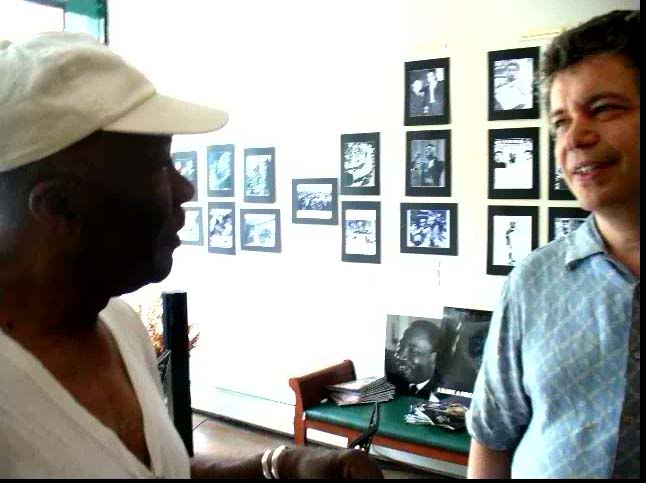
Obviously Marty needs to get out into the world more, almost as much as I do. So I brought Marty and his designer shirt collection to meet the famous filmmaker Bill Miles up on 116th Street at Harlem Heritage Tours. See and listen to the electrifying results.After viewing, the gifted wordsmith Marty declared the event, "A humanistic experience sprinkled with musical sunshine."

Sunday, April 23, 2006

Strange Fruit


Listening to Strange Fruit reminded me of some very powerful passages from Striver's Row where Kevin Baker provides the background for Elijah Muhammed's conversion to the Muslim faith. The scenes take place in Elijah's (born Elijah Poole) hometown of Sandersville, Georgia where he comes upon the sights of ritualistic lynchings. Later he would see postcards of these lynchings along with packets of fabric of the clothing of those murdered and other "memorabilia" for sale in local stores. It provides the impetus or his move to Detroit. I combined some of these archived images with Billie's version of Strange Fruit. Beware of the graphic nature. Many of the images come from this excellent sight called withoutsanctuary. The images include lynchings of perceived non-black outside agitators as well. There is also a new powerful film on the murder of Emmett Till (emmetttillstory). The library of congress has series on the anti-lynching crusades of the early 1900's.The pbs site also has a story on the show it produced on the fasscinating history of the song Strange Fruit

Friday, December 30, 2005

Harlem On My Mind: The Great Migration, Maps

Yesterday I spoke to Nancy Bayer (Bueller), the former Most Beautiful Girl in Knickerbocker Village, so I won't be having Harlem On My mInd now. Here's a slide show of maps from the Schomburg Collection

Harlem On My Mind: The Great Migration II

Here's the migration, in slide show form, with historical images instead of Jacob Lawrence's paintings. The more accurate soundtrack is entitled "Back Water Blues," by Bessie Smith. The source of the images is the great Schomburg Collection at the NYPL Digital site.

Sunday, December 25, 2005

Harlem On My Mind: A 4 slide show feature

Last year Isabel wanted resources on the Harlem Renaissance. This was a topic out of the norm for elementary school social studies, it's more middle school. I think her Urban Academy student teacher was doing a project with her kids on it. Before I rounded up a critical mass of material, she was on to something else. Anyway in organizing some of my files I revisited the topic, just in case someone else wants to do it. There's a lot to "mine" (the Schomburg Center for Research in Black Culture site for one) and It gives me a chance to use my jazz collection. Here's a sampling: This slide show (be patient 5.2MB) features Sid Grossman's late 1930's photos of Harlem from the New Deal Collection at the Library of Congress. Music by Fletcher Henderson. Here's another that features famous people of the Harlem Renaissance. Sound track by Jimmy Lunceford ("Tain't What You Do"). A third slide show features images from Columbia University's Harlem History site. Music, Jumpin at the Woodside-not the original but a great recreation for the film "Swing Kids." A fourth slide show features postcard images of Harlem found on Gotham's York Library. This was combined with James P. Johnson's version of the Charleston. There's a lot of resources from feature films and documentaries as well: A Walk Through Harlem, I Remember Harlem, Murder on Lenox Avenue, Cotton Comes To Halem, etc. Here's a small clip, (but still 6MB) from the American Century Collection.