A panoramic movie taken in Red Hook Park In Brooklyn on 5/6/08
Thursday, May 15, 2008


Red Hook Greenery
Most of these were taken in Red Hook Park. They were used to make the panorama in the following post. The version of Mountain Greenery is by the Joe Loss orchestra, a Great Britain based band with a long history
Wednesday, May 14, 2008
Habana Outpost Panoramic Movie
A panoramic movie taken at the intersection of Fulton and South Portland Streets
Mike Snaps Back
from nymagazine
As the Times once exhaustively noted, Bloomberg loves the word “unconscionable.” He is apparently less enthusiastic about the word “maintain,” judging by this exchange with Newsday reporter Michael Frazier:
Frazier says: “Mayor, you maintain that you kept a dialogue open with Sean Bell—”
Bloomberg, whose head had snapped up at the word maintain, interrupts: “‘Maintain’ is a word that I don’t think is appropriate, sir. The next time you have a question and want to insinuate that I lie, just talk to the press secretary. I don’t think we have a question for you.”
We don't even know what the reporter wanted to ask; we just know that the question involved the murder of Sean Bell.
When there is a divergence of opinions, and you believe you are right, then, especially if you are in a position of responsibility and authority, as the mayor is, the correct and respectful thing is to explain clearly and logically why you hold the opinion you do.
The mayor bullied this reporter out of asking his question but the people should condemn the mayor for bullying the reporter in that way. The word "maintain," used in a situation like this, does not imply that somebody is lying, as Bloomberg asserted. It implies that they have one understanding and/or view while others have other views. There was nothing legitimate about Bloomberg's reaction to this reporter. I for one would like to see New York magazine learn that reporter's identity, and the question he wanted to ask, and then pose the same question to the mayor. It could be re-phrased to mean the same thing without using the word "maintain."
Noelle Hancock
The mayor's behavior was cowardly and obnoxious. He just doesn't want to answer any challenging questions about the case around the killing of Sean Bell.
By ScottRose on 05/12/2008 at 4:48pm
TNTP Throws Down the Gauntlet, Joel Klein Blames Idle Teachers for $4 Gas, Subprime Crisis
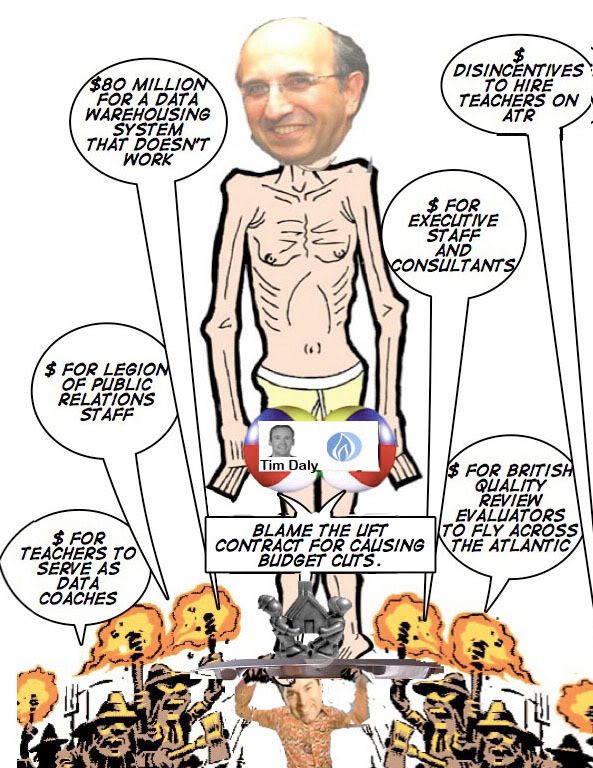 from eduwonkette, with original graphic courtesy of norm and sol
note, The TNTP stands for "The New Teacher Network" feel free to substitute flunky, lacky, sycophant, tuchis lecher....
Forget Secretary of Education - this guy should be running the Fed. This morning, the Daily News reported that "Schools Chancellor Joel Klein said the teachers union - and policies that keep instructors from their classrooms - bear some of the blame for next school year's budget cuts."
You've got to give the man props for having the cojones to craft a budgeting rule that creates disincentives to hire teachers from closing schools on Monday, spend $80 million on a data warehousing system that doesn't work on Tuesday, hire a legion of PR and executive staff at McKinsey prices on Wednesday, pay for British quality review evaluators to fly across the pond on Thursday, and on Friday, blame the freaking teachers union for his lack of fiscal discipline and America's economic downturn. Those are epic cojones, really.
So if we could get back to the real issues - I'd like to know the answers to these questions:
1) What percentage of ATRs are carrying full loads but haven't been formally hired? Now that the UFT has established that many ATRs are serving as regular teachers, a third party needs to formally study this question. I do wonder why these data weren't collected and analyzed as part of the original report.
2) How do budgeting rules affect experienced teachers' odds of being hired? Yesterday, Daly clarified that some excessed teachers are on local budgets (34% of the 2006), but there are good reasons to believe that it's the younger teachers who are on local budgets. As I understand it, here's the budgeting rule: If the teacher comes from a closing school, the ATR goes on central payroll. If a school is simply deciding that it wants to close down one of its programs, or its student enrollment goes through the ordinary dips, the ATR remains on the school's budget.
In a comment, Daly reported that senior ATRs are more likely to come from closing schools - it follows, then, that experienced teachers are more likely to be on the central budget. If experienced teachers are more likely to be centrally financed, this may explain, in part, why they are more likely to remain in the ATR pool.
If, as TNTP report said, we need a solution "that recognizes the value, commitment and service of New York City’s teachers," we first need to understand why experienced teachers are more likely to remain in the ATR pool. More hard numbers on these issues would be a good start.
The Grand Plan Encounters A Setback
from nycpublicschoolparents.blogspot.com
Yesterday, the City Comptroller’s office released an excellent report on school overcrowding, focusing on certain “hot spots” in each borough, where a boom in residential development is overtaking school capacity.
It follows an analysis put out by the Manhattan Borough President a few weeks ago,that also showed how inadequate the DOE’s planning process is when it comes to our schools.
Yesterday's NY Times ran an article that describes the crisis of overcrowding that now exists in downtown Manhattan; though the same story could be written about neighborhoods in almost every part of the city.
Indeed, not a single school district in the city could achieve the smaller class size goals now mandated by the state and adopted by the city, calling for an average of 20 students per class in K-3 and 23 in all other grades.
This new Comptroller’s report points out that there are many policy levers that could be used to solve this problem, by providing incentives to developers to build schools along with new housing and office space. We are co-chairing a task force on school overcrowding, hosted by the Manhattan Borough president’s office – and we hope to devise some other practical solutions that can be used throughout the city.
Our experience has been that there are multiple ways of finding sites for schools and devising affordable ways to build them if people put their minds to it. By taking matters into their own hands, parents in Greenwich Village held meetings with a developer who has now offered the old Foundling Hospital on W. 17 St. for a new school in District 2.
This should not be the responsibility of parents but instead, the Mayor and the Chancellor, who have utterly failed to show leadership in this regard. Despite the fatalism often expressed, there is no reason that we could not eliminate overcrowding and reduce class size if there is the political will and commitment to do so.
Too often this administration has either claimed the problem did not exist, or said there were no good sites for schools, or, as the Mayor recently commented on his radio show, that New Yorkers didn’t want schools placed in their neighborhoods.
Rather than helping to solve the problem, the DOE has made it worse by putting new small schools and charter schools in existing school buildings; as each new small school eats up classroom space with office and cluster rooms.
See for example, the recent NY Times column by Sam Freedman about how the placement of small schools in Lafayette HS has led to an increased number of 9th graders, many of them extremely high needs, at nearby John Dewey HS, leading to safety problems and now threatening to overwhelm the school.
The administration has also been extremely slow in building new schools; see this graph of how many seats have been created over the last six years.
As a result, according to the latest Mayor’s Management Report, there has been a jump in the number of elementary schools that are overcapacity – 27% last school year, compared to 24.3% the year before.
Actually, using the DOE’s “target” definition that includes class sizes of 20 in grades K-3 and 28 in grades 4-8th (which are still much larger than the city’s adopted class size goals), 48% of our elementary school students, and 63% of our middle school students are in schools over 100% capacity.
As Comptroller Thompson and MBP Stringer have now pointed out, the city’s next five year capital plan, to be released in November, must be far more ambitious than the last, if we are serious about providing NYC children with a quality education. We will have a petition online soon, urging the administration to do so.
Tuesday, May 13, 2008
Teacher Voice: How Teachers See the Teacher Quality Debate: Part 3
from edsector.org
Teacher Voice: How Teachers See the Teacher Quality Debate
May 7, 2008 9:00 AM - 11:00 AM (Capital Hilton)
Featured Presenters:
Andrew J. Rotherham
Elena Silva
ABOUT THIS EVENT:
As policymakers, teachers unions, and other stakeholders react to changing demands on the nation's public education system, there is considerable debate about what teachers think and what they want. Too often assumptions define this conversation rather than actual evidence of what teachers want and how teachers see their profession evolving.
A new survey, Waiting to Be Won Over, from Education Sector by Ann Duffett, Steve Farkas, Andrew J. Rotherham, and Elena Silva examines teachers' opinions and attitudes toward teacher unions, teacher unionism, and a range of current district reforms, including those aimed specifically at improving teacher quality.
Waiting to be Won Over was presented at this event, followed by a panel discussion of the survey's findings.
This event featured:
Greg Ahrnsbrak, Teacher, Denver Public Schools
Ann Duffett, FDR Group
Steven Farkas, FDR Group
Ellen Halloran, Teacher, New York City Public Schools
Michelle Rhee, Chancellor of D.C. Public Schools
Steven Smith, President, Providence Teachers Union
Elena Silva, Senior Policy Analyst, Education Sector (as moderator)
Andrew J. Rotherham, Co-director, Education Sector (introductory remarks)
WHEN:
Wednesday, May 7, 2008, 9:00 to 11:00 AM
WHERE:
Federal Room, Capital Hilton
1001 16th Street, NW
Washington, D.C. 20036
Teacher Voice: How Teachers See the Teacher Quality Debate: Part 2
from edsector.org
Teacher Voice: How Teachers See the Teacher Quality Debate
May 7, 2008 9:00 AM - 11:00 AM (Capital Hilton)
Featured Presenters:
Andrew J. Rotherham
Elena Silva
ABOUT THIS EVENT:
As policymakers, teachers unions, and other stakeholders react to changing demands on the nation's public education system, there is considerable debate about what teachers think and what they want. Too often assumptions define this conversation rather than actual evidence of what teachers want and how teachers see their profession evolving.
A new survey, Waiting to Be Won Over, from Education Sector by Ann Duffett, Steve Farkas, Andrew J. Rotherham, and Elena Silva examines teachers' opinions and attitudes toward teacher unions, teacher unionism, and a range of current district reforms, including those aimed specifically at improving teacher quality.
Waiting to be Won Over was presented at this event, followed by a panel discussion of the survey's findings.
This event featured:
Greg Ahrnsbrak, Teacher, Denver Public Schools
Ann Duffett, FDR Group
Steven Farkas, FDR Group
Ellen Halloran, Teacher, New York City Public Schools
Michelle Rhee, Chancellor of D.C. Public Schools
Steven Smith, President, Providence Teachers Union
Elena Silva, Senior Policy Analyst, Education Sector (as moderator)
Andrew J. Rotherham, Co-director, Education Sector (introductory remarks)
WHEN:
Wednesday, May 7, 2008, 9:00 to 11:00 AM
WHERE:
Federal Room, Capital Hilton
1001 16th Street, NW
Washington, D.C. 20036
Teacher Voice: How Teachers See the Teacher Quality Debate: Part 1
from edsector.org
Teacher Voice: How Teachers See the Teacher Quality Debate
May 7, 2008 9:00 AM - 11:00 AM (Capital Hilton)
Featured Presenters:
Andrew J. Rotherham
Elena Silva
ABOUT THIS EVENT:
As policymakers, teachers unions, and other stakeholders react to changing demands on the nation's public education system, there is considerable debate about what teachers think and what they want. Too often assumptions define this conversation rather than actual evidence of what teachers want and how teachers see their profession evolving.
A new survey, Waiting to Be Won Over, from Education Sector by Ann Duffett, Steve Farkas, Andrew J. Rotherham, and Elena Silva examines teachers' opinions and attitudes toward teacher unions, teacher unionism, and a range of current district reforms, including those aimed specifically at improving teacher quality.
Waiting to be Won Over was presented at this event, followed by a panel discussion of the survey's findings.
This event featured:
Greg Ahrnsbrak, Teacher, Denver Public Schools
Ann Duffett, FDR Group
Steven Farkas, FDR Group
Ellen Halloran, Teacher, New York City Public Schools
Michelle Rhee, Chancellor of D.C. Public Schools
Steven Smith, President, Providence Teachers Union
Elena Silva, Senior Policy Analyst, Education Sector (as moderator)
Andrew J. Rotherham, Co-director, Education Sector (introductory remarks)
WHEN:
Wednesday, May 7, 2008, 9:00 to 11:00 AM
WHERE:
Federal Room, Capital Hilton
1001 16th Street, NW
Washington, D.C. 20036
Monday, May 12, 2008
They Say Privatize, We Say Organize
from demonstration of 5/9/08
from ice-uft-blog
For those who were not able to attend here is a great way to become part of our growing movement. On Monday May 12th from 12p to 5p, the Coalition Against Privatization is asking supporters to call or email the office NY State Superintendent of Insurance Eric Dinallo and register your opposition to the "conversion plan" for GHI & HIP. Please call early and often and encourage others to do the same. Out-of-state friends can also call as it will let the Superintendent know that a larger national audience is watching.
see nyc indy media site for more information
Sunday, May 11, 2008
Saturday, May 10, 2008
Friday, May 09, 2008
A Hat Tip To Bobby Murcer
This combines footage from an award ceremony earlier this year and a 1971 clip of Bobby Murcer doing a public service announcement
from the 5/9/08 nytimes
Murcer the Author Tells of His Life and New Yogiism, By RICHARD SANDOMIR
Bobby Murcer did not expect to write his autobiography so soon, but in 11 days, on his 62nd birthday, “Yankee for Life: My 40-Year Journey in Pinstripes” (Harper), will be released. It is funny, wry, lovely — and about having the worst brain cancer possible.
“I’d always thought about writing a book, but I wasn’t going to do until I was totally retired,” Murcer, a YES Network analyst, said by telephone from his car on Thursday. “But since I had the cancer, I thought I ought to ratchet it up a year or two.”
The book is not entirely about cancer, but also deals with his upbringing in Oklahoma; his minor league and major league careers; his enduring thrill at being a Yankee; his sense of exile after being traded to the Giants (with glee, he writes, by the Yankees president Gabe Paul); and his elation at returning to the Bronx. It includes his broadcasting career in which, thanks to Phil Rizzuto, he ate about 2,500 cannolis; his devotion to his wife, Kay, and their two children; and his regrets at once endorsing tobacco (and driving the Skoal Mobile).
His chapters about being a Yankee offer mostly gentle, amusing observations. He noted that he was nicknamed Lemon by Fritz Peterson, whose family-swapping with his fellow Yankee pitcher Mike Kekich buried the news in 1973 that Murcer had signed a $100,000 contract. He recalled how the longtime pitching coach Jim Turner, a chocoholic, desperately sought edible pieces of a chocolate cake unspoiled by reliever Sparky Lyle’s nude plunges into pastry delivered to the clubhouse.
He remembered Tommy John’s excessive loquaciousness; his closeness with Thurman Munson and Lou Piniella (and the time they spent together before Munson’s fatal airplane crash); and his decision, rendered within 30 minutes at the persuasive request of George Steinbrenner, that he retire and move into the broadcast booth.
Another “request” by Steinbrenner came a year and a half later: leave Rizzuto’s side to become assistant general manager and succeed Clyde King as G.M. after a year. Murcer’s reaction: “What an honor! What an opportunity! What a mistake!” After a year, he knew a front-office job was not his personal destiny and happily returned to Rizzuto’s side.
Obligatory Rizzuto story: The Tiger Stadium’s radio booth offered a difficult vantage point, prompting the Scooter to declare that a fly ball by Cecil Fielder had soared over the roof. Yet, to Rizzuto’s shock, it was caught by Yankee shortstop Alvaro Espinoza. “The shortstop!” Murcer recalls Rizzuto saying. “Murcer! How can the shortstop catch ... oh, Murcer! I can’t talk anymore.” True to his word, he stopped talking.
Obligatory Yogiism from the book: Berra got a call from Mel Stottlemyre asking about Murcer. “Hey Carm!” Berra shouted to his wife. “He wants to know if we’ve heard anything about Bobby’s autopsy down in Houston.” Not autopsy, Yogi, biopsy.
Murcer writes candidly about his brain tumor, a glioblastoma multiforme discovered in December 2006, and his surgery, radiation, chemotherapy and vaccine, which he takes as part of a clinical trial. He tells an intimate story that does not seem as harrowing as it should be, in a casual voice captured well by his collaborator, Glen Waggoner (a co-creator of Rotisserie baseball). Murcer and his family cry but seem to believe they were chosen by God for the ordeal.
About the five hours required to remove the three-and-a-half-centimeter tumor (which was lifted out of his brain like a golf ball from the rough, his surgeon told him), Murcer wrote: “Think an extra-inning game, plus a couple of rain delays.”
At the end of a course of radiation, he and Kay drove from the M. D. Anderson Cancer Center in Houston to Dallas in time for the birth of their son’s twins.
After Murcer finished his final round of radiation, Kay sent friends a poem she had written that read, in part:
“The end’s in sight, and so tonight/our greeting’s sent with glee./With 7 ‘zaps’ and cute skull caps/From Houston we’ll soon flee.”
Murcer said Thursday that he was accustomed to discussing terminal brain cancer. The book reflects that ease.
“It is what it is,” he said. “I know we have a battle on our hands, and we’re equipped for the battle because we have God on our side. I’m realistic about where things are and how they might turn out but we’re not shying from anything.”
About his wife, whom he met in childhood, he added, “I don’t know why God sent me an angel to take care of me, but she’s that angel for sure.”
Murcer returned to his work at YES last weekend, sounding weak last Friday but stronger on Sunday. He will continue to work as he often as he can.
“God has blessed us so much since I was diagnosed with this brain tumor and so many blessings have come my way,” he said. “It’s changed our lives for the better.”
His coming birthday is a reminder of his mortality and his hope. He will not celebrate it with a book party. He will be in Houston, taking a vaccine whose goal is to stop or slow the growth of new cancer cells.
Wednesday, May 07, 2008
Finally: The Junking Of The Junk
from Nick Anderson from chron.com
Don't get me wrong, I'm a big fan of junk, but not of Hillary's "internal" variety.
The "Crazy House"
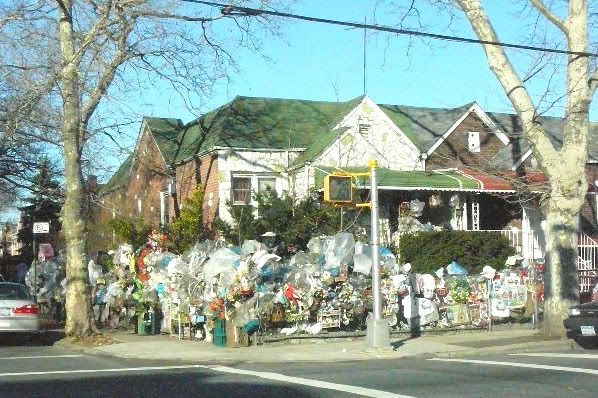
I wandered upon this house in East Flatbush a few months ago and had to capture an image of it. I knew there was a story that went with it. The city lore blog: sense and the city recently found out.
A few blocks past the tabernacle churches, hair-braiding salons, and Laundromats of Church Avenue lies a quiet residential neighborhood. Dogs bark. Children play catch in driveways. Ornamental cabbages grow along the edges of the sidewalks. But at 615 Lenox Road, at the corner of East 43rd Street, the suburban Brooklyn birdsong seems to swell. This is the home of Manny, a Vietnam vet who for the last twenty years has been transforming the chain-link fence around his house into a paradise for local birds.
“Some people like cats, some people like dogs; I like birds,” Manny told me. He said he got the idea for the bird fence when he saw a similar installation in Texas, where he was in the air force. Manny is from Panama, middle-aged, with dark skin and milky blue eyes that give him the appearance of being blind, though his vision—in the many senses of the word—is obviously keen. On the afternoon I visited, he was making the rounds of his fence in camouflage pants, vivid blue and green Nikes, and a hat with earflaps held together by a safety pin. His house is modest, covered in faux-stone siding, a corrugated metal roof over the porch. But even from a few blocks away it’s the fence you notice first, and the bush in the front yard that quivers with the hundreds of birds that call 615 Lenox Road their home.
“In the mornings the sidewalk is filled with birds,” Manny says, gesturing down the street with the tip of his cane. He suffered injuries in the war and walks with a limp, and he claims his hands don’t work as well as they used to. Still, every morning he sifts birdseed into the hundreds of cages and birdhouses that festoon his fence, and the birds arrive in droves; some even spend the night. “But the neighbors don’t mind, because I keep things clean,” he says. Manny’s English is impeccable, though his accent is barbed by the five languages he picked up during the war.
Manny’s collection includes wooden birdhouses with heart-shaped holes and slanted roofs, bird churches with steeples nestled in beribboned Easter baskets, traditional wire cages with swinging perches and feeding dishes, bookshelves lined with miniature houses and bird figurines. The blank spaces along the fence—and there aren’t many—are filled in with bird-themed doormats and chair pads and other souvenirs, all draped with bright flower garlands.
As the birdhouse fence grew into a neighborhood fixture, he says, people began to leave contributions on his doorstep. During the winter, when there are fewer birds, he covers the houses with an equally motley collection of plastic bags—Sears, Duane Reade, Met Foods—to protect them from the weather. But in the spring he unveils them, and birdsong and the colors of his collection fill the Flatbush air once again.
Tuesday, May 06, 2008
Prospect Park Mountain Greenery
After Torme and Jackie and Roy, mountain greenery props have to be given to Rosemary.
Somehow a KV alum and his secret love managed to wander onto the scene.
Sunday, May 04, 2008
Flushing Queens
from the nytimes, 5/2/08
Weekend Explorer, The Melting Pot on a High Boil in Flushing, By JOHN STRAUSBAUGH
IT was slow going on the thronged sidewalks of downtown Flushing, Queens, one recent spring afternoon, in the heart of its huge and bustling Asian community. Along Main and Union Streets many of the signs and the conversations are in Chinese, Korean or Vietnamese. A street vendor blasted Chinese pop music. At a sidewalk counter you can buy Peking duck to go. I passed under the wide window of a tea shop where high school kids sat people-watching and text-messaging as they sipped bubble tea, the sweet Chinese tea with pearls of tapioca in it. At a Chinese grocery tiny grandmas elbowed me aside, the better to haggle with the grocers over vegetables and fruit.
I was walking with John C. Liu, the city councilman for District 20, which includes Flushing. Mr. Liu was born in Taiwan and has lived in Flushing since his family moved there in 1972, when he was 5. In 2002 he became the first Asian-American on the New York City Council. He was happy to play tour guide on the crowded streets.
Indians, Pakistanis and Afghans also make their homes in Flushing, alongside growing groups of Mexicans and Central Americans. They have all followed previous waves of Russians, Greeks, Italians, Irish and African-Americans.
If America really is a melting pot, Flushing seems one place where it’s on a high boil.
Mr. Liu agreed. “You could say that we’re kind of like the crusty concentrate at the bottom of that pot,” he said with a smile.
We ducked around a corner onto the quieter 41st Avenue and bought pork dumplings to eat standing on the sidewalk. They were hot, juicy and the size of tennis balls. But I wasn’t there just for the renowned Asian food that makes Flushing a culinary destination. I was seeking its houses of worship, the places that make it, in Mr. Liu’s words, “the true birthplace of religious freedom here in the United States.”
Today Flushing is chock-a-block with many Protestant and Roman Catholic churches, a few synagogues, several Hindu temples, a beautiful mosque and a brand new Buddhist temple. The free expression of religious beliefs is a tradition that goes back three and a half centuries, to Flushing’s beginnings.
You can see where it started a couple blocks east of Main Street, on Bowne Street, a long thoroughfare lined with apartment complexes and canopied by giant oaks. In the 1600s the area was the site of a small settlement of English farmhouses in the Dutch colony of New Netherland. (Flushing is probably an English corruption of Vlissingen, the name of a town in the Netherlands.)
One of those farmhouses, a simple brown-shingled home built by a farmer named John Bowne around 1661, still stands, near 37th Avenue. Bowne was among those who defied the authorities who denied Quakers the freedom to worship as they chose.
Fleeing persecution in England, members of the Society of Friends (also known, at first derisively, as Quakers) had begun to arrive in Flushing in the 1650s. Peter Stuyvesant, director general of New Netherland, saw them as dangerous radicals and forbade anyone in the colony to consort with them.
On Dec. 27, 1657, 30 citizens of Flushing, not Quakers themselves, signed a remarkable letter to him, now known as the Flushing Remonstrance. They refused to “stretch out our hands against” the Quakers, “to punish, banish or persecute them,” and reminded Stuyvesant that under Colonial law freedom of religion extended to “Jews, Turks and Egyptians” and “Presbyterian, Independent, Baptist or Quaker.” One of the signatories, Tobias Feake, was a cousin of Bowne’s first wife. A century later a descendant of another signer, Richard Stockton, signed the Declaration of Independence.
Stuyvesant answered with fines and jail terms. Bowne, who let Quakers worship in his home, was arrested and banished from the colony in 1662. He successfully argued his case in Holland and returned to his home in 1664, where his descendants continued to live until the mid-1940s. In 1947 the house was opened to the public as a museum by the Bowne House Historical Society. Rosemary Vietor, the president of the society, is a Bowne descendant. The house, which has been showing its age, is now closed for “soup to nuts” restoration and renovation, Ms. Vietor told me, “which will take a couple of years.”
The Friends worshiped at Bowne’s house until 1694, when they built their own meeting house. It too is still standing, a plain brown-shingled hall a few blocks north on the heavily trafficked Northern Boulevard (formerly Broadway, and an Indian trail before that). Except for a period of British occupation during the Revolutionary War, Friends have met in this place every Sunday for more than three centuries.
Naomi Paz Greenberg showed me the main meeting room, which looks much as it did in 1694, from the hand-cut nails in the plank floor to the wavy glass in the windows. The sturdy wooden benches date from the 1780s; British soldiers used the originals for firewood.
On a typical Sunday 18 to 25 Friends meet there, Ms. Greenberg said, adding: “Ours is an unprogrammed meeting, which means there are no prescribed prayers that must be said. There is no prepared sermon. There’s no paid minister. We listen for the divine, and when there is a message that is irresistible to share, to deliver to the Friends in the meeting, we stand up and deliver the message.”
Many members, like Ms. Greenberg, were drawn to Quakerism from other religious backgrounds.
“I was raised Jewish,” she said. “I have never stopped being a Jew. That is my community. That is my culture. But my religion is Quakerism.”
We strolled out to the small cemetery behind the meeting house. Somewhere there, in an unmarked grave, lies John Bowne.
Today, across Northern Boulevard, on a single block of 33rd Avenue between Union Street and Parsons Boulevard, you can get a sense of how many different religions are practiced in Flushing.
There’s the small B’Nai Abraham synagogue on one corner, the Korean St. Paul Chong Ha-Sang Roman Catholic Chapel and Center around the other corner, the Evergreen Presbyterian Church in the middle of the block, and, right next door, the blue-topped dome and minaret of the Hazrat-I-Abubakr Sadiq mosque, opened in 1999 by the Afghan Turkistan Islamic Foundation in America.
Two blocks up Parsons Boulevard I turned right on Bayside Avenue, another leafy, almost suburban thoroughfare. There among the large, comfortable-looking single-family homes I came on the startling apparition of a soaring pagoda-roofed Buddhist temple still under construction. It’s being built by the Korean organization Hanmaum Seon Won, founded in the 1970s by a Buddhist nun, Dae Haeng Sunim. It’s typical of Flushing that a Christian Science reading room sits right next door.
I walked back to Bowne Street and down past Ash, Beech and Cherry Avenues to Holly Avenue. The streets’ names, like the stately trees that shade them, are reminders of a horticultural tradition thought to go back to French Huguenots who came to Flushing around the same time as the Quakers, also seeking religious freedom. Lewis and Clark sent plant specimens to the commercial nursery founded here by Robert Prince in 1737. Remnants of Samuel Parsons’s nursery, established in the 1830s, are all over Flushing, from Weeping Beech Park near John Bowne’s house south to Kissena Park.
On Bowne Street near Holly Avenue ornate blue towers rise on a block of small town houses and storefronts: they top Maha Vallabha Ganapathi Devasthanam, one of Flushing’s several Hindu temples. In English it’s called the Ganesh Temple for its main deity, the elephant-headed Ganesh.
The temple’s spokesman, Ganapathy Padmanabhan (G. P. for short, he said), told me that its history begins with two dates associated with freedom. The Hindu Temple Society of North America, which built the temple, was formed on Jan. 26, 1970, India’s Republic Day. The group purchased a disused Russian Orthodox Church on the site and brought over craftsmen and materials from India to construct the temple, which was consecrated on July 4, 1977.
As is customary, we removed our shoes before entering the temple, a square hall with polished black-granite statues of various gods standing in shrines all around. The central shrine houses Ganesh.
“We believe there is one supreme being, but according to our scripture there are also 3.3 million gods,” Mr. Padmanabhan explained. “These gods are manifestations of the one supreme being. Ganesh is special because he clears any obstacles before we start any project. So he is the first god we pray to, before the other gods.”
The temple has 10 priests whose duties include chanting the thousands of Sanskrit verses of the epic “Ramayana,” Rama’s life story, and reciting the traditional names of the gods.
The temple keeps fruits and flowers on hand for devotees to offer up at the gods’ shrines. We watched as a woman in a sari reached into a tub of coconuts, cracked one open in a basin set against a wall and placed the two halves on Ganesh’s shrine as an offering. A bearded and robed priest sat crossed-legged on the floor and cut flowers to be offered during the spring festival, Vasanta Navaratri.
The temple’s largest festival honors Ganesh’s birthday in the fall. The nine-day festival concludes with a procession up Bowne Street to Main Street, with Ganesh riding a silver chariot and “much dancing and rejoicing and singing all the hymns,” Mr. Padmanabhan said.
The temple is undergoing renovation and expansion, which will include a grand new entrance. Its large, modern community center next door has a canteen in the basement, which serves traditional Indian food and is open daily.
I stopped in for a crisp, spicy dosa to fortify myself for the walk up Kissena Boulevard back to Main Street. I passed the salmon-colored Sri Shirdi Saibaba Temple, dedicated to the Indian guru Sai Baba, on Robinson Street near Holly Avenue, and the lofty pink spire of the Hindu Center at Kissena and Holly. A few blocks farther on, the imposing neo-Classical stolidity of the Free Synagogue of Flushing dominates the corner of Kissena and Sandford Avenue.
I re-entered the pedestrian throngs on Main Street, recalling a claim of Councilman Liu’s:
“This is the only Main Street in New York City,” he told me in a burst of civic pride. (Actually, there are others. But not, at that moment, for Mr. Liu.) “We call it Main Street U.S.A.”
Two Views Of The Kantor Video
I admit I was cheering that Kantor really said it. Just goes to show you how this infighting amongst the Dems is helping the Republican cause. Nevertheless, the Clinton's deserve whatever ills come back to them.
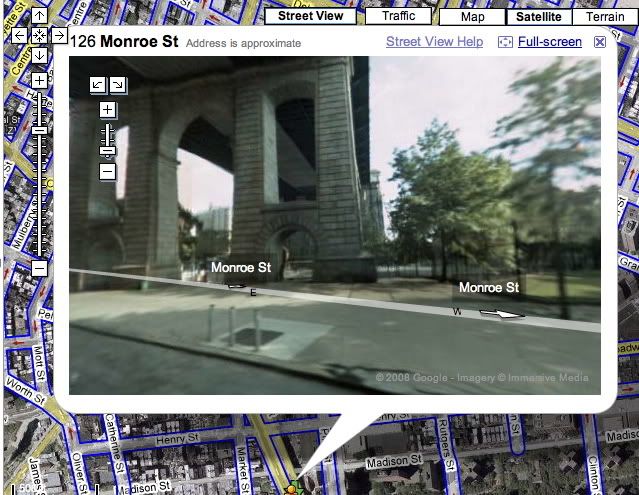
127 Monroe Street, 1908

I came across the old photo above, on Flickr, while gathering resources for my new labor history site Those kids
could have gone to PS 177, which was right next door to their building. Right now that address is either part of the Coleman Oval ball field or the skating park that adjoins it.
Friday, May 02, 2008
Fashion Mayday

from the nytimes of 3/8/08 (but not the pic)
It’s free-agency season in American fashion.
Isaac Mizrahi, the everyman’s fashion oracle, is about to leave behind his wildly popular cheap-chic clothing collections at Target to be the creative director for Liz Claiborne, the stalwart shopping-mall label.
Dana Buchman, a longtime favorite of customers at upscale stores like Saks Fifth Avenue and Neiman Marcus, is decamping this fall to the budget-conscious Kohl’s.
And Tommy Hilfiger, a constant in department stores like Dillard’s and Bon-Ton for two decades, now says he will sell his clothes only at Macy’s.
Over the next year, an unusually large group of famous clothing designers, motivated by lucrative deals, plan to shift their retail allegiances, in many cases abandoning stores and customers who have supported them for years.
So like angry sports fans wounded by a the trade of a star player, consumers (and even stores) are left to wonder: What ever became of loyalty?
The sudden flurry of designer address changes — J. C. Penney, Gap, Old Navy and Wal-Mart have also recruited their own designers over the last six months — is likely to create jarring transitions for American consumers as they try to navigate the once-familiar aisles of their local clothing chains, wondering where to find Isaac, Dana and Tommy, among others.
“There will be a period of dislodgment and disenfranchisement,” said William L. McComb, chief executive of Liz Claiborne, whose efforts to revive flagging sales hinge upon his company’s aggressive wooing of Mr. Mizrahi from Target.
After Claiborne announced the move in January, Target responded by saying it would end its relationship with Mr. Mizrahi at the end of the year, leaving, for now, a void in its lineup.
The motivation behind these defections and poachings is equal parts economic and egocentric. Clothing manufacturers are responding to a seemingly insatiable appetite for fashion across every income bracket. They are also benefiting from a lively, and occasionally vindictive, competition between mass retailers (Wal-Mart and Kohl’s) and the traditional department stores (Macy’s, Bloomingdale’s and Lord & Taylor) that remain after years of industry mergers.
When it comes to luring designer brands, it seems that popularly priced chains are suddenly on equal footing with their glossier rivals.
For decades, department stores like Saks had a virtual lock on designer clothing labels, until Mr. Mizrahi broke that barrier with his collection at Target in 2003, which, rather than burying his career, became an estimated $300-million-a-year success.
Once the stigma of crossing into mass-retail territory lifted, such high-low designer partnerships became commonplace, with Vera Wang selling a line at Kohl’s and blue-chip names like Karl Lagerfeld and Stella McCartney creating lines for H&M.
All this activity has raised a bar for traditional retailers like Macy’s, which rarely had to fend off competition from below. Its 2005 merger with May Department Stores, which created the country’s largest department store company, was in part an effort to use size to wield more influence over designers.
The democratization of design forced Macy’s to claim exclusives it never before needed, and to punish designers who cut deals elsewhere. When Ms. Wang went to Kohl’s, Macy’s dropped her popular lingerie line. The chain cut orders from Liz Claiborne after the company offered a line called Liz & Co. to Penney.
“If the product is available in 50 different points of distribution in a five-mile driving radius, convenience becomes the No. 1 reason to buy a brand,” said Terry J. Lundgren, chief executive of Macy’s. “And so we lose.”
That’s why Macy’s, which has begun promoting its designer relationships in television ads, persuaded Mr. Hilfiger to drop his other partnerships, infuriating regional department store chains like Bon-Ton, Belk and Dillard’s that had promoted his brand.
“The stores we exited were very upset,” Mr. Hilfiger said. “I’m sure we’ll lose certain consumers in certain areas, but I’m sure the gain is much greater than the loss could potentially be.”
In recent months, the designer poaching has devolved into open warfare among retailers, leaving some battlefield casualties.
Only a year ago, Dana Buchman was designing a $6,950 leopard-patterned swing coat made, with real mink, for the affluent women who shopped for decades at high-end stores like Saks Fifth Avenue and Bloomingdale’s.
But as Liz Claiborne tried to reorganize its business because of declining sales from department stores like Macy’s, the company decided to close the Dana Buchman line and reinvent it as a bargain-conscious brand for Kohl’s, where no article of clothing is sold at full price, and most are under $100.
Ms. Buchman does not expect most of her customers will follow her there. Judith Galubchick, 60, a loyal Dana Buchman shopper, is worried that the Kohl’s line “will be lower-quality product” than what she buys at Ms. Buchman’s store off Madison Avenue in Manhattan. That location is expected to close March 26.
“It’s very sad for me,” Ms. Galubchick said, dressed head to toe, she proudly announced, in Ms. Buchman’s fashions.
“It’s traumatic,” Ms. Buchman said of losing customers. “Traumatic.” But, she added, “I am not stuck on one kind of retailer, or one kind of customer. It’s a big country and everyone wants fashion.”
”
Thursday, May 01, 2008
May Day Special Edition 4: Joe Hill
Lyrics by Phil Ochs:
Joe Hill come over from Sweden shores
Looking for some work to do
And the Statue of Liberty waved him by
As Joe come a sailing through, Joe Hill
As Joe come a sailing through.
Oh his clothes were coarse and his hopes were high
As he headed for the promised land
And it took a few weeks on the out-of-work streets
Before he began to understand
Before he began to understand
And Joe got hired by a bowery bar
sweeping up the saloon
As his rag would sail over the baroom rail
Sounded like he whistled on a tune
You could almost hear him whistling on a tune
And Joe rolled on from job to job
From the docks to the railroad line
And no matter how hungry the hand that wrote
In his letters he was always doing fine
In his letters he was always doing fine
Oh, the years went by like the sun goin' down
slowly turn the page
And when Joe looked back at the sweat upon his tracks
He had nothing to show but his age
He had nothing to show but his age
So he headed out for the California shore
There things were just as bad
So he joined the industrial workers of the world
'Cause, The union was the only friend he had
'Cause, The union was the only friend he had
Now the strikes were bloody and the strikes were black
as hard as they were long
In the dark of night Joe would stay awake and write
In the morning he would raise them with a song
In the morning he would raise them with a song
And he wrote his words to the tunes of the day
To be passed along the union vine
And the strikes were led and the songs were spread
And Joe Hill was always on the line
Yes Joe Hill was always on the line
Now in Salt Lake City a murder was made
There was hardly a clue to find
Oh, the proof was poor, but the sheriff was sure
Joe was the killer of the crime
That Joe was the killer of the crime
Joe raised his hands but they shot him down
he had nothing but guilt to give
It's a doctor I need and they left him to bleed
He made it 'cause he had the will to live
Yes, He made it 'cause he had the will to live
Then the trial was held in a building of wood
And there the killer would be named
And the days weighed more than the cold copper ore
Cause he feared that he was being framed
Cause he found out that he was being framed
Oh, strange are the ways of western law
Strange are the ways of fate
For the government crawled to the mine owner's call
That the judge was appointed by the state
Yes, The judge was appointed by the state
Oh, Utah justice can be had
But not for a union man
And Joe was warned by summer early morn
That there'd be one less singer in the land
There'd be one less singer in the land
Now William Spry was Governor Spry
And a life was his to hold
On the last appeal, fell a governor's tear
May the lord have mercy on your soul
May the lord have mercy on your soul
Even President Wilson held up the day
But even he would fail
For nobody heard the soul searching words
Of the soul in the Salt Lake City jail
Of the soul in the Salt Lake City jail
For 36 years he lived out his days
And he more than played his part
For his songs that he made, he was carefully paid
With a rifle bullet buried in his heart
With a rifle bullet buried in his heart
Yes, they lined Joe Hill up against the wall
Blindfold over his eyes
It's the life of a rebel that he chose to live
It's the death of a rebel that he died
It's the death of a rebel that he died
Now some say Joe was guilty as charged
And some say he wasn't even there
And I guess nobody will ever know
'Cause the court records all disappeared
'Cause the court records all disappeared
Say wherever you go in this fair land
In every union hall
In the dusty dark these words are marked
In between all the cracks upon the wall
In between all the cracks upon the wall
It's the very last line that Joe Will wrote
When he knew that his days were through
Boys, this is my last and final will
Good luck to all of you
Good luck to all of you
May Day Special Edition 3: May Day In England, Part 2
Didn't we fight a revolution to create a more democratic society? Looks like we've regressed.
May Day Special Edition 2: May Day In England, Part 1
from youtube user workersunited
A 15 minute film celebrating international workers day.
May Day has been celebrated in London since the 1880's. The march has traditionally started from Clerkenwell Green -- the heart of an area noted for its radicalism in the late and early 19th centuries. In 1890 London's first full May Day March progressed from the Green, organised by the London Trades Council in conjunction with 28 radical clubs and many trade unionists.
As ever this years march was a unique mix of trade unionists, workers from many international communities, pensioners, youth, students, political organisations and many others in a show of working class unity.
Filmmakers and Unison members Hazuan Hashim and Phil Maxwell captured the last two May day marches and have produced a short film using archive material as well as contemporary comments from trade Union members and leaders.
The film showcases the banners of the march, the diversity of its participants, humour and music. Often ignored by the mass media the filmmakers wanted to make the values embodied in the traditions of the march accessible to a wider audience. To this end the film has educational, entertainment and historic value.
As well as capturing icons of the movement (Jack Jones and Tony Benn) the film shows the international nature of the event as well as the contribution of ethnic minorities and women; in short the film celebrates the wide ranging membership of a confident and modern trade union movement and its traditions.
May Day Special Edition: There's Power In The Union
from youtube user WonderBoysFan, sung by Billy Bragg, the lyrics:
There is power in a factory, power in the land
Power in the hands of a worker
But it all amounts to nothing if together we don't stand
There is power in a Union
Now the lessons of the past were all learned with workers' blood
The mistakes of the bosses we must pay for
From the cities and the farmlands to trenches full of mud
War has always been the bosses' way, sir
The Union forever defending our rights
Down with the blackleg, all workers unite
With our brothers and our sisters from many far off lands
There is power in a Union
Now I long for the morning that they realise
Brutality and unjust laws can not defeat us
But who'll defend the workers who cannot organise
When the bosses send their lackies out to cheat us?
Money speaks for money, the Devil for his own
Who comes to speak for the skin and the bone
What a comfort to the widow, a light to the child
There is power in a Union
The Union forever defending our rights
Down with the blackleg, all workers unite
With our brothers and our sisters together we will stand
There is power in a Union.
Subscribe to:
Posts (Atom)

 Posts
Posts


